
Portable Tire Inflator Teardown: What the Motor, Gear Train and Pump Assembly Reveal
A portable tire inflator may look simple from the outside. But its actual performance depends on the components hidden inside: the motor, gear transmission, pump mechanism, battery system and pressure-control components.
For sourcing teams, reviewing the product appearance and supplier specification sheet is only the first step. The internal construction determines what needs to be verified before a product is approved for mass production.
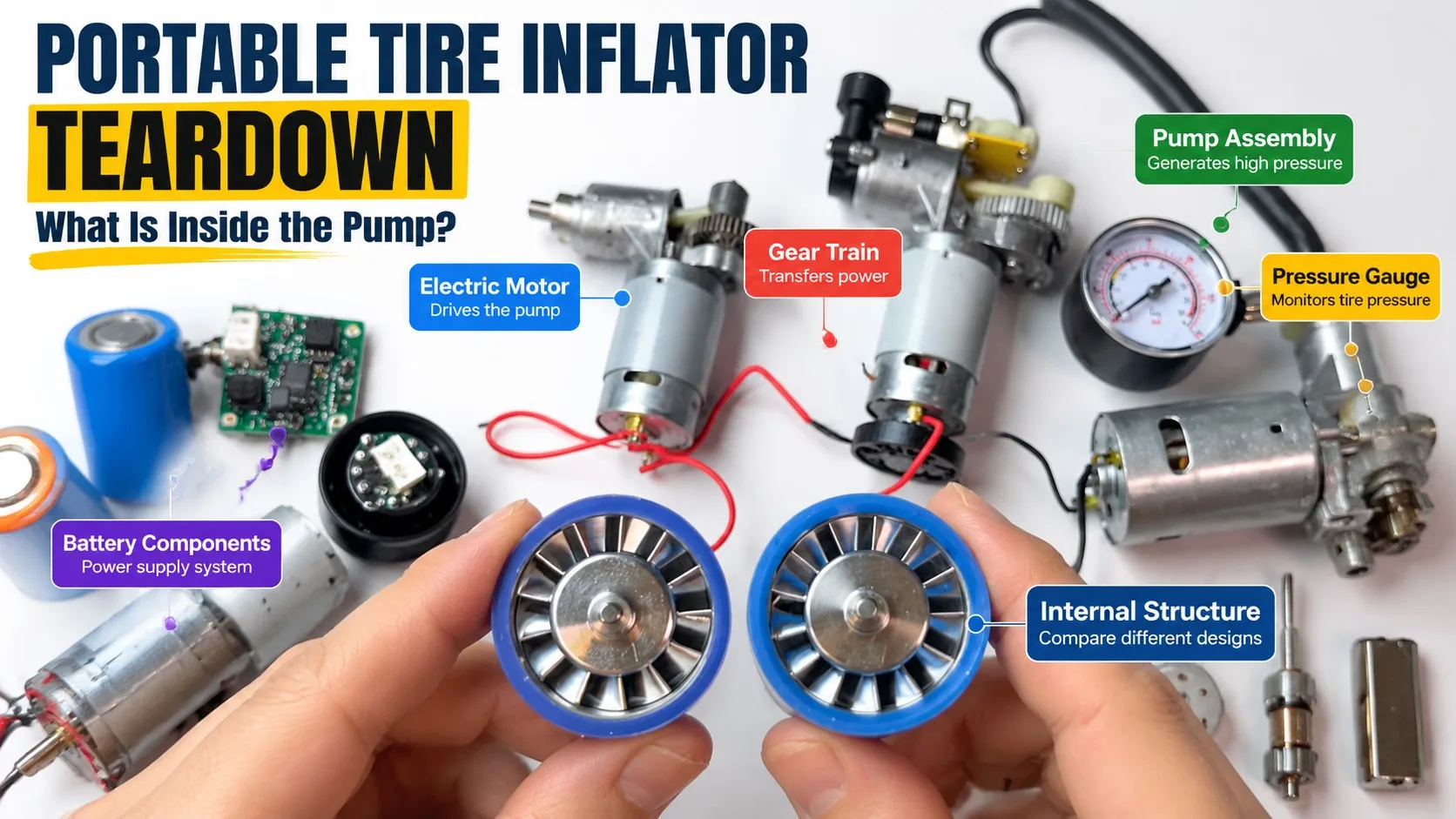
In this teardown, we examine disassembled motor and pump assemblies, exposed gear trains, a pressure gauge, motor cores and battery-related components. The objective is to identify the design features that matter during supplier evaluation—and the tests needed to verify the claims made about the finished product.
1. The Motor: Start With the Drive System
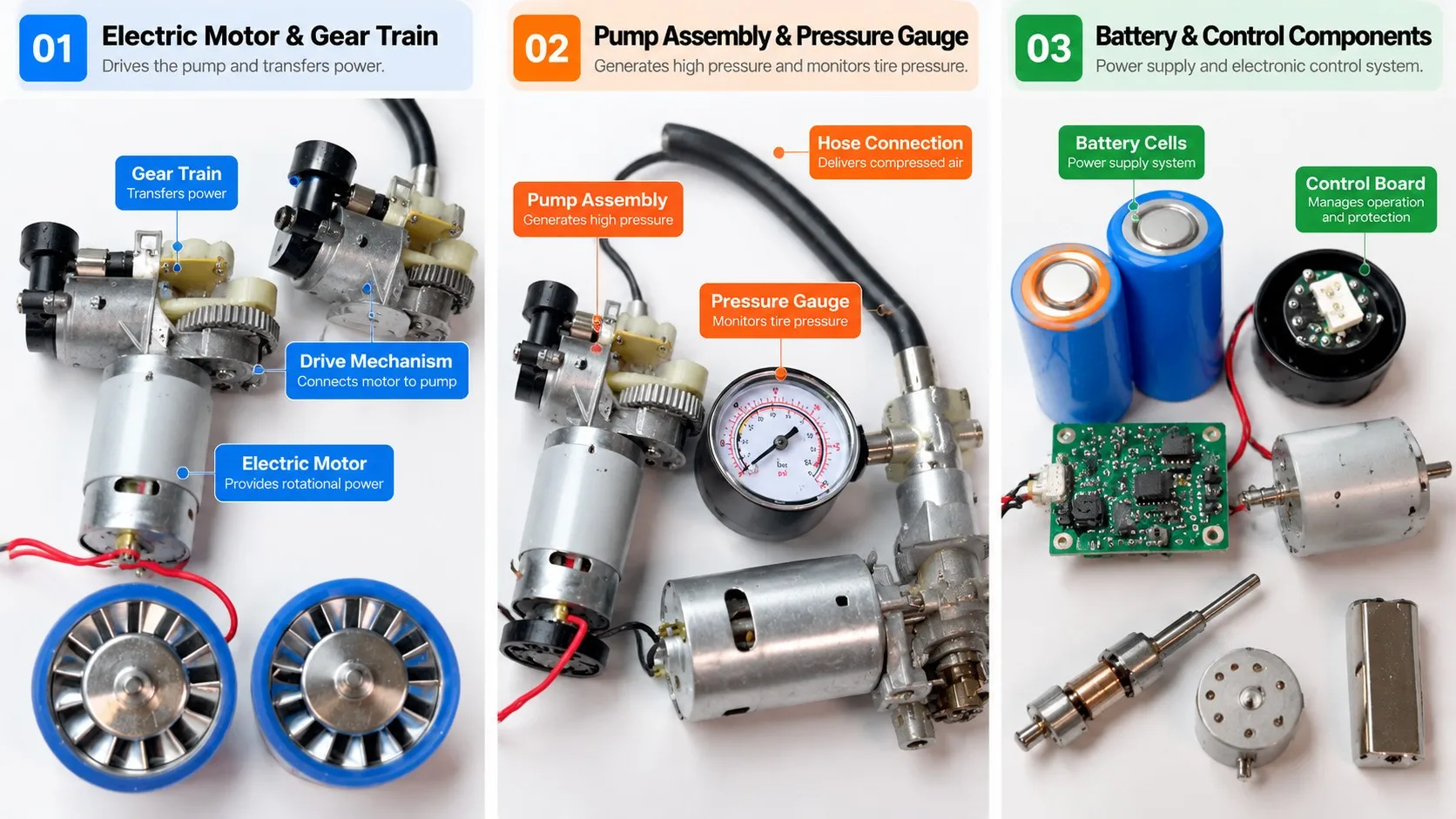
The teardown reveals several cylindrical electric motors used in compact electromechanical assemblies.
However, motor size and external appearance alone cannot establish rated power, efficiency or service life. Even motors that look similar may behave differently under load.
For a portable tire inflator, buyers should verify:
- Motor type and rated voltage: Brush composition (carbon vs. copper leaf), winding copper purity, and armature balance.
- Current consumption under operating load: Operating current at 0 PSI vs. max backpressure (e.g., 35–45 PSI).
- Speed under load: RPM retention under backpressure rather than only unloaded free-spinning speed.
- Temperature rise: Thermal dissipation curves and insulation class during repeated 10-minute continuous inflation cycles.
- Shaft alignment & bearings: Shaft runout tolerance, bushing vs. ball bearing condition, and operational acoustic noise.
2. Gear Train: Inspect the Mechanical Transmission
Several of the disassembled assemblies show visible reduction gears connected directly to the motor pinion and mechanical piston drive components.
The gear transmission is a critical part of the design because it steps down high motor RPM into high-torque linear piston strokes. Gear geometry, tooth pitch, material selection (powder metallurgy steel vs. POM engineering plastic), alignment, and lubrication dictate overall mechanical efficiency, noise, and operating lifespan.
During a hardware teardown, inspect:
- Gear material & tooth integrity: Check for metal fatigue, burrs, or weak plastic tooth profiles under torque.
- Gear alignment & backlash: Tolerance fit between pinion and spur gear to prevent gear stripping.
- Shaft support & mounting stability: Die-cast zinc/aluminum housing rigidity preventing shaft deflection under load.
- Lubrication coverage & consistency: High-temperature synthetic grease coverage that won't liquefy or dry out at 80°C+.
- Wear patterns: Tooth mesh wear after 50+ continuous operating cycles.
3. Pump Assembly: Verify Real Inflation Performance
The teardown also shows pump-related mechanical cylinder blocks, piston connecting rods, high-pressure check valves, and pressure-gauge hardware.
For a portable tire inflator, the pump mechanism is central to the product's ability to deliver compressed air at the required pressure (e.g., 30 to 120 PSI). Its performance cannot be established from appearance alone.
A meaningful engineering evaluation must include:
- Inflation time under identical benchmark conditions: Timed inflation from 28 PSI to 35 PSI on a standard 195/65 R15 tire.
- Final pressure accuracy: Digital/analog sensor accuracy against a calibrated reference laboratory gauge (±1 PSI tolerance).
- Air leakage & seal integrity: High-temperature PTFE piston cup seal and brass hose connection airtightness.
- Automatic shutoff precision: Pressure cutoff responsiveness when reaching the preset target threshold.
- Thermal rise and duty cycle: Cylinder head temperature after inflating two consecutive standard tires.
Maximum advertised pressure is not the same as inflation speed. A product may advertise a high maximum pressure (e.g., 150 PSI) but still inflate a standard car tire slowly (low L/min flow rate) due to a narrow cylinder bore. Buyers should compare complete products under standardized volumetric test conditions instead of relying on a single headline specification.
4. Battery and Control Components: Check the Complete Power System
The teardown includes cylindrical lithium battery cells (typically 18650 or 21700 formats) and dedicated electronic control PCBAs.
For cordless battery-powered inflators, the battery system must be evaluated in direct conjunction with the motor's heavy startup surge current (often exceeding 10A–15A) and the control board's protection circuitry.
Key procurement checks include:
- Cell identification & brand traceability: Confirming genuine cell brand, model, and manufacturing date codes.
- Pack configuration & capacity: Distinguishing between series (e.g., 2S / 7.4V or 3S / 11.1V) and parallel configurations, calculating total Wh rather than relying on ambiguous mAh labels.
- Protection circuit (BMS/PCM) rating: Overcurrent protection, overdischarge cutoff (preventing cell bricking), and NTC thermistor thermal cutoff.
- Voltage sag under peak load: Measuring whether cell internal resistance causes premature low-voltage shutdown while pumping at 35+ PSI.
- Repeatable runtime: Number of tires inflated per full charge cycle under ambient operating temperatures.
Printed capacity figures are not verified test results. A battery pack should be evaluated using its actual multi-cell configuration and controlled discharge curves.
5. What Should Buyers Verify Before Approving a Supplier Sample?
The following matrix connects common supplier marketing claims with the concrete engineering evidence procurement teams must request:
6. Why Component-Level Teardown Matters for Sourcing
A supplier quotation describes what the product is supposed to deliver. A component-level teardown reveals how it has actually been built.
For portable tire inflators, the most reliable sourcing decisions come from cross-referencing three sources of truth:
- The Physical Hardware: What motors, gear metallurgy, cylinder materials, battery cells, and control boards are actually present inside the casing?
- The Supplier Documentation: Do the official BOM, component datasheets, and declared parameters match the physical sample?
- The Performance Benchmarks: Does the finished assembly deliver the required pressure accuracy, inflation speed (L/min), thermal endurance, and duty cycle?
No single source is sufficient on its own. A teardown identifies the exact components that deserve scrutiny; controlled measurements and traceable documentation confirm compliance and reliability.
Final Takeaway: Look Inside the Product
A portable tire inflator should never be evaluated solely by its exterior styling or printed box specifications.
The motor, gear transmission, pump assembly, battery architecture, and pressure control electronics all deserve thorough verification before a sourcing decision is finalized.
At BaiSourcing, we inspect products at the component level to help buyers audit BOM costs, uncover hidden engineering risks, and ensure production consistency before mass production.
Looking to Source Tire Inflators or Portable Power Hardware?
BaiSourcing helps global brands, retailers, and distributors discover promising products, inspect component BOMs, verify supplier specifications, and manage OEM/ODM manufacturing in China.