
What Does a $4.50 Manufacturing Cost Actually Buy?
A portable air pump can look advanced with digital displays and LED lights. Discover how 7.4V vs. 3.7V battery capacity ratings, 390 motor gearboxes, and acoustic vibration dampening dictate real manufacturing quality and true landed BOM cost.
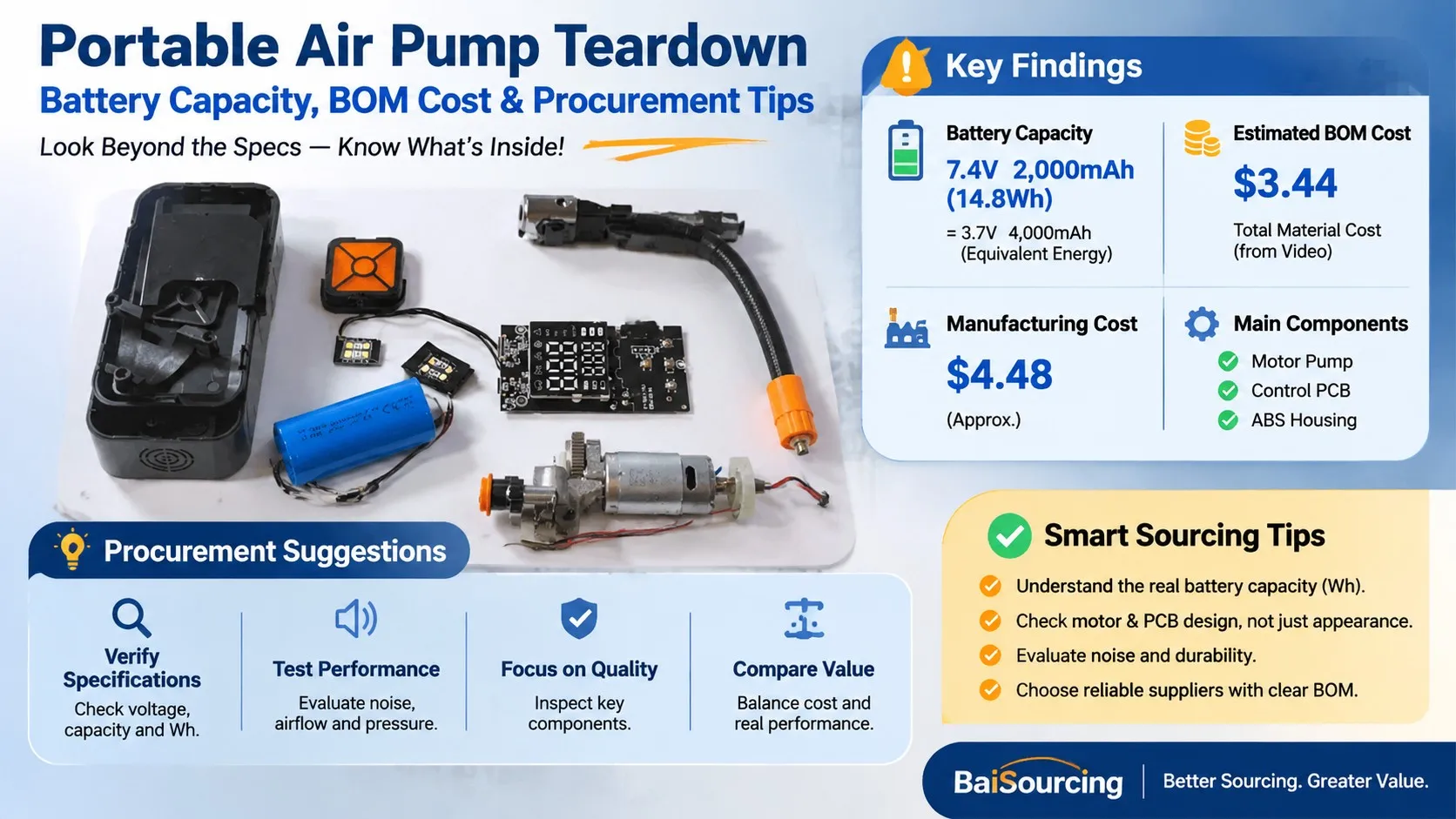
A portable air pump can look sophisticated on the outside, with a digital pressure display, multiple inflation modes, a rechargeable battery, and a built-in LED light.
But what is actually inside? And how much does it cost to manufacture?
In this teardown, we disassemble a portable tire inflator and air pump to examine its battery pack, motor-driven pump assembly, control PCB, plastic housing, and other components.
Our component inspection reveals several key baseline details:
- An 83 g ABS plastic housing costing approximately $0.52 (¥3.50).
- A digital control and display PCB costing approximately $0.75 (¥5.00).
- A 390 motor-driven metal/plastic pump assembly costing approximately $1.49 (¥10.00).
- A battery pack labeled 7.4 V, 2,000 mAh (14.8 Wh), while advertised as 4,000 mAh.
- An estimated total material cost of approximately $3.44 (¥23.00).
- An estimated finished manufacturing cost of approximately $4.48 (¥30.00).
More importantly, the teardown illustrates how component selection, electrical labeling, and manufacturing decisions can affect user experience and product return rates.
1. The Product Looks Advanced. What Is Inside?
| Component | Function & Engineering Role |
|---|---|
| ABS plastic housing (83g) | Protects internal mechanisms and provides external ergonomics |
| 18650 2S battery pack | Supplies 7.4V high-current DC power to the pump motor |
| 390 DC motor & gearbox | Converts motor rotation into reciprocating piston air compression |
| Control & display PCB | Manages digital pressure sensor, preset shutoff, and UI buttons |
| Air hose, valve & LED | High-pressure braided hose with brass Schrader valve and LED light |
2. Battery Capacity: 2,000 mAh or 4,000 mAh?
One of the most interesting details in this teardown is the battery specification. The physical battery pack label clearly shows:
- Nominal voltage: 7.4 V (2S configuration)
- Rated capacity: 2,000 mAh
- Stored Energy: 14.8 Wh
However, the retail marketing claims a "4,000 mAh" battery. Does this indicate false advertising?
Understanding the Voltage Math:
• Actual 2S pack: 7.4 V × 2.0 Ah = 14.8 Wh
• Equivalent at 3.7 V baseline: 14.8 Wh ÷ 3.7 V = 4.0 Ah (4,000 mAh)
Procurement takeaway: A 7.4V 2,000mAh pack contains identical energy to a 3.7V 4,000mAh setup. However, to prevent consumer confusion and regulatory scrutiny, buyers should mandate clear Watt-hour (Wh) labeling alongside voltage.
3. Component Deep Dive: Housing ($0.52) & Control PCB ($0.75)
ABS Plastic Housing (83g / ~$0.52): The lightweight enclosure uses injection-molded ABS with screw fastening bosses. For automotive emergency tools, buyers should check wall thickness (>2.2mm) and drop resistance from 1 meter.
Control & Display PCB (~$0.75): The PCBA integrates an LED 3-digit pressure readout, microswitch buttons, and a piezoresistive pressure sensor for auto-stop at target PSI. Verify temperature drift calibration on the pressure sensor.
4. 390 Motor-Driven Pump ($1.49) & Acoustic Trade-Offs
The 390 brushed motor and die-cast zinc/plastic gearbox constitute the primary mechanical assembly ($1.49).
⚠️ The Low-Cost Engineering Trade-off: Noise & Vibration
To hit the ultra-low $4.48 manufacturing target, this model omits dedicated silicone motor dampening isolation mounts and acoustic foam dampening. As a result, operating noise exceeds 82 dB with noticeable handle vibration. Adding $0.20 in silicone isolation can dramatically improve perceived customer quality.
5. BOM Cost Breakdown: What Does This Product Actually Cost?
| Component / Cost Item | Estimated Cost (RMB) | Approx. Cost (USD) |
|---|---|---|
| ABS plastic housing (83 g) | ¥3.50 | $0.52 |
| Control & display PCB | ¥5.00 | $0.75 |
| 390 motor-driven pump assembly | ¥10.00 | $1.49 |
| Other parts (battery, hose, valves, wiring) | ¥4.50 | $0.68 |
| Total material cost (BOM) | ¥23.00 | $3.44 |
| Assembly, testing, packaging & tooling amortization | ¥7.00 | $1.04 |
| Estimated finished manufacturing cost | ¥30.00 | $4.48 |
6. Practical Supplier Verification Checklist
✓ Battery Energy: Confirm cell configuration (2S 18650), rated Wh (14.8Wh), and UN38.3 shipping reports.
✓ Pump Performance: Measure inflation time for standard 195/65 R15 tires from 2.0 to 2.5 bar under continuous run.
✓ Acoustic Noise: Measure dBA noise at 1 meter distance and inspect motor mounting isolation pads.
✓ Quotation Scope: Clarify whether air needles, Presta adapters, USB-C cables, and storage pouches are included.
7. How BaiSourcing Helps Buyers Look Beyond the Quotation
At BaiSourcing, effective sourcing starts with understanding what is actually inside the product. Our automotive and portable electronics team helps buyers through four integrated services:
🔍 Product Discovery
Discover vetted portable inflators and automotive electronics matched to your target price.
⚙️ Product Intelligence
Physical teardowns, bottom-up BOM cost analysis, and motor gearbox/battery comparison.
🏭 Supplier Matching
Direct factory vetting, quotation benchmarking, and cleanroom production validation.
🛠️ OEM/ODM Development
Custom housing tooling, noise reduction dampening engineering, and pilot QC testing.
Frequently Asked Questions
Q1. Is a 7.4 V, 2,000 mAh battery equivalent to a 3.7 V, 4,000 mAh battery?
They are nominally equivalent in total stored energy: both contain approximately 14.8 Wh. However, 7.4V delivers higher operating power directly to the motor without requiring lossy boost converters.
Q2. Does a $1.49 motor-driven pump assembly mean the product is low quality?
Not necessarily. Standard 390 brushed motors are widely mass-produced and cost-effective. However, buyers should test continuous duty cycles and thermal cutoff behavior under high PSI load.
Q3. Can the manufacturing cost of a product be determined from a teardown?
A teardown estimates component BOM costs and identifies cost drivers. Total manufacturing cost also includes assembly labor, testing, tooling amortization, and packaging.
Q4. Is noise reduction worth the additional cost?
Yes. Adding $0.15–$0.25 in silicone vibration isolation pads between the motor and housing can reduce operating noise from 82dB to under 72dB, significantly lowering negative Amazon reviews.
Q5. How can importers verify battery claims?
Request battery pack specifications showing rated voltage, capacity in mAh, and energy in Wh, supported by UN38.3 and IEC 62133 test reports.