
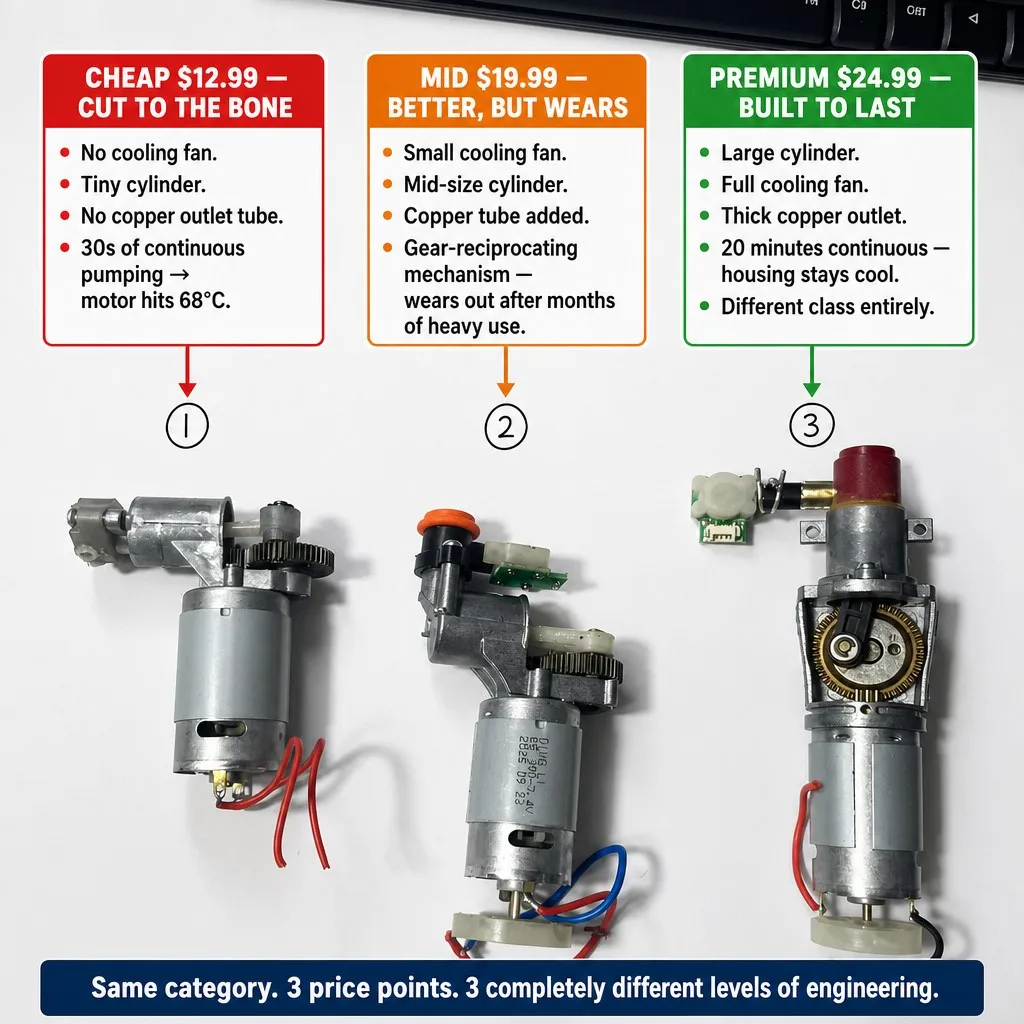
Three Best-Selling Car Air Pumps. Three Price Points. Three Completely Different Machines.
We sourced three of the most popular portable car air pumps on the market — at $12.99, $19.99, and $24.99 — and tore down all three to the component level.
From the outside, the three units look nearly identical. Same form factor. Overlapping spec sheets. Similar catalog photos. The price difference looks like marketing.
It is not. The price difference is material — and it only becomes visible when you open the products.
Teardown #1 — $12.99: Cut to the Bone
The budget unit is stripped to the absolute minimum required to inflate a tire slowly:
- No cooling fan: The motor runs with zero active thermal management
- Tiny cylinder: Smallest displacement in the test — visibly smaller piston chamber
- No copper outlet tube: The air outlet skips even the basic copper tube found in mid-range units
Thermal test: After 30 seconds of continuous pumping, a thermal gun pointed at the motor housing recorded 68°C and climbing.
This unit isn't engineered to pump. It's engineered to sell. The motor will thermally stress during any sustained use — inflating multiple tires, or topping up after a slow leak, pushes it into the danger zone.
Teardown #2 — $19.99: Better, But It Wears
The mid-range unit is a genuine upgrade over the budget model:
- Small cooling fan added — heat management during normal use is acceptable
- Mid-size cylinder — larger displacement than the budget unit
- Copper outlet tube present — basic heat transfer at the outlet restored
The structural weakness: a gear-reciprocating mechanism.
In the teardown, the gear train shows visible edge wear. The mechanism converts motor rotation to piston movement through a geared reciprocating assembly. Under frequent high-load use — the exact scenario car owners face with regular inflation — the gear edges wear progressively. When the gear wears past its tolerance, the motor stalls or skips, and the unit fails.
For a user inflating tires once or twice a month, this unit is acceptable. For anyone using an air pump weekly — motorcycles, bicycles, sports equipment — the wear window is real.
Teardown #3 — $24.99: Built to Last
The premium unit costs roughly double the budget model in component terms — and it shows:
- Large cylinder: The largest displacement in the test, visibly more air per stroke
- Full cooling fan: Active thermal management across the motor assembly
- Thick copper outlet: Heavy-gauge copper tube at the outlet for heat transfer
- Brass gear mechanism: The reciprocating drive uses a brass gear set instead of the cheaper plastic/steel combination
Thermal test: 20 minutes of continuous operation — the housing stayed cool to the touch. No thermal stress at the motor. This is a different class of engineering entirely.
The brass gear mechanism has measurably higher wear resistance than the plastic gear in the mid-range unit. For continuous-duty use — professional drivers, RV owners, frequent long-trip inflations — this is the difference between a pump that lasts one season and one that lasts a decade.
Side-by-Side: What the Price Difference Buys
| Component | $12.99 | $19.99 | $24.99 |
|---|---|---|---|
| Cooling fan | ❌ None | ✅ Small | ✅ Full |
| Cylinder size | Tiny | Mid | Large |
| Outlet tube | ❌ None | ✅ Copper | ✅ Thick copper |
| Drive mechanism | Basic | Gear-reciprocating (wears) | Brass gear (long life) |
| 30s thermal test | 68°C and climbing | Acceptable | 20 min — housing cool |
| Build class | Sellable, not usable long-term | Good daily-use value | Continuous-duty |
The Sourcing Lesson
All three pumps sit side by side on the same retail shelf. Catalog photos look the same. Spec sheets overlap. The buyer chooses by price or reviews — never by what's inside.
The difference between these units is not branding. It's material:
- No cooling fan = thermal stress on every sustained use
- Tiny cylinder = slow inflation, motor strain under load
- No copper tube = heat concentrated at the motor
- Gear-reciprocating mechanism = a defined wear window
If you are sourcing air pumps, tire inflators, or any motor-driven car accessory as a wholesale order — the spec sheet will not tell you which class of unit you are getting. Only disassembly does.
What We Do at BaiSourcing
Every motor-driven product we audit includes:
- Full BOM cost breakdown with component-level pricing
- Motor class verification: brushed vs brushless, RPM testing
- Thermal stress testing under continuous load
- Drive mechanism audit: gear material, wear tolerance, failure window
- Component substitution detection across every line of the BOM