
How Much Does a Rechargeable Fabric Shaver Really Cost to Manufacture?
A fabric shaver is a high-volume consumer product. Learn how DC motor torque under load, stainless rotary blade sharpness, protective mesh flatness, 1,800mAh 18650 battery cells, and total product weight (146.4g) dictate real cutting performance and true manufacturing cost.
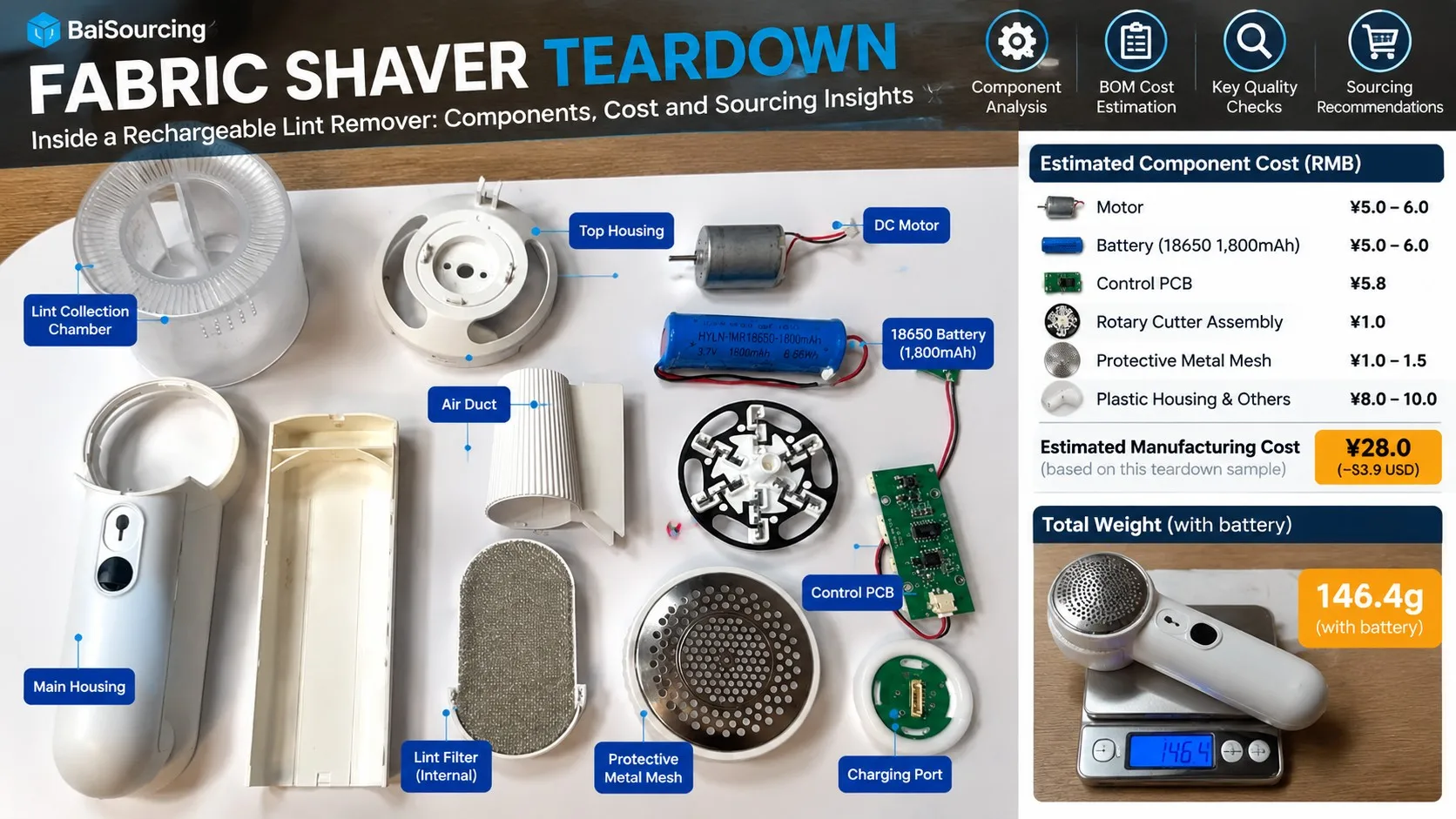
A fabric shaver, also known as a lint remover, is a relatively simple consumer product. But its real-world performance depends on several components working together: the motor, rotary cutter, protective mesh, battery, control electronics, and housing.
For importers, retailers, and private-label brands, the challenge is not simply finding the lowest factory quotation. It is understanding what is inside the product, which components determine performance, and whether the quoted price reflects the required specification.
In this teardown, we disassembled a rechargeable fabric shaver to examine its internal construction, identify its key components, and estimate its manufacturing cost structure.
The sample weighs 146.4 grams and contains a rechargeable lithium-ion battery marked 1,800mAh. The teardown reveals an important sourcing lesson: even a simple product requires component-level evaluation before its quality and value can be assessed.
1. Inside the Fabric Shaver: What We Found
After disassembly, the product can be divided into several main assemblies:
| Component | Function | What Buyers Should Check |
|---|---|---|
| Outer housing | Protects internals and provides grip | Material, wall thickness, fit, finish, and durability |
| Lint collection chamber | Collects removed fabric fibers | Capacity, transparency, snap fit, and ease of cleaning |
| Protective metal mesh | Covers rotary cutter; admits pill fibers | Hole geometry, thickness, flatness, and deformation resistance |
| Rotary cutter assembly | Cuts loose fibers and fabric pills | Blade sharpness, alignment, wear resistance, and balance |
| DC motor | Drives the rotary cutter | Torque under load, operating stability, noise, and service life |
| Lithium-ion battery | Supplies operating DC power | Verified capacity (1,800mAh), BMS protection, charging safety |
| Control PCB | Manages electrical operation | Component selection, soldering quality, USB charging behavior |
2. Motor Performance: Why Torque Matters
The motor's job is to drive the rotary cutter at a stable speed while maintaining sufficient torque to cut coarse fabric pills without stalling.
• Torque Under Load: A motor that spins fast in free-air may stall immediately when pressed against thick wool sweaters.
• Recommended Test: Test on wool, polyester, and cashmere swatches. Record cutting time, operating sound, and motor temperature after 15 minutes of continuous operation.
3. Rotary Cutter and Protective Mesh: The Core Cutting System
The rotary cutter and perforated stainless steel foil guard work as a precision scissor system:
- Protective Mesh: 3-size honeycomb hole geometry captures different pill sizes while preventing fabric snagging. Mesh must not flex inward under pressure.
- Rotary Cutter: 6-blade centrifugal floating cutter with precision spring-loaded suspension maintains consistent edge contact with the foil.
4. Battery Analysis: Verify Capacity and Charging Performance
| Parameter | Observed Specification |
|---|---|
| Battery type | 18650 cylindrical lithium-ion cell |
| Marked capacity | 1,800mAh |
| Nominal voltage | 3.7V |
| Marked energy | 6.66Wh (3.7V × 1.8Ah) |
5. Manufacturing Cost: What Does This Product Really Cost?
| Component / Cost Item | Estimated Cost (RMB) | Approx. Cost (USD) |
|---|---|---|
| DC motor | ¥5.00 – 6.00 | $0.69 – $0.83 |
| 18650 Battery (1,800mAh) | ¥5.00 – 6.00 | $0.69 – $0.83 |
| Control PCB module | ¥5.80 | $0.81 |
| Rotary cutter assembly | ¥1.00 | $0.14 |
| Protective metal mesh | ¥1.00 – 1.50 | $0.14 – $0.21 |
| Plastic housing & others | ¥8.00 – 10.00 | $1.11 – $1.39 |
| Estimated Manufacturing Cost | ¥28.00 | ~$3.89 USD |
6. Product Weight: Why 146.4 Grams Matters
The sample weighs 146.4g on a precision digital scale. This balance provides adequate motor stability and hand grip comfort while maintaining optimal dimensional weight for air express and e-commerce parcel shipping.
7. Procurement Checklist: What Should Buyers Request Before Ordering?
1. Confirm Product Specifications: Document motor torque, blade steel grade, battery capacity (1,800mAh), and total weight (146.4g ±5g).
2. Approve Reference Golden Sample: Retain sealed reference samples with verified cutting sharpness.
3. Test Actual Performance: Perform cutting tests across wool, knitwear, and fleece fabrics.
4. Verify Detailed BOM: Itemize PCBA, motor, replacement blades, cleaning brush, and retail packaging.
5. Establish Production Quality Controls: Set AQL 1.5/2.5 inspection criteria and verify CE, FCC, RoHS, and UN38.3 test certificates.
8. How BaiSourcing Can Help
BaiSourcing helps retailers, brands, distributors, and product teams discover products, evaluate suppliers, analyze component configurations, and make better sourcing decisions in China.
🔍 Product Discovery
Discover vetted fabric shavers, garment care devices, and personal grooming tools.
⚙️ Product Intelligence
Physical teardowns, bottom-up BOM cost analysis, and motor/battery specification comparison.
🏭 Supplier Matching
Direct factory vetting, quotation benchmarking, and cleanroom production validation.
🛠️ OEM/ODM Development
Custom handle tooling, blade configuration, and pilot production quality control.