
When you send the exact same RFQ to three Chinese factories and receive quotes of $6.90, $8.50, and $12.80, the cheaper supplier is rarely offering a “better deal.” In manufacturing, price variance is driven by internal component grades, motor lifespans, battery protection, and omitted quality assurance.
1. Why Do Factory Quotations Vary So Widely?
Every international brand procurement manager experiences this scenario: you submit a product spec sheet to multiple suppliers and receive vastly different unit prices:
Supplier C
$6.90
Looks like an unbeatable bargain.
Supplier A
$8.50
Moderate mid-tier quote.
Supplier B
$12.80
Appears overpriced at first glance.
Inexperienced buyers assume Supplier B has an excessive profit margin while Supplier C offers the best deal. But in Chinese manufacturing clusters, raw materials and component markets are hyper-transparent.
A lower quotation does not mean a cheaper price—it usually means you are purchasing a fundamentally different product.
2. Empirical Evidence: Same Appearance, Completely Different Internals
To illustrate why quotations differ, BaiSourcing engineers procured and disassembled three versions of a portable electronic hardware product sharing identical exterior dimensions:
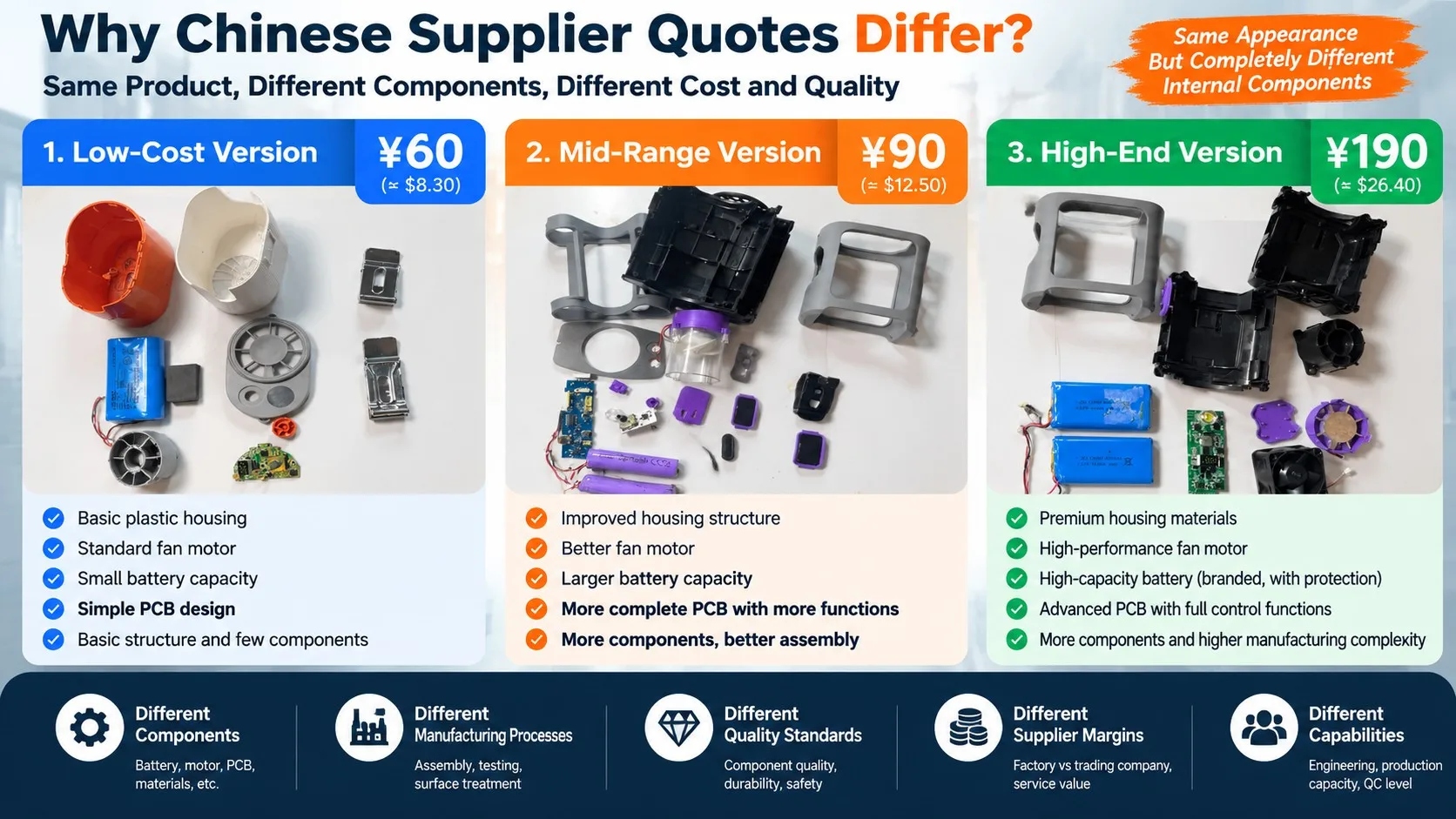
Fig 1. Real 3-tier component teardown: Low-Cost (¥60 / $8.30) vs. Mid-Range (¥90 / $12.50) vs. High-End (¥190 / $26.40).
3. 5 Hidden Drivers Behind Quotation Variance
1. Component Grade Substitution
Two suppliers may both describe their quotation as “2000mAh battery, high-speed motor.” But Supplier A quotes authentic Grade-A cells from certified vendors, while Supplier B quotes recycled B-grade cells with high internal impedance.
2. Surface Finishing & Tooling Precision
Precision CNC molds with tight draft tolerances cost 3x more than rapid steel molds, but they eliminate ugly seam lines and uneven gaps. Multi-layer UV coating or anodized aluminum prevents color fading after 30 days of sun exposure.
3. Factory QC Rigor & Testing Standards
Tier-1 OEM factories budget for full incoming inspection (IQC), in-process PCB soldering checks (IPQC), and 100% 4-hour burn-in aging rooms. Budget workshops skip aging tests entirely, pushing defect discovery onto your end customers.
4. MOQ Volume Price Breaks
A supplier quoting on 500 units must amortize setup time and material batch minimums at higher unit costs. A factory quoting on 10,000 units unlocks tier-1 sub-supplier volume discounts across plastics, metals, and chips.
5. Supplier Entity & Margin Layering
A direct OEM factory prices at true manufacturing EXW cost. A commercial trading middleman layers a 15%–25% management markup to cover their overhead and sales commission.
4. Why the Cheapest Quote Is Often the Most Expensive
Accepting the lowest quote without verifying component specs creates compounding financial downstream risks:
- High Return Rates on Amazon & DTC: A $1.50 component saving that increases defect rates from 1% to 8% wipes out your entire product margin in reverse logistics and restocking fees.
- Account Health & Review Damage: Early motor burnouts and battery swelling generate 1-star reviews that permanently suppress organic search rankings.
- Recall & Compliance Fines: Missing battery protection circuits can trigger customs border seizures and devastating product liability claims.
5. The 4-Step Quote Comparison Framework
Step 01
Demand Component-Level Transparency
Require suppliers to itemize exact IC models, motor duty cycles, battery cell brands, and plastic resin grades.
Step 02
Perform Physical Sample Teardowns
Disassemble golden samples to verify whether physical internal components match the quotation sheet.
Step 03
Audit Factory QC Equipment
Verify whether the factory owns active aging rooms, drop testers, and battery discharge analyzers.
Step 04
Calculate Total Cost of Ownership
Evaluate unit price against estimated warranty reserves, return logistics, and brand equity impact.
6. Explore Related Sourcing Due Diligence Guides
BOM Audit
How to Review a Supplier Quote: A Complete BOM Audit Guide →
Deconstruct supplier pricing with real component-level cost modeling.
Cost Reduction
How to Reduce Product Costs Without Sacrificing Quality →
Discover value engineering and structural optimization strategies.
Holding Multiple Chinese Supplier Quotes and Unsure How to Choose?
Send BaiSourcing your supplier quotations, spec sheets, or physical samples. We will perform an independent teardown and BOM audit to tell you exactly where the cost differences lie.