
Reducing manufacturing costs in China is not about squeezing supplier margins until they cut corners. True cost optimization comes from BOM restructuring, eliminating non-value-add features, and value engineering while protecting core reliability.
1. The Wrong Way to Reduce Manufacturing Costs
When sourcing consumer electronics, hardware, or small appliances from China, many international buyers start with a single negotiating tactic:
“Can you make this $1.50 cheaper per unit?”
A factory eager for order volume will almost always agree. However, raw material prices in Chinese industrial clusters are hyper-transparent. When a supplier grants a 15% price cut without engineering modifications, they recoup their margin through hidden compromises:
- Substituting B-grade unbranded lithium battery cells for certified tier-1 packs
- Eliminating PCB surge protection and NTC thermal management ICs
- Thinning electroplated surface coatings (failing 24h salt-spray corrosion tests)
- Reducing factory run-in aging tests from 4 hours down to 10 minutes
The initial unit price drops, but warranty claims, negative Amazon reviews, and customer return rates skyrocket. The real question is: Which parts of your product create unnecessary cost without adding perceptible customer value?
2. Real Case Study: High-Speed Hair Dryer Value Engineering ($11.20 → $7.60)
Below is a real engineering teardown and cost optimization conducted in BaiSourcing's Ningbo lab for a high-speed personal care hair dryer. Through structural consolidation and component right-sizing, factory EXW cost was reduced by 32% with zero reduction in customer air-velocity performance:
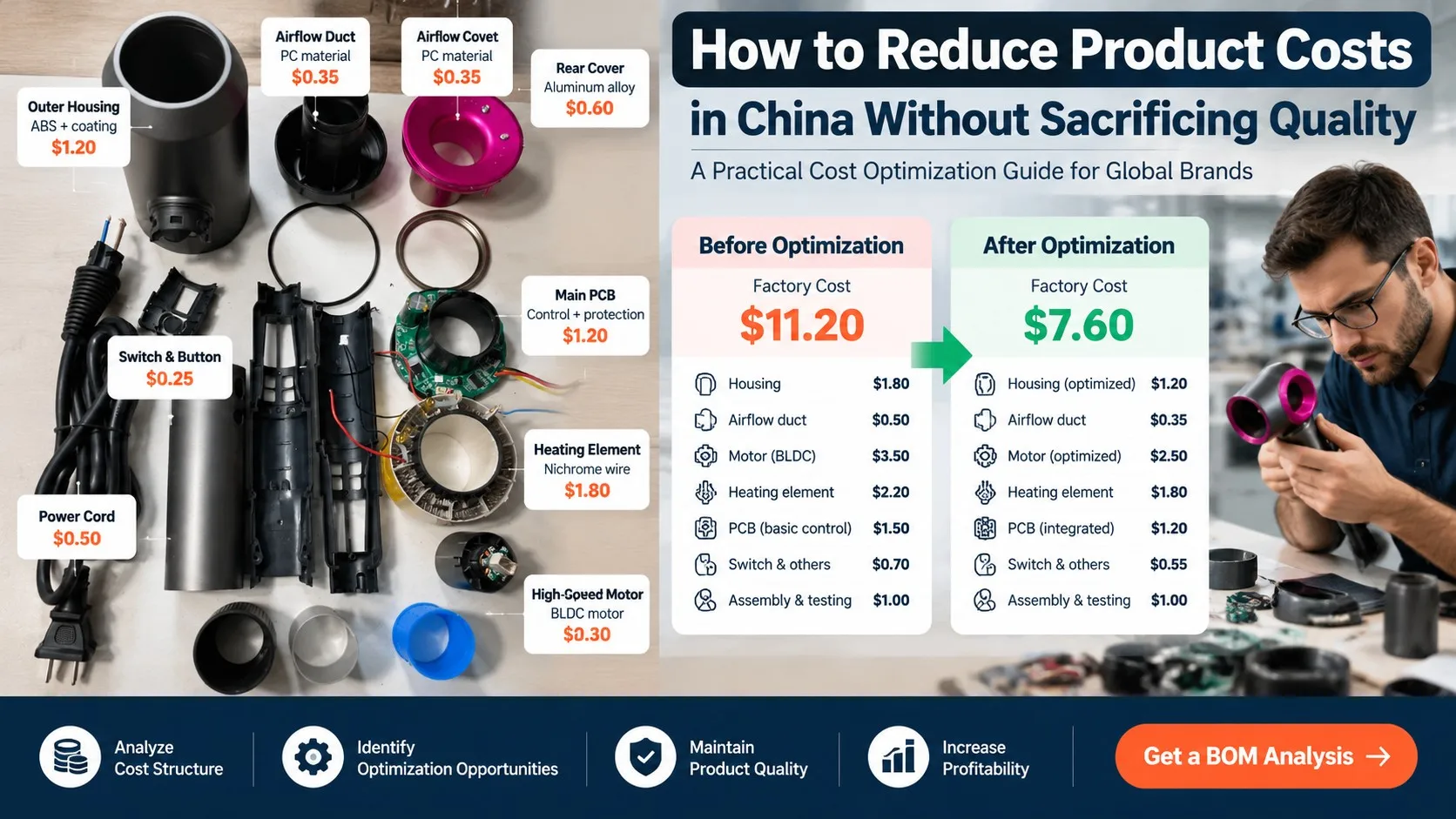
Fig 1. Real component-level teardown comparing standard factory configuration ($11.20) vs. value-engineered optimized BOM ($7.60).
Before vs. After Optimization Cost Breakdown
3. 4 High-Impact Value Engineering Strategies
1. Eliminate Decorative & Over-Engineered Materials
A high-end tactile feel does not always necessitate heavy CNC aluminum. High-grade engineered ABS or PC with metallic vacuum coating or soft-touch UV spray delivers identical premium aesthetics at 40% of the raw material tooling cost.
2. Consolidate Component Count & Snap-Fit Assembly
Every screw, bracket, and manual wire connection adds assembly cycle seconds and human error probability. Designing internal snap-fits and integrating split PCBA boards into a single controller reduces assembly line labor and lowers factory defect rates.
3. Standardize Around Mature Supply Chain Platforms
Custom motor windings or proprietary battery form-factors carry massive sub-tier supplier MOQs and long lead times. Specifying standard tier-1 platform components (e.g. standard 18650/21700 cells or mainstream JL Bluetooth SoCs) gives you immediate volume pricing leverage.
4. Cluster-Specific Supplier Matching
Sourcing personal care products from Taizhou/Ningbo or smart electronics from Shenzhen/Dongguan places your production directly inside specialized sub-tier supply clusters, eliminating inter-provincial shipping freight and sub-assembly markups.
4. Avoid the Cheapest Quote Trap: Total Cost of Ownership (TCO)
Smart brands do not optimize for the lowest initial quote; they optimize for Total Cost of Ownership (TCO):
TCO = Factory Unit Price + Quality Failure Costs + Return Logistics + Brand Equity Impact
A product costing $0.80 more to manufacture with balanced motors and certified battery protection ICs generates exponentially higher net profits by holding Amazon return rates under 2% and eliminating container-scale quality recalls.
5. The BaiSourcing 5-Step Cost Optimization Process
Step 01
Sample Disassembly & Teardown
We disassemble your current product or supplier sample and weigh/catalog every component.
Step 02
BOM Cost Modeling
We benchmark current raw material prices and SMT/tooling costs against active China cluster data.
Step 03
Value Engineering Review
We identify non-essential components, over-specced chips, and structural consolidation opportunities.
Step 04
Supplier Negotiation Leverage
You receive an itemized cost model to negotiate with your existing factory on verifiable facts.
6. Explore Related Sourcing & BOM Guides
Quotation Audit
How to Review a Supplier Quote: A Complete BOM Audit Guide →
Learn how to evaluate supplier quotations with real BOM cost modeling.
Supplier Verification
Factory or Trading Company? How to Identify Your Real Supplier →
Verify whether your supplier is a direct manufacturer or a trading middleman.
Need a Value Engineering & BOM Audit for Your Product?
Send us your current supplier quotation, product sample, or target unit cost. BaiSourcing will analyze where your costs originate and identify exact component optimization opportunities.