Power Bank Teardown: 20000mAh Claim vs Reality
Power bank teardown analysis: BaiSourcing verifies a claimed 20,000mAh battery configuration, breaks down BOM engineering, and explores redesign opportunities.

Executive Summary: Beyond the Number on the Box
A consumer product specification is only as reliable as the underlying engineering architecture. In the power bank category, purchasing decisions frequently revolve around a single marketing benchmark: "20,000mAh." Higher capacity claims naturally appeal to buyers seeking extended battery life for travel, outdoor use, and heavy mobile usage.
However, before committing to a mass production purchase order, global brands must answer a fundamental engineering question: Does the internal hardware configuration realistically support the claimed performance?
At BaiSourcing Product Lab, we evaluate hardware from the inside out — conducting physical teardowns, bill-of-materials (BOM) cost cross-checks, and internal component verifications before production molds are opened. This teardown analysis evaluates a portable multi-cable power bank labeled as 20,000mAh, identifies internal design constraints, and provides an actionable engineering roadmap to build a higher-converting, commercially viable product.
Market Opportunity: Real Performance vs. Marketing Inflation
In mature e-commerce channels (such as Amazon US/EU, TikTok Shop, and specialty retail), low-cost power banks with inflated capacity ratings suffer from high customer return rates (frequently exceeding 12–18%), negative reviews citing slow charging speeds, and severe platform compliance scrutiny regarding battery certifications.
💡 Key Sourcing Takeaway for Brand Owners:
The strategic goal for global brands is not simply printing the highest possible number on packaging. The real competitive advantage lies in delivering true usable capacity, modern bidirectional USB-C fast charging, and compact ergonomics that build long-term brand credibility.
Teardown Analysis: Physical Disassembly & BOM Breakdown
Upon opening the ultrasonic-welded plastic enclosure at BaiSourcing Product Lab, we cataloged and measured each core subsystem.
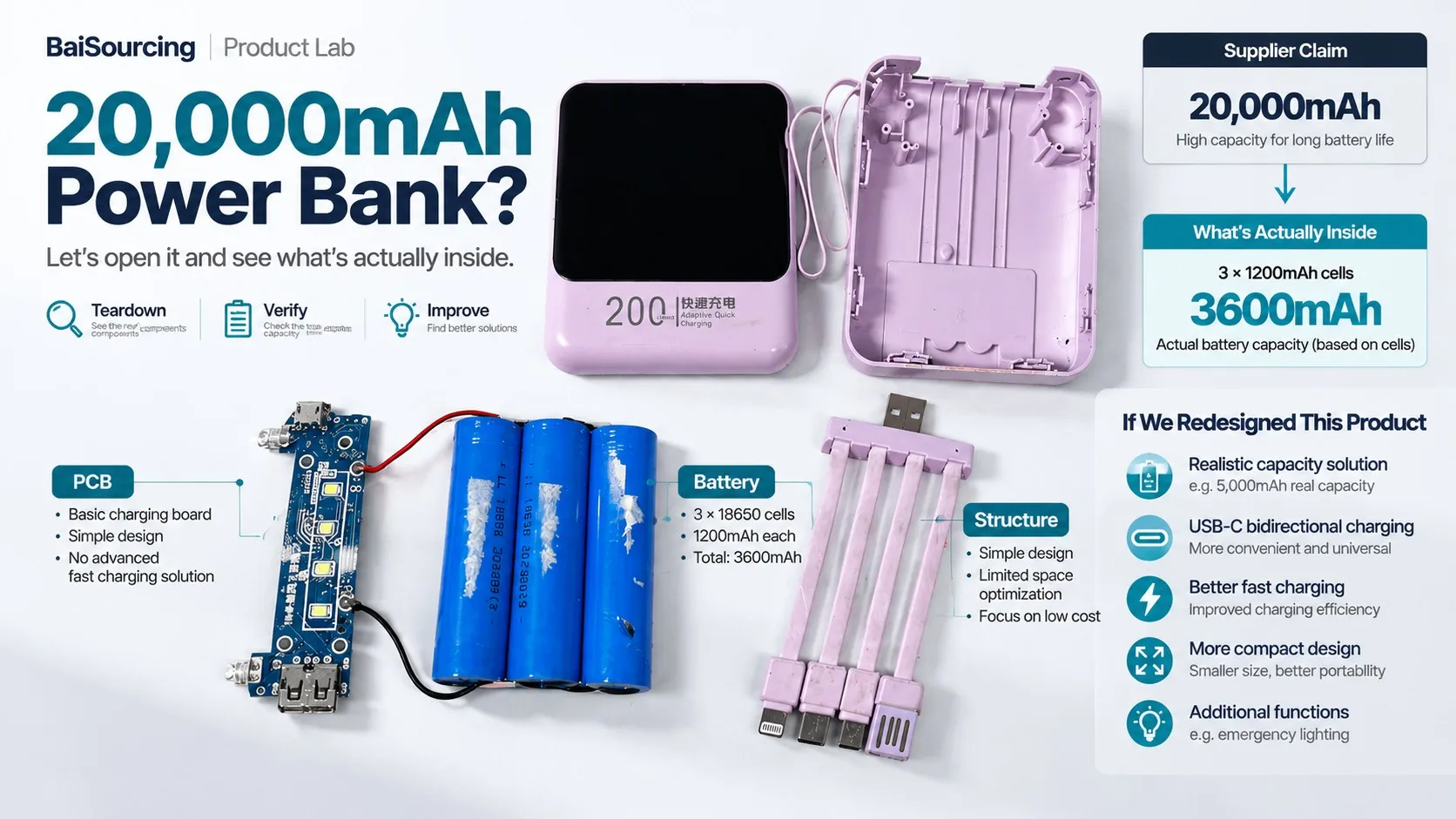
Figure 1: BaiSourcing Product Lab internal teardown, cell capacity calculation, and product improvement blueprint.
1. Battery Cell Configuration & Capacity Verification
The unit incorporates three cylindrical lithium-ion battery cells in parallel configuration:
- Cell Format: Standard 18650 cylindrical cells (18mm diameter, 65mm height).
- Individual Cell Marking: 1,200mAh nominal rating at 3.7V.
- Measured Cell Count: 3 cells.
-
Total Internal Chemistry Capacity:
1,200mAh × 3 = 3,600mAh (13.32 Wh).
This reveals a substantial divergence between the supplier's exterior 20,000mAh label and the actual 3,600mAh internal cell capacity. For an authentic 20,000mAh battery pack using 18650 format cells, an assembly would require either 6–7 high-density 3,000mAh cells or modern high-capacity 21700/Li-polymer pouch cells, which would significantly alter the weight, volume, and BOM baseline.
2. Charging PCB & Power Electronics
- Mainboard Topology: Single-sided PCB utilizing entry-level integrated power management IC (PMIC).
- Charging Protocols: Standard 5V/1A to 5V/2.1A basic charging curve; lacks dedicated USB-C Power Delivery (PD) or Quick Charge (QC) negotiation ICs.
- Thermal Safeguards: No negative temperature coefficient (NTC) thermal sensor attached to the battery pack cells, limiting thermal runaway detection during sustained high-current draw.
3. Structural & Enclosure Efficiency
- Volumetric Utilization: The plastic chassis is dimensioned for a larger cell cluster, leaving substantial unutilized interior void space.
- Cable Integration: Includes an integrated multi-head charging harness (Lightning / Micro-USB / Type-C) molded into the casing; convenient for casual users, but wire gauges limit current throughput to sub-10W levels.
Pre-PO Buyer Checklist: 4 Battery Verification Protocols
- Request Cell Manufacturer Brand & Grade: Demand tier-1 cell sourcing provenance (e.g., EVE Energy, BAK, Lishen, or LG) with official batch datasheets rather than generic unbranded cells.
- Require Constant-Current Discharge Curves: Verify usable watt-hour (Wh) capacity at 0.5C and 1.0C discharge rates to ensure conversion efficiency exceeds 85% at 5V output.
- Audit On-Board Protection Circuits: Inspect PCB schematics for independent Over-Charge (OVP), Over-Discharge (UVP), Over-Current (OCP), Short-Circuit protection, and dual NTC thermal sensors.
- Mandate Transport Certification Validation: Ensure authentic UN 38.3 test reports, 1.2m drop test records, and valid MSDS documentation specifically matched to the exact cell model and factory name.
BaiSourcing Evaluation Score Card
| Evaluation Dimension | Baseline Score | Engineering Assessment |
|---|---|---|
| Capacity Claim Accuracy | 40 / 100 | Exterior 20,000mAh claim vs. 3,600mAh internal hardware. |
| Circuit & Thermal Protection | 62 / 100 | Basic protection present; lacks NTC thermistor & fast-charge IC. |
| Mechanical & Volumetric Efficiency | 58 / 100 | Oversized housing relative to actual internal cell volume. |
| BOM Cost Transparency | 48 / 100 | Low-cost bill of materials disguised under high-capacity exterior. |
| Redesign & Upgrade Potential | 92 / 100 | High market viability if retooled into a compact 5,000mAh PD model. |
Engineering Blueprint: How to Redesign a Winning Product
Rather than participating in race-to-the-bottom capacity inflation, brand owners can leverage this teardown to engineer a differentiated, high-margin consumer product:
1. Right-Sized Real Capacity
Reconfigure with a genuine 5,000mAh single 21700 cell or ultra-slim Lithium Polymer pouch. Delivers a pocket-friendly form factor perfect for daily commutes and emergency power.
2. 20W Bidirectional USB-C PD
Upgrade the PCB with an IP5356 / SW6208 fast-charge controller supporting USB Power Delivery (PD 3.0) and PPS, charging modern smartphones to 50% in 30 minutes.
3. Compact Industrial Ergonomics
Eliminate dead enclosure space to reduce overall product volume by 45%. Integrate soft-touch matte finishes, reinforced braided cables, and an emergency LED work light.
Verified Sourcing & OEM Manufacturing Specs
- Recommended Production Path: ODM upgrade utilizing audited Shenzhen/Dongguan power electronics specialists.
- Target MOQ: 1,000 – 3,000 units (Custom colorway, laser logo, and retail packaging).
- Realistic FOB Target: $4.80 – $6.50 (with authentic 5,000mAh A-grade cells & 20W PD circuit).
- Mandatory Compliance: UN 38.3, CE-EMC, FCC Part 15B, RoHS 2.0, UL 2056 / IEC 62368-1.
Frequently Asked Questions (FAQ)
Q1: What is the difference between battery nominal capacity and rated output capacity?
Battery nominal capacity represents internal chemistry storage at 3.7V (e.g., 5,000mAh × 3.7V = 18.5Wh). When stepped up to 5V output via the PCB boost converter, energy loss occurs (typically 80–90% efficiency). The actual rated output capacity at 5V would be approximately (18.5Wh × 85%) / 5V = 3,145mAh. Reputable brands always print both nominal and rated capacity.
Q2: Why do some factories quote 20,000mAh power banks below $4.00?
Legitimate tier-1 20,000mAh battery packs (requiring ~74Wh of raw lithium cells) have a raw cell material cost alone exceeding $5.50–$7.00. Quotations significantly below this threshold typically indicate recycled/B-grade cells, missing protection circuitry, or inflated labeling.
Related Product Verification Insights
Explore more engineering teardowns and battery sourcing analysis from BaiSourcing Product Lab:
- 18650 Battery Sourcing Guide: Real vs. Recycled Cells
- UN 38.3 Test Report Checklist for Battery Shipping Compliance
- Portable Tire Inflator Teardown: Series vs. Parallel Battery Engineering
Looking to Build a Differentiated Hardware Product?
BaiSourcing helps global brands audit supply chain BOMs, verify internal product architectures, and coordinate qualified China manufacturing.