
Similar Looks, 2X the Price: What a Neck Fan Teardown Reveals
Two wearable neck fans look almost identical from the outside but carry a ¥100 ($14.97) price gap. Compare their cylindrical 18650 cells vs. pouch battery packs, axial cooling fans, and integrated control PCBs to evaluate if paying double is commercially justified.
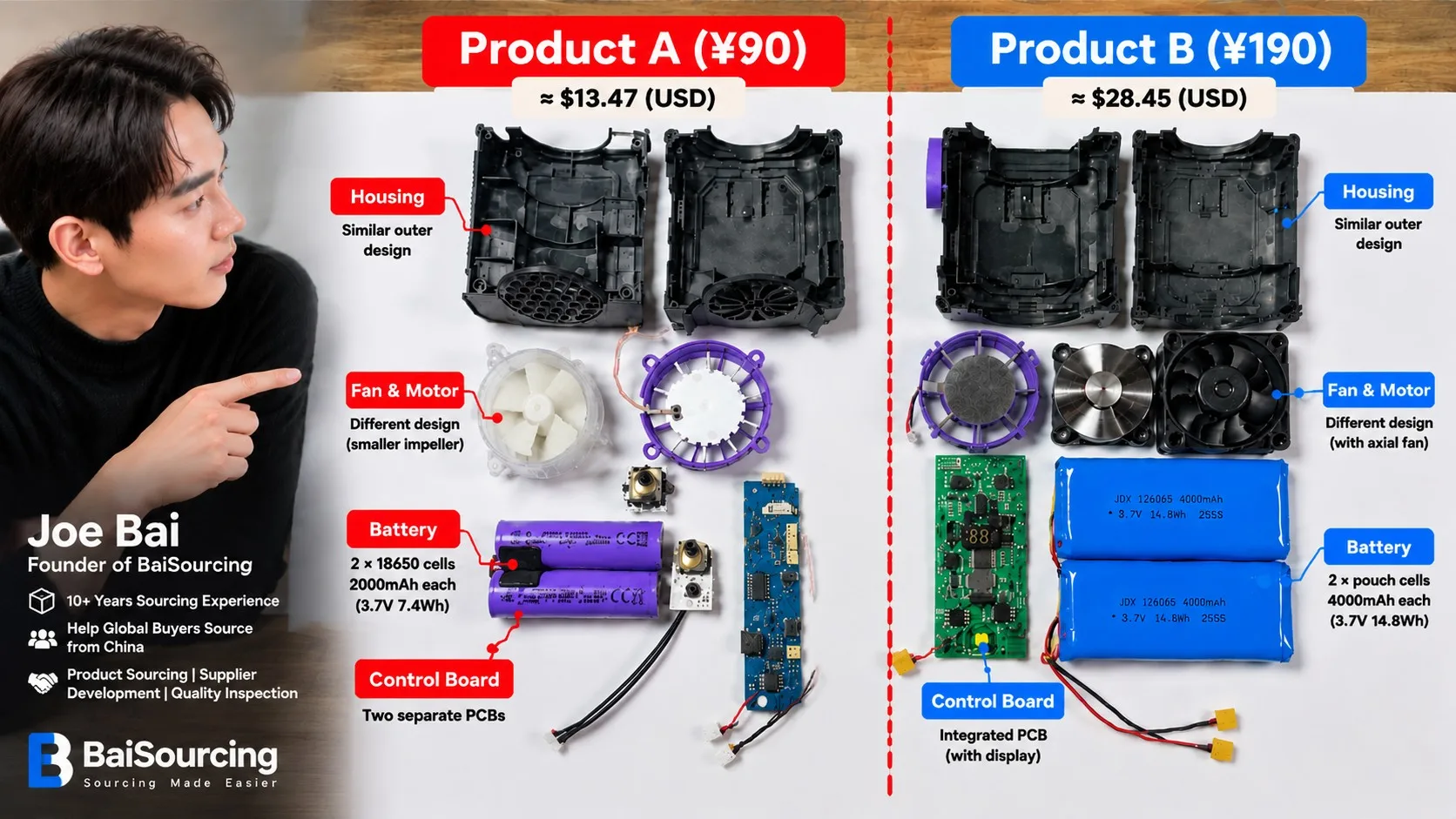
1. Two Similar Products. One ¥100 Price Difference.
At first glance, these two neck fans look remarkably similar.
Both have black molded plastic housings, compact internal fan assemblies, rechargeable lithium batteries, and electronic control boards. From the outside, a buyer might easily assume they offer comparable performance and reliability.
But their selling prices tell a very different story:
| Comparison Metric | Product A (Left) | Product B (Right) |
|---|---|---|
| Selling price in RMB | ¥90 | ¥190 |
| Approximate price in USD | $13.47 | $28.45 |
| Price difference | — | +¥100 (+ $14.97) |
| Price multiplier | 1.00× | 2.11× (+111%) |
Product B costs approximately 111% more than Product A. The important sourcing question is not simply why one product is more expensive, but whether the additional $14.97 buys a meaningful improvement in battery capacity, airflow, runtime, user comfort, safety, and field reliability.
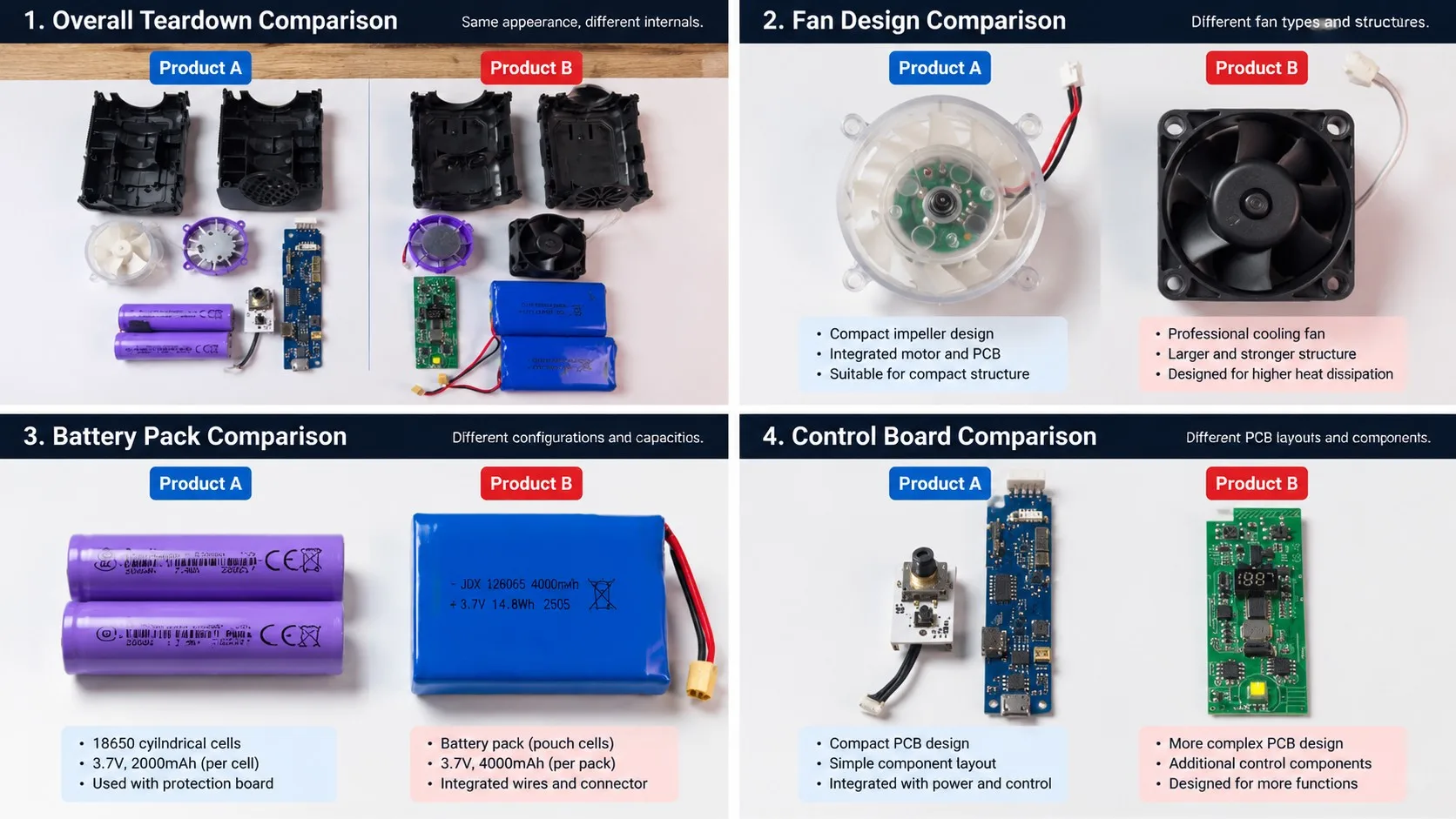
2. Battery Comparison: The First Difference Worth Investigating
Battery specifications are the single largest driver of runtime, weight distribution, and BOM cost in wearable electronics. The teardown reveals distinctly different cell form factors:
Product A: Two 18650 Cylindrical Cells (14.8Wh Nominal)
The left-hand unit contains two purple 18650 cylindrical lithium-ion cells with printed markings: 2,000mAh, 3.7V, 7.4Wh per cell. If both cells operate in parallel or series as designed, the combined nominal energy is:
Product B: Two Pouch-Style Battery Packs (29.6Wh Nominal)
The right-hand unit uses two blue pouch-style lithium battery packs marked JDX 126065 4000mAh, 3.7V, 14.8Wh per pack. Connected together, their combined nominal energy is:
| Battery Parameter | Product A (¥90) | Product B (¥190) |
|---|---|---|
| Battery form factor | 2 × 18650 Cylindrical cells | 2 × Pouch-style battery packs |
| Marked capacity per unit | 2,000mAh (3.7V) | 4,000mAh (3.7V) |
| Marked energy per unit | 7.4Wh per cell | 14.8Wh per pack |
| Total nominal energy (Marked) | 14.8Wh | 29.6Wh (2.0× Energy) |
Crucial Sourcing Rule: Does 2× nominal battery energy mean 2× runtime? Not necessarily. A higher-power motor or larger fan impeller will consume more milliwatts per minute. Sourcing teams must verify actual discharge runtime under standardized air-speed settings rather than relying on cell label math alone.
3. Motor and Fan Assembly: Different Internal Aerodynamic Designs
The teardown demonstrates two distinct airflow generation strategies:
- Product A (Left): Features a compact plastic centrifugal impeller integrated directly over the motor and motor-drive PCB. Designed for ultra-compact packaging and low weight.
- Product B (Right): Incorporates a dedicated square-framed industrial axial fan module with larger, reinforced fan blades engineered for higher static pressure and active heat dissipation.
While marketing claims frequently cite extreme RPM figures (such as 14,000 RPM), rotational speed alone does not equal effective outlet airflow. Impeller blade curvature, duct sealing, backpressure resistance, and noise suppression (dBA) determine the user experience.
4. PCB and Control Electronics: Multi-Board vs. Integrated Digital Display
The electronic architectures reflect different product tiers:
• Product A (Two Separate Blue PCBs): Uses a split layout with a primary elongated power/charging board and a separate push-button control sub-board connected via wire harness.
• Product B (Single Integrated Green PCB with LED Display): Features an all-in-one mainboard with an integrated 7-segment digital display showing battery percentage and speed level, reducing internal wire interconnects.
5. Housing and Internal Construction: Wearable Weight vs. Battery Mass
For wearable personal products, heavier batteries create a design trade-off. While 29.6Wh pouch cells provide longer runtime, they increase neck fatigue if weight is not balanced around the collarbone. In contrast, 18650 cells are heavier per unit of energy density but allow symmetrical left/right distribution.
6. Cost Comparison: What Does the Extra $14.97 (¥100) Actually Buy?
| Subsystem / Factor | Product A — ¥90 ($13.47) | Product B — ¥190 ($28.45) |
|---|---|---|
| Battery configuration | 2 × 18650 cells (14.8Wh marked) | 2 × Pouch packs (29.6Wh marked) |
| Fan & motor assembly | Integrated centrifugal impeller | Dedicated axial cooling fan module |
| Control electronics | Two separate blue PCBs (Split) | Integrated green PCB with LED display |
| Internal construction | Lightweight compact chassis | Heavier frame for axial fan & packs |
| Commercial positioning | Mass-market / Budget retail | Mid-to-high tier / Feature-rich |
What Does the Price Gap Mean at Scale?
| Order Quantity | Additional Expenditure for Product B |
|---|---|
| 100 units | + ¥10,000 (≈ $1,497) |
| 1,000 units | + ¥100,000 (≈ $14,972) |
| 5,000 units | + ¥500,000 (≈ $74,857) |
7. Procurement Checklist: How to Choose Between the Two Products
Step 1: Verify Battery Cell Traceability: Demand UN38.3 test reports, battery brand datasheets, and actual 0.2C discharge capacity test curves.
Step 2: Measure Standardized Performance: Test airflow (CFM), motor RPM under load, acoustic noise (<50dBA), and continuous runtime until auto-cutoff.
Step 3: Request an Itemized BOM Quotation: Ask factories to break down motor, battery cell, display board, and housing tool amortizations.
Step 4: Check Destination Safety Compliance: Confirm CE-EMC, FCC Part 15, RoHS, and MSDS battery transport documentation.
Step 5: Calculate Total Landed Cost of Quality: Factor in warranty return risk, return shipping, and customer review sentiment on Amazon/Shopify.
8. Sourcing Verdict: Which Neck Fan Should You Buy?
✅ Choose Product A (¥90 / $13.47) If:
Your market is highly price-sensitive, 14.8Wh battery runtime fulfills customer expectations, and target retail is under $25.
✅ Choose Product B (¥190 / $28.45) If:
You target premium channels with an LED battery display hook, verified 29.6Wh runtime, and target retail of $45–$60.
Frequently Asked Questions (FAQ)
1. Does the ¥190 neck fan offer twice the runtime of the ¥90 model?
Not necessarily. While the battery energy marking is double (29.6Wh vs 14.8Wh), the axial fan motor may draw higher wattage. Standardized runtime tests are required.
2. Why do two similar-looking products have a ¥100 price gap?
The price difference is driven by battery chemistry/capacity (pouch packs vs 18650), fan motor architecture, display electronics, and assembly overhead.