
18650 vs. 21700 vs. 26650: Capacity Verification & Battery BOM Cost Analysis
When sourcing battery-powered consumer electronics, the label on the cell is only the starting point. Compare physical cell formats, calculate real stored energy in Watt-hours (Wh), understand pack BMS protection costs, and verify supplier claims before mass production.
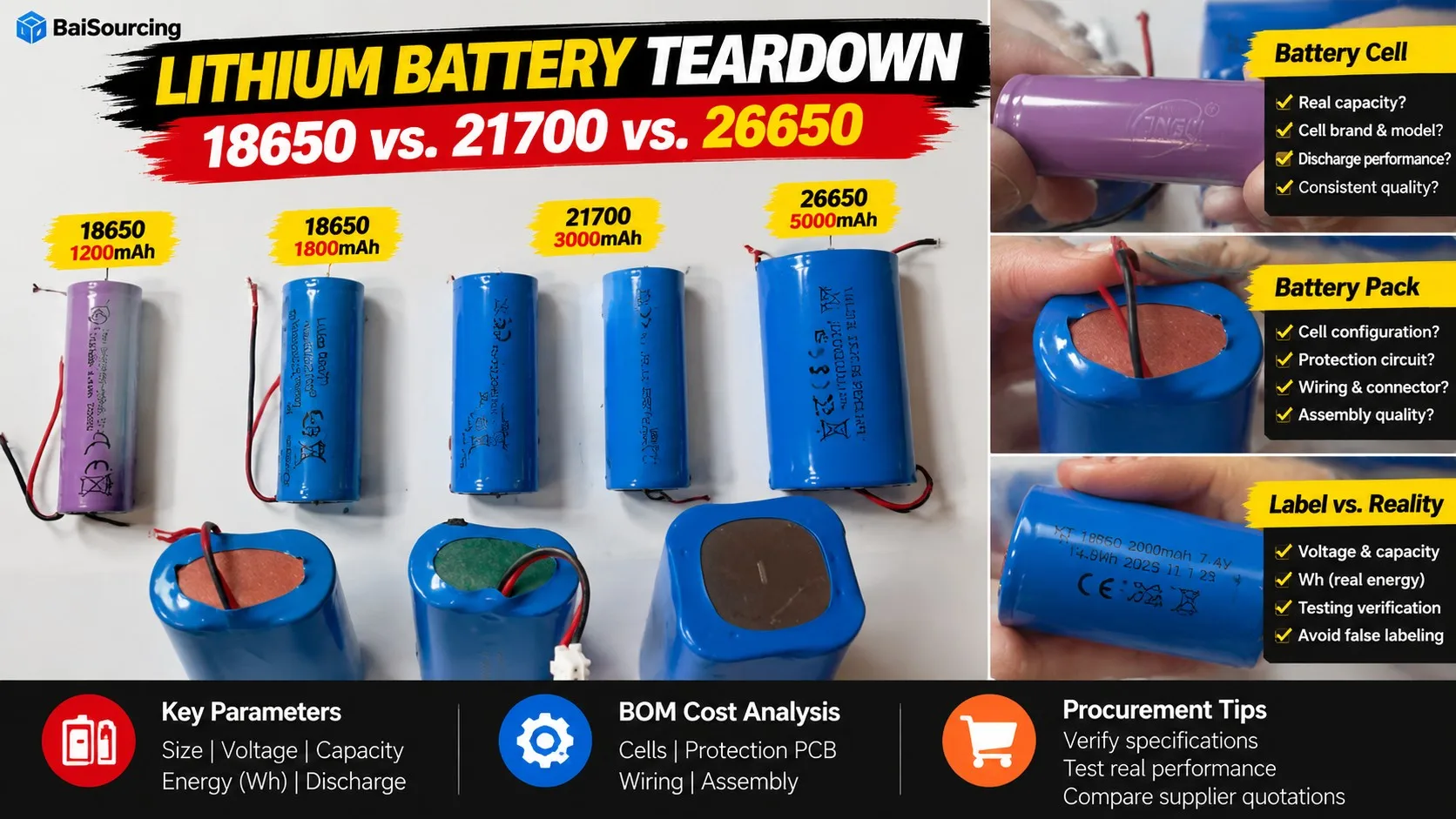
When sourcing battery-powered consumer products from China, buyers often compare batteries using three basic parameters: battery size, rated capacity, and unit price.
However, these figures alone do not tell the whole story.
A teardown comparison of lithium-ion cells and battery packs reveals significant differences in physical dimensions, labeled capacity, voltage, and packaging configurations. These differences directly affect product runtime, available space, weight, manufacturing cost, and reliability.
In the physical samples examined, visible battery markings include:
- 18650 cells: Rated at 1,200mAh (4.44Wh) and 1,800mAh (6.66Wh).
- 21700 cell: Marked at 3,000mAh (11.1Wh).
- 26650 cell: Marked at 5,000mAh (18.5Wh).
- 2S Battery pack: Labeled 7.4V, 2,000mAh, and 14.8Wh.
For product developers and sourcing teams, the key question is not simply what the label says, but whether the battery delivers the specified performance at the required cost.
1. Battery Teardown: Understanding the Differences
1.1 18650 Lithium-Ion Cells (1,200mAh vs. 1,800mAh)
The 18650 is the most widely used cylindrical cell format (18mm diameter, 65mm length). Two examined samples share identical physical size but differ by 50% in stored energy:
| Parameter | Sample A (1,200mAh) | Sample B (1,800mAh) |
|---|---|---|
| Format | 18650 | 18650 |
| Nominal voltage | 3.7V | 3.7V |
| Nominal energy (Wh) | 4.44 Wh | 6.66 Wh (+50%) |
1.2 21700 Cells: 3,000mAh / 11.1Wh (+67% Energy Density)
The 21700 cell (21mm × 70mm) provides 11.1Wh of nominal energy. It delivers higher continuous discharge currents without voltage sag, making it ideal for high-drain applications like car tire inflators and high-torque tools.
1.3 26650 Cells: 5,000mAh / 18.5Wh Max Capacity
The 26650 cell (26mm × 65mm) packs 18.5Wh of energy. While offering maximum single-cell runtime, its 95g+ weight and 26mm diameter require larger housing tooling and internal space.
2. Why mAh Alone Is Not Enough: The Watt-Hour Math
Capacity in mAh indicates electric charge, but stored energy in Watt-hours (Wh = Voltage × Ah) governs true runtime across different voltage configurations:
| Battery Specification | Nominal Voltage | Rated Capacity | Nominal Stored Energy |
|---|---|---|---|
| Single 21700 cell | 3.7V | 3,000mAh | 11.1 Wh |
| 2S Battery pack | 7.4V | 2,000mAh | 14.8 Wh (+33% energy) |
3. Battery Pack Teardown: What Is Included in the Cost?
An assembled pack costs significantly more than bare cells due to five essential cost drivers:
| Cost Element | What Buyers Should Verify |
|---|---|
| Battery cells | Cell grade (Grade A vs. recycled B/C), brand, and rated capacity |
| Protection circuit (BMS) | Overcharge, over-discharge, short-circuit, and thermal cutoffs |
| Spot welding & nickel strips | Pure nickel strips (low resistance) vs. nickel-plated steel |
| Insulation & shrink wrap | Barley paper insulation rings and flame-retardant PVC shrink wrap |
| Testing & Compliance | UN38.3 transport certification, MSDS, and IEC 62133 safety compliance |
4. How to Verify Battery Capacity Before Mass Production
Step 1: Confirm Exact Cell Part Numbers: Demand original manufacturer datasheets and cell batch codes.
Step 2: Conduct 0.2C Discharge Testing: Use calibrated electronic battery testers at 25°C ambient temperature.
Step 3: Measure Internal Resistance (AC IR): Check IR (<20 mΩ for 21700, <35 mΩ for 18650) to verify high-current health.
Step 4: Verify BMS Protection Limits: Test overcharge cutoff voltage (4.25V ±0.05V) and over-discharge cutoff (2.5V–2.8V).
Step 5: Enforce Production Consistency: Lock in cell part numbers contractually to prevent unannounced substitutions.
5. Procurement Recommendations: Five Checks Before Placing an Order
- 1. Specify Performance, Not Just Cell Format: Define minimum Ah, Wh, continuous discharge C-rate, and operating temp (-10°C to 60°C).
- 2. Compare Cost Per Watt-Hour ($/Wh): $ ext{Cost per Wh} = ext{Battery Price} \div ext{Energy (Wh)}$ to normalize pricing across cell sizes.
- 3. Audit BMS Protection Circuits: Verify whether short-circuit and over-temp protections are integrated or omitted.
- 4. Require UN38.3 & MSDS Documentation: Ensure air/sea freight logistics compliance before export shipping.
- 5. Establish Golden Reference Samples: Retain sealed sample packs and mandate incoming AQL battery capacity testing.
6. How BaiSourcing Helps You Evaluate Battery Hardware & Suppliers
At BaiSourcing, we evaluate battery hardware through physical construction, cell chemistry, protection circuits, and cost structure:
🔍 Product Discovery
Discover vetted battery-powered consumer electronics and portable appliances.
⚙️ Product Intelligence
Physical teardowns, battery capacity verification, and bottom-up pack BOM cost analysis.
🏭 Supplier Matching
Direct battery pack factory vetting, quotation benchmarking, and cleanroom production validation.
🛠️ OEM/ODM Development
Custom battery pack layout, BMS engineering, and UN38.3 export compliance certification.