
Approving a golden sample is only the beginning. A product can look flawless on the exterior while concealing downgraded battery cells, unbranded motors, or omitted thermal protection circuits. Here is how international brands validate internal BOM components and factory capability before transferring mass production deposits.
1. The "Golden Sample" Trap in China Manufacturing
One of the costliest mistakes overseas importers and hardware brands make is approving a hand-assembled sample and immediately releasing a 30% tooling or mass production deposit.
In Chinese supply chains, prototype samples are often custom-crafted by senior R&D engineers using premium components. But when full-scale production begins, factories under margin pressure frequently substitute sub-tier parts:
- Claimed “4000mAh Battery”: Delivered units contain unbranded 2200mAh recycled cells with no internal BMS protection.
- Claimed “Brushless BLDC Motor”: Replaced with low-cost carbon-brush motors that wear out after 100 operating hours.
- Claimed “Virgin PC/ABS Housing”: Injected with brittle regrind plastic prone to cracking in ocean freight transit.
Independent pre-production product validation ensures that what you approved in the golden sample is exactly what rolls off the automated assembly line.
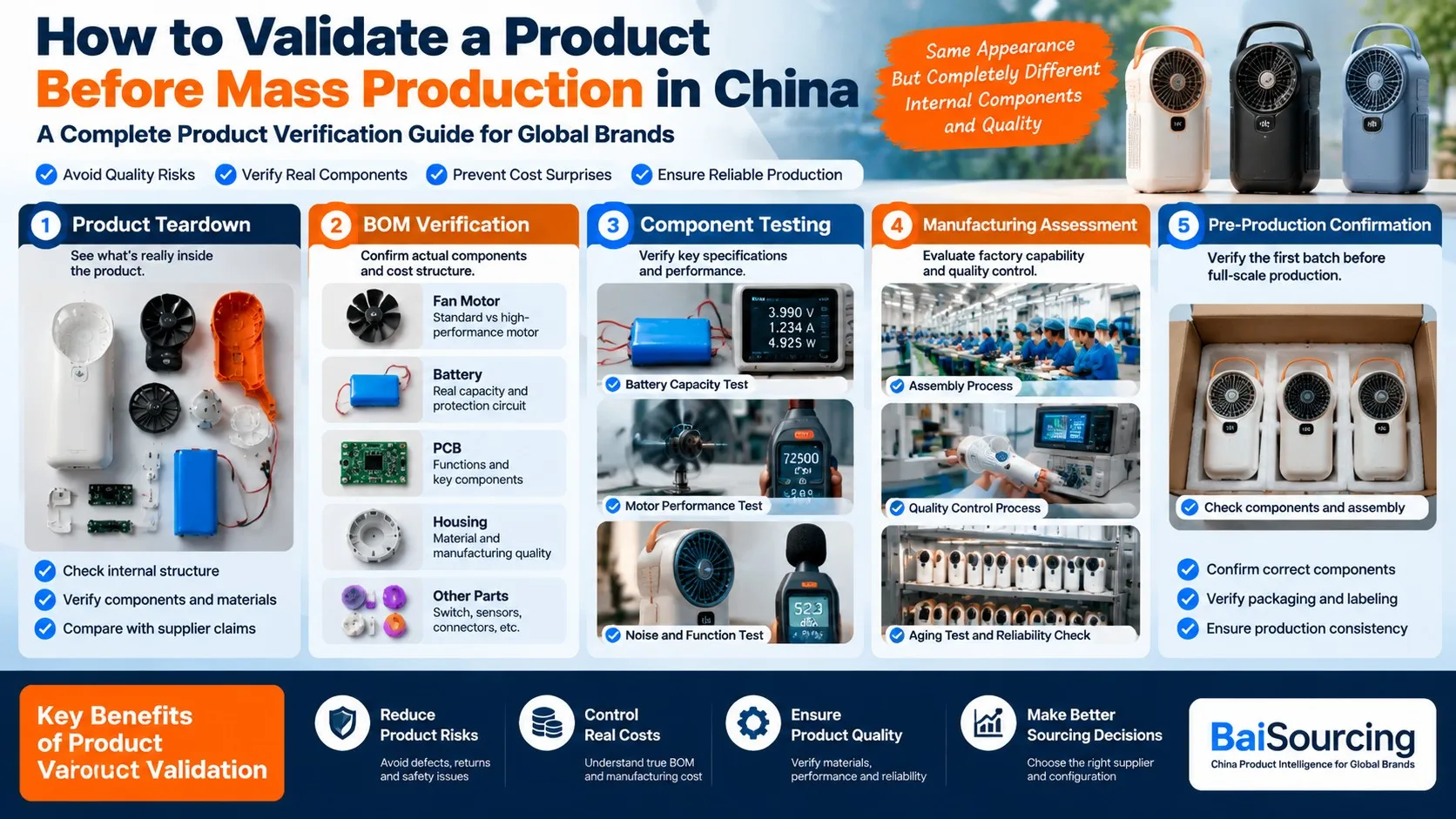
Fig 1. The complete 5-step pre-production validation process: teardown, BOM audit, bench testing, factory assessment, and pilot run confirmation.
2. The 5-Step Pre-Production Verification Framework
Physical Product Teardown Analysis
Disassemble the physical product down to individual sub-assemblies to inspect hidden internal engineering:
- Mechanical Enclosures: Check wall thickness uniformity, mold draft angles, parting line flash, and true material composition (die-cast zinc vs aluminum vs ABS).
- Electrical Sub-systems: Inspect soldering joint quality, strain relief brackets, wire gauge ratings, and PCB moisture-proof conformal coatings.
Comprehensive BOM Cost & Specification Audit
Cross-reference every physical component against the quotation spec sheet:
| Component | Critical Verification Criteria | Common Failure Points |
|---|---|---|
| Drive Motor | Motor frame size, copper winding, operating RPM under load | Overheating, brush arcing, acoustic whine |
| Battery Cell | Actual mAh capacity, cell vendor, dual BMS protection IC | Fake capacity labels, missing UN38.3 certs |
| Main PCBA | Microcontroller (MCU), charging management IC, NTC sensor | Cold solder joints, missing over-voltage fuse |
| Housing | Resin density, UV coating thickness, drop-test resilience | Brittle recycled resin, coating peeling |
Empirical Laboratory Testing & Benchmarking
Subject the sample to rigorous bench instruments in an engineering lab:
- Battery Discharge Analyzer: Test true watt-hours and continuous discharge curve under load (e.g. 3.990V / 1.234A / 4.925W).
- Tachometer & Airflow Chamber: Benchmark actual motor rotational speed (e.g. 72,500 RPM) and air delivery CFM.
- Acoustic Decibel Meter: Measure operating sound pressure levels at 1 meter (e.g. <52.3 dB limit).
On-Site Factory Capability & Quality Assessment
Audit the manufacturing plant where volume production will physically occur:
- IQC Protocols: Verify how incoming battery cells, plastic pellets, and PCBA boards are inspected.
- Aging & Burn-In Racks: Confirm the factory owns and operates automated multi-hour aging test chambers.
- Defect Tracking: Review historical yield rates and remedial corrective action procedures (CAPA).
Pilot Run & Pre-Production Batch Confirmation
Before releasing 10,000-unit mass manufacturing, conduct a controlled pilot trial (50–100 units):
- Identify assembly line bottleneck stations and manual worker error rates.
- Confirm retail packaging inserts, barcode scannability, and master carton drop survivability.
- Seal two official Golden Reference Samples (one retained in China, one sent to brand HQ).
3. 3 Common Validation Mistakes Brands Make
Mistake 01
Trusting Spec Sheets
A PDF spec sheet represents sales claims, not verified production reality.
Mistake 02
Skipping Teardowns
Evaluating only exterior cosmetics without dissecting internal battery and PCB layout.
Mistake 03
No Golden Sample Lock
Failing to seal a reference unit in China to hold the factory legally accountable during AQL audits.
4. How BaiSourcing Protects Your Pre-Production Investment
Operating directly from our hardware teardown lab and factory audit hub in Ningbo, China, BaiSourcing provides independent validation before you commit volume capital:
- Physical Teardown & Bench Testing ($299): Complete X-ray component analysis, battery discharge curve testing, and motor benchmarking.
- Bottom-Up BOM Cost Verification: Validating raw material expenses and identifying supplier pricing markups.
- On-Site Factory Audits ($499): Physical plant inspection, machinery verification, and ISO quality system audits.
- Golden Sample Sealing & Pre-Shipment Inspection: Sealing reference units and conducting statistical MIL-STD-105E AQL batch inspections.
5. Explore Related Sourcing Due Diligence Guides
Quotation Audit
How to Review a Supplier Quote: A Complete BOM Audit Guide →
Deconstruct supplier pricing with real component-level cost modeling.
Supplier Verification
Factory or Trading Company? How to Identify Your Real Supplier →
Verify whether your supplier is a direct manufacturer or a trading middleman.
Need Independent Product Verification Before Mass Production?
Send us your supplier's sample unit, spec sheet, or quotation. BaiSourcing will perform an independent teardown, test critical battery and motor specs, and deliver an actionable pre-production validation report.