
When sourcing hardware and consumer products from China, adding your logo to an off-the-shelf catalog item is only the beginning. Choosing between OEM (Original Equipment Manufacturing) and ODM (Original Design Manufacturing) dictates your upfront tooling capital, minimum order quantities (MOQ), product differentiation, and long-term brand equity.
1. The Cost of Choosing the Wrong Manufacturing Model
When hardware founders, Amazon sellers, and brand procurement managers begin searching for Chinese factories, the earliest question is often: “Can you print my logo on this sample?”
However, choosing the wrong manufacturing route before market validation can quickly derail your timeline and budget:
- Jumping into Custom Tooling (ODM) Too Early: Sinking $15,000–$30,000 into injection molds for an unproven concept before testing customer conversion.
- Relying on Generic Public Molds (OEM) Too Long: Selling the exact same electric toothbrush or hair clipper as 20 other Amazon competitors, triggering an aggressive price race to the bottom.
The optimal manufacturing model is not static—it evolves based on your brand lifecycle stage, target retail price point, tooling budget, and required degree of technical differentiation.
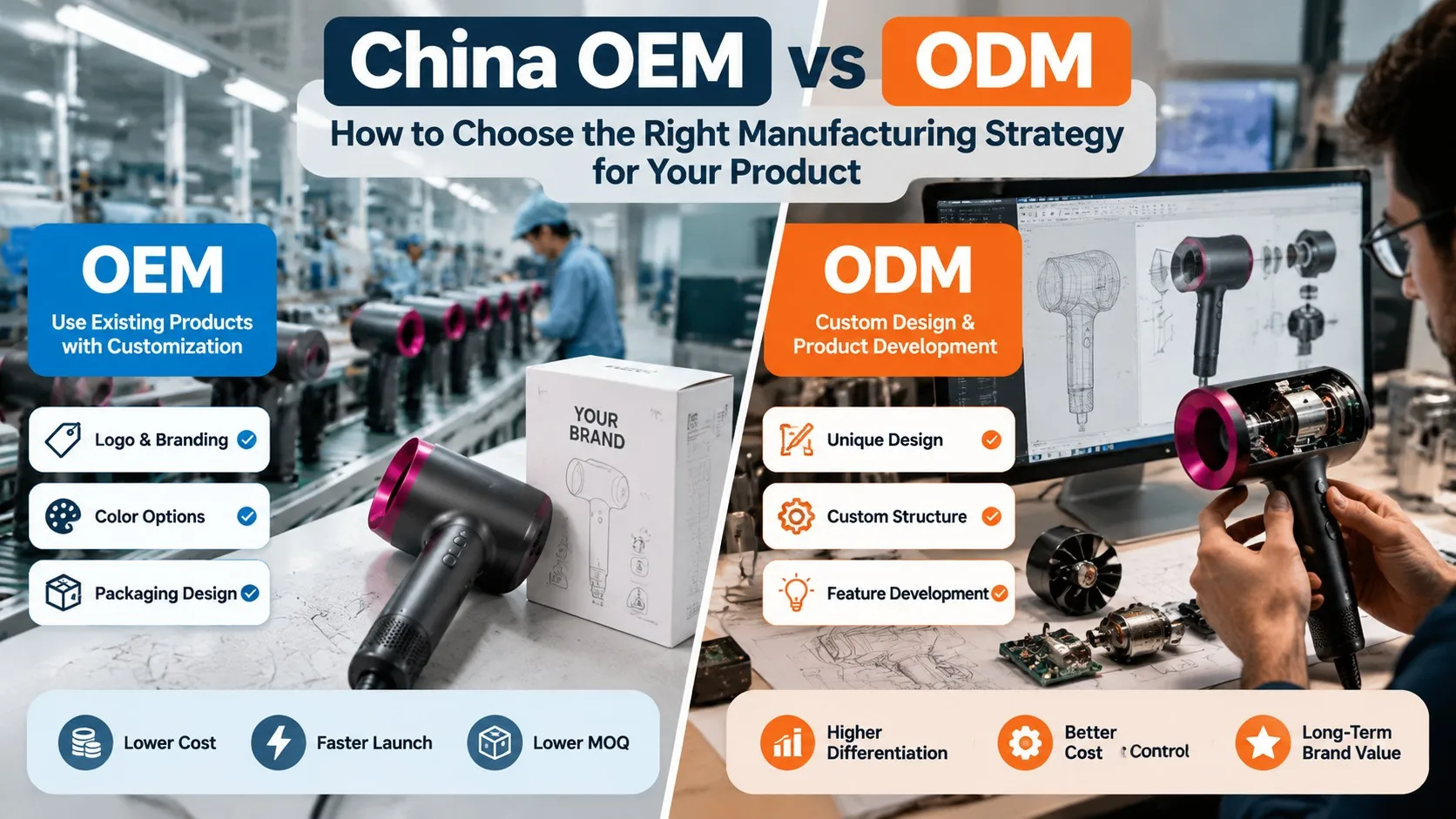
Fig 1. Comprehensive breakdown comparing OEM (existing tooling customization) vs. ODM (custom engineering & industrial design).
2. What Is OEM Manufacturing?
In China's manufacturing ecosystem, OEM (Original Equipment Manufacturing) means the factory owns the existing industrial tooling, internal mechanical architecture, and verified PCBA control boards. You purchase their established platform and customize specific brand-facing elements:
- Silk-screen, laser-etched, or pad-printed brand logos
- Custom Pantone / CMF (Color, Material, Finish) surface coatings
- Retail packaging (color box, blister tray, instruction manual)
- Minor accessory bundles (nozzle attachments, USB cables, travel pouches)
The OEM Workflow:
Factory Existing Tooling → CMF / Logo Customization → Mass Production (30–60 Days) → Market Launch
Advantages of OEM:
- Zero Tooling Investment: Launch without $10k+ mold expenses.
- Rapid Speed-to-Market: Production ready in 30–60 days.
- Low Initial MOQs: Often 500–1,000 units per batch.
Limitations of OEM:
- Zero Defensibility: Competitors can buy the identical tool.
- Price Pressure: Margin depends purely on marketing and PPC.
- Fixed Internal Specs: Cannot alter internal motor or PCB structure.
3. What Is ODM Manufacturing?
ODM (Original Design Manufacturing) involves collaborating with a capable manufacturer or hardware engineering studio to develop, modify, or create a proprietary product structure from the ground up:
- Industrial Design (ID): Custom ergonomic geometry, proprietary aesthetics, and bespoke mold cavities.
- Mechanical Engineering (MD): Custom internal airflow ducts, structural snap-fits, and thermal heat sink routing.
- Electronic Hardware: Customized PCBA schematics, motor firmware tuning, and smart Bluetooth/IoT integration.
The ODM Workflow:
Market Spec → ID & 3D Modeling → Rapid Prototyping → Tooling & DFM → Pilot Run → Production (3–9 Months)
Advantages of ODM:
- Defensible IP & Moat: Proprietary molds protect against copycats.
- Higher Margin Multipliers: Command premium DTC retail pricing.
- BOM Optimization: Select exact tier-1 components for lower failure rates.
Limitations of ODM:
- Upfront Tooling Capital: Mold costs range from $3,000 to $30,000+.
- Longer Lead Time: Development and mold trials require 3–9 months.
- Higher Production MOQs: Factories require 2,000–5,000 units.
4. Comprehensive OEM vs. ODM Matrix
5. Which Strategy Fits Your Brand Stage?
Stage 1: Market Validation (New Brands & Sellers) → Start with OEM
If you are testing a new category, source 1,000 units of a high-quality existing factory model. Validate customer acquisition costs (CAC), collect real user feedback, and prove commercial velocity before investing capital into custom tooling.
Stage 2: Category Scaling (Growing DTC & Amazon Brands) → Transition to ODM
Once monthly unit volume exceeds 2,000+ units, transition to ODM. Modify exterior ergonomics, upgrade critical components (e.g. brushless motors or high-capacity cells), and secure exclusive distribution rights in your target territory.
Stage 3: Market Leadership (Established Brands) → Proprietary Custom R&D
Develop ground-up bespoke hardware backed by utility patents and dedicated assembly line tooling to establish insurmountable competitive moats against market copycats.
6. 3 Common Mistakes When Selecting Manufacturing Models
Mistake 01
Premature Tooling
Spending $25k on custom tooling before proving product-market fit or understanding true customer pain points.
Mistake 02
Ignoring Product Spec
Relying on the factory's default component BOM without auditing battery cell grades or motor duty cycles.
Mistake 03
Over-Engineering
Adding complex microprocessors or smart app connectivity that inflates BOM costs without driving conversion.
7. How BaiSourcing Bridges OEM & ODM Hardware Execution
Located in China's prime manufacturing heartland (Ningbo/Shenzhen), BaiSourcing guides global brands from initial concept definition to volume delivery:
- Product Discovery & Teardowns: Dissect market leaders and evaluate existing public molds before spending development capital.
- Bottom-Up BOM Cost Modeling: Right-size components and eliminate non-value-add features to protect margins.
- OEM/ODM Factory Matching: Pair your product with verified tier-1 specialized factories that have proven mass-production experience.
- Tooling, DFM & Quality Control: On-site Golden Sample sign-off, mold trial inspection (T1/T2), and pre-shipment AQL quality control.
8. Explore Related Sourcing Due Diligence Guides
Quotation Audit
How to Review a Supplier Quote: A Complete BOM Audit Guide →
Learn how to evaluate supplier quotations with real BOM cost modeling.
Cost Reduction
How to Reduce Product Costs in China Without Sacrificing Quality →
Discover value engineering and structural optimization strategies.
Ready to Define Your China Manufacturing Strategy?
Send us your product concept, target unit price, or competitor reference. BaiSourcing will evaluate OEM vs. ODM feasibility, estimate real tooling expenses, and connect you with verified factory partners.