
Executive Summary: Finding an electric toothbrush manufacturer in China is relatively easy, but securing consistent mass-production quality requires looking far past golden samples. This guide outlines 7 non-negotiable procurement checks—from BOM verification and motor acoustic validation to battery cycle consistency and sealing IP-tests—to protect your brand before issuing a deposit.
Introduction: A Good Sample Doesn't Guarantee a Good Shipment
Finding an electric toothbrush manufacturer in China is relatively easy. Finding a supplier that can consistently deliver products meeting your specifications is much harder.
Many buyers start by comparing factory prices, product designs, and minimum order quantities (MOQs). These factors matter, but they don't tell the whole story.
A well-finished sample does not necessarily prove that the manufacturer uses consistent components, follows reliable production processes, or can maintain the same quality across multiple production batches.
For electric toothbrushes, performance and reliability depend on several interconnected elements, including the motor, battery, printed circuit board (PCB), brush head, sealing structure, charging system, and assembly quality.
Before placing an order, buyers should evaluate not only the product itself but also the manufacturer's ability to control its quality.
Here are seven checks to include in your electric toothbrush sourcing process.
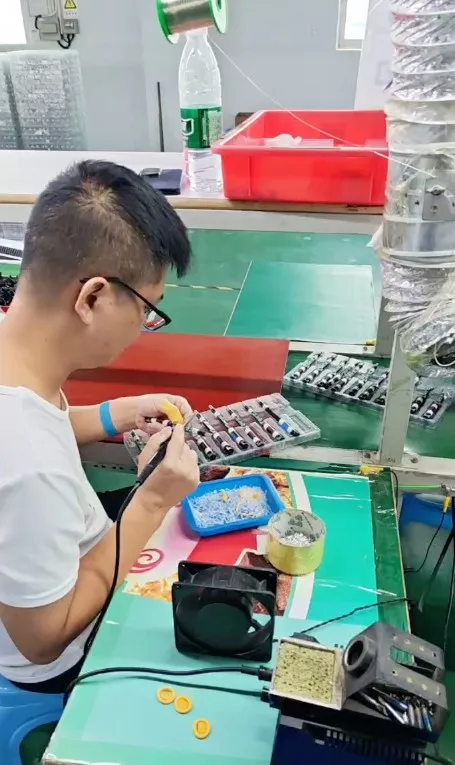
Figure 1: On-the-ground factory inspection: Reviewing manual soldering, wire harness routing, and battery assembly on an electric toothbrush production line in Guangdong, China.
1. Verify the BOM and Key Components
The bill of materials (BOM) is one of the most important documents to review when evaluating an electric toothbrush supplier.
Two products can look almost identical while using different internal components. These differences may affect performance, durability, and manufacturing consistency.
Ask the manufacturer for a BOM that identifies the main components and their specifications.
Key items to check include:
- Motor: Motor type (magnetic levitation sonic vs eccentric rotating), operating specifications, vibration performance, and noise.
- Battery: Battery chemistry (standard Li-ion 14500 vs NiMH), rated capacity (mAh), supplier specifications, and charging characteristics.
- PCB: Main control functions, charging circuit, and relevant protection features.
- Brush head: Bristle material (e.g. DuPont Tynex vs generic nylon), head construction, attachment mechanism, and replacement compatibility.
- Charging system: Charging interface (Type-C direct vs inductive wireless base), power requirements, and compatibility with the intended market.
- Housing and seals: Materials (ABS/PC), assembly design, and features relevant to water resistance.
Do not rely solely on descriptions such as "high-quality motor" or "long-lasting battery." Request identifiable specifications and supporting documents.
Where appropriate, compare the BOM against the physical sample and confirm that the components approved during sampling will also be used in mass production.
📺 Field Video: Looking for an electric toothbrush supplier in China?
Watch on YouTube2. Evaluate the Motor and Actual Brushing Performance
The motor is a key factor in an electric toothbrush's performance, but its specifications alone do not determine the final user experience.
Depending on the product design, an electric toothbrush may use a sonic vibration mechanism or an oscillating-rotating mechanism. Buyers should evaluate the selected technology against their target price, market positioning, and performance requirements.
During sample evaluation, check:
- Whether vibration feels consistent during operation under brushing pressure.
- Whether excessive acoustic noise or uncomfortable hand handle vibration occurs.
- Whether performance changes as the battery discharges.
- Whether the brush head remains securely attached during use.
- Whether the product performs consistently across multiple samples.
If the supplier advertises a particular vibration frequency (e.g., 38,000 VPM) or operating mode, ask for supporting technical specifications and acoustic test results.
Avoid selecting a motor based only on a headline specification. The motor, control electronics, mechanical structure, and brush head work together to determine the final performance.
For private-label products, define measurable acceptance criteria rather than relying on subjective descriptions such as "powerful" or "premium."
3. Check Battery Performance and Charging Reliability
Battery-related issues can lead to customer complaints, returns, and warranty claims.
A supplier's stated battery capacity is only one part of the evaluation. Actual runtime depends on power consumption, operating mode, battery condition, and the product's control system.
Before approving a sample, verify:
- The battery's rated capacity and supporting specifications (UN38.3, MSDS reports).
- Actual operating time under a defined test procedure (e.g. 2 minutes x 2 times per day).
- Charging behavior, temperature rise during charging, and charging completion auto-cutoff.
- Whether the product operates consistently after repeated charging cycles.
- Whether the battery and charging system have appropriate protection features (OVP, OCP, SCP).
- Whether the supplied battery documentation matches the actual component inside the unit.
For products intended for repeated daily use, establish a practical runtime requirement based on the target market and expected usage.
For mass production, request relevant charging, battery-cycle, and reliability test records. Confirm that the testing method and results apply to the actual product configuration.
4. Verify Water-Resistance Design and Testing
Electric toothbrushes are routinely exposed to water, toothpaste, and wet bathroom environments. Water resistance is therefore an important design and quality consideration.
However, an enclosed housing does not automatically mean a product is waterproof.
Performance depends on the housing structure, seals, joints, charging interface, material selection, and assembly process.
Ask the manufacturer:
- What water-resistance level is the product designed to meet (e.g. IPX7)?
- Which test method and acceptance criteria are used?
- Are test results available for the specific model?
- How are sealing components and assembly quality controlled?
- Are water-resistance checks conducted 100% during production or only during initial product development?
Where an IP rating or another water-resistance claim is made, request the corresponding test evidence and verify that it applies to the exact model and configuration being purchased.
Also confirm whether the charging design introduces additional requirements. A product with a USB-C charging port may need different design and validation considerations from one using inductive contact charging.
Water-resistance testing should be performed using a defined procedure. Informal exposure to running water is not a substitute for an appropriate pressure-decay air-leak test.
5. Inspect the Factory's Quality Control Process
A factory's quality management capability is more important than the size of its showroom or the number of workers on the production floor.
The key question is whether the supplier can identify defects, control production variables, and prevent the same problems from recurring.
When evaluating an electric toothbrush manufacturer, examine three stages of quality control:
- Incoming quality control (IQC): How does the factory verify incoming motors, batteries, PCBs, brush heads, and housing components? Are specifications checked against approved requirements?
- In-process quality control (IPQC): How are assembly quality, soldering joints, charging performance, functional operation, and sealing characteristics monitored during production?
- Final quality control (FQC / OQC): What checks are completed before shipment? How are defective units identified, recorded, and handled?
Ask for relevant inspection procedures, actual test records, defect-handling procedures, and sample inspection reports.
If possible, observe the production and inspection processes directly. Compare what the factory says it does with the records and practices you can verify.
6. Confirm Sample-to-Batch Consistency
One of the most common sourcing risks is a difference between the approved sample and the products delivered in bulk.
The sample may use one battery, motor, or PCB configuration, while the mass-production version uses an alternative component. Changes may also occur in housing materials, brush heads, assembly processes, or packaging.
These differences are not always obvious from the outside.
To reduce this risk, establish a formal sample approval process before production.
Your approval records should identify:
- The approved product model and revision.
- The critical component specifications.
- The agreed functional and performance requirements.
- The appearance, dimensions, and packaging requirements.
- The inspection methods and acceptance criteria.
Retain an approved reference sample, often called a golden sample, and document the agreed specifications.
Before mass production, confirm that the factory's production BOM matches the approved version. During inspection, verify the delivered goods against the same requirements.
The objective is not simply to approve a good sample. It is to establish a repeatable standard for every production batch.
7. Verify Compliance, MOQ, Lead Time, and Supplier Capability
Technical quality is only one part of supplier selection. The manufacturer must also meet your commercial and market-entry requirements.
Check Market-Specific Compliance
Requirements depend on the destination market, product configuration, and claims made by the supplier.
Ask for the applicable documentation covering electrical safety (CE, FCC), electromagnetic compatibility, battery safety and transportation (UN38.3, MSDS), and bristle food-contact compliance (FDA, LFGB).
Verify that the documents match the actual manufacturer, product model, and configuration. Do not assume that a certificate for a similar product automatically covers the unit you intend to purchase.
Confirm Commercial Terms
Before placing an order, clarify:
- Minimum order quantity (MOQ) for custom colors and custom packaging.
- Sample cost and sample lead time.
- Mass-production lead time (typically 35–45 days).
- Payment terms and delivery conditions (FOB / EXW).
- Replacement brush-head availability, compatibility, and ongoing replenishment lead times.
- Spare parts, after-sales support, and warranty responsibilities.
Electric Toothbrush Supplier Evaluation Checklist
Before approving a supplier, use this checklist to organize your findings:
| Evaluation Area | What to Verify & Test | Key Standard |
|---|---|---|
| BOM | Identifiable specifications for critical components (MCU, motor, cell) | No unapproved swaps |
| Motor | Operating performance, vibration consistency under load, and noise | <60 dB acoustic level |
| Battery | Rated capacity, actual discharge runtime, and safety PCM protection | UN38.3 + MSDS verified |
| Water Resistance | Applicable test method, pressure-decay leak testing, and evidence | IPX7 certified |
| Quality Control | Incoming (IQC), in-process (IPQC), and final (FQC) inspection procedures | ISO 9001 factory system |
| Sample Approval | Documented specifications, change-control process, and Golden Sample | 3-way sealed Golden Sample |
| Compliance | Applicable market requirements (CE, FCC, RoHS, FDA food-contact bristles) | Matching test reports |
| Commercial Terms | MOQ, mass-production lead time, payment terms, and delivery conditions | Clear purchase agreement |
| Replacement Parts | Brush-head compatibility, continuous availability, and replenishment times | Standardized head mold |
| Defect Management | Inspection records, corrective action reports (CAR), and rework rules | Clear warranty terms |
Final Thoughts: Choose a Supplier That Can Prove Its Capability
Selecting an electric toothbrush manufacturer in China should involve more than comparing quotations and reviewing product photographs.
The most reliable sourcing decisions combine component verification, sample testing, production-process evaluation, and clearly documented acceptance criteria.
A manufacturer does not become reliable simply because it has a large factory or offers a competitive price. Its capabilities must be demonstrated through specifications, test records, production controls, and consistent results.
Before placing an order, ask yourself three questions:
- Do I know exactly what components and specifications I am buying?
- Do I have evidence that the product meets my performance and quality requirements?
- Can the supplier demonstrate that mass production will follow the approved standard?
If any answer is unclear, resolve the issue before committing to mass production.
Related Sourcing & Procurement Guides:
- Electric Toothbrush Teardown: Inside a 22 RMB Sonic Toothbrush BOM Breakdown →
- Electric Shaver OEM Sourcing Guide: Rotary vs Foil BOM Cost Comparison →
- Why 18650 Batteries Have a 5X Price Difference: Sourcing Guide & Cost Breakdown →
- Factory or Trading Company? How to Identify Your Real Supplier in China →
- How to Source Kitchen Products from China: A Complete Guide for Importers →
Joe Bai
China Sourcing Specialist & Hardware Engineering Consultant
Joe Bai specializes in BOM cost auditing, factory evaluations, and precision manufacturing across Chinese industrial hubs. He helps global brands, importers, and hardware startups navigate supplier risks and build reliable supply chains in China.
Need Help Evaluating an Electric Toothbrush Supplier?
BaiSourcing helps international buyers conduct component-level teardowns, BOM cost auditing, factory quality assessments, and pre-shipment inspections across China. Avoid costly manufacturing mistakes before transferring your deposit.