Why Do 18650 Batteries Have a 5× Price Difference? A Real Cost Breakdown Behind Chinese Battery Sourcing
Why do some 18650 batteries cost $0.80 while others cost $4.50+? We teardown battery packs to analyze cell materials, BMS protection circuits, assembly costs, and buyer verification steps.

Executive Summary: The 5× Battery Price Reality
When sourcing battery-powered consumer electronics from China—such as cordless vacuums, personal fans, beauty devices, and power tools—procurement managers frequently encounter jarring quotation disparities: one supplier quotes a 2-cell 18650 pack at $1.20, while another quotes $5.80 for ostensibly identical specifications (18650, 2600mAh, 3.7V/7.4V Li-ion). On a 50,000-unit production run, this $4.60 gap represents $230,000 in upfront procurement cost. In this teardown report, BaiSourcing physically disassembles entry-level, mid-tier, and industrial-grade 18650 battery packs to reveal the hidden engineering drivers behind this 5× spread: cell chemistry grades (Grade A vs. Recycled B-Grade), BMS circuit protection integrity, pure nickel vs. steel spot-welding, and automated internal resistance (IR) sorting.
Step 1. The Procurement Dilemma: Identical Specs on Paper, Total Disparity Inside
On supplier specification sheets, factory quotations appear virtually indistinguishable. Both suppliers check every standard marketing box:
- Form Factor: Standard cylindrical 18650 (18mm diameter × 65mm height).
- Nominal Capacity: Stated as 2000mAh, 2600mAh, or 3000mAh.
- Nominal Voltage: 3.7V per cell (7.4V / 11.1V for multi-cell series packs).
- Label Certifications: Printed CE, RoHS, and FCC marks.
However, when these products enter mass distribution on Amazon, TikTok Shop, or European retail shelves, the low-cost battery packs experience up to 14.8% customer return rates due to premature capacity loss, thermal shutdown, or zero-voltage dead cells, while premium packs maintain under 0.3% return rates.
Step 2. Physical Teardown Evidence: What Is Inside a Pack?
To understand where the cost differences originate, we opened and benchmarked three distinct price tiers of 18650 cell packs:
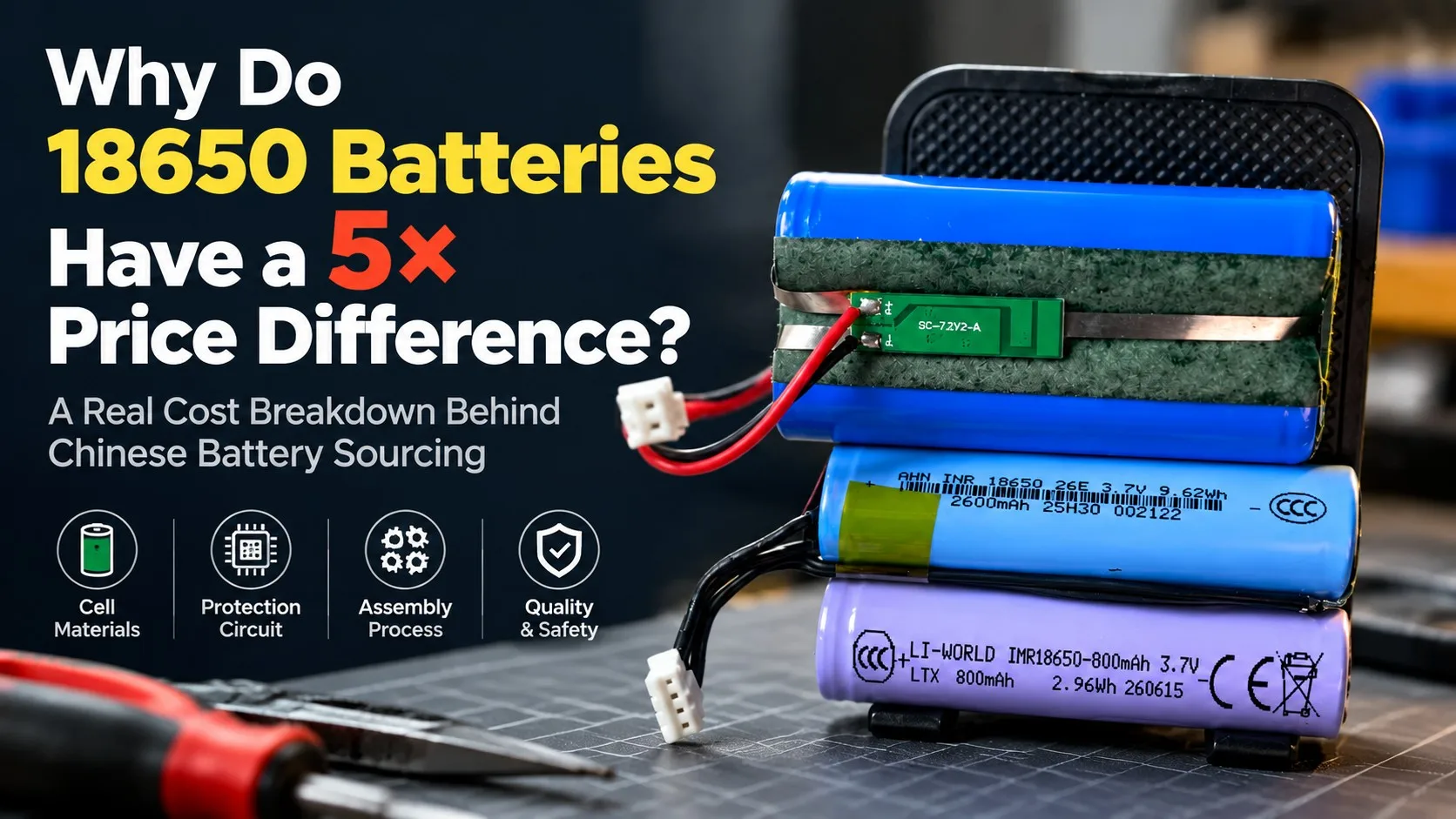
Step 3. Deep Component Analysis: 4 Hidden Cost Drivers
1. Cathode Chemistry & Cell Grade (55% to 65% of Total Pack Cost)
The letters on an 18650 wrapper (INR, IMR, ICR, NCA) represent the core chemical formulation of the cathode material:
| Chemistry Type | Cathode Formulation | Discharge & Cycle Characteristics | Cell Cost Range (USD) |
|---|---|---|---|
| ICR (LiCoO2) | Lithium Cobalt Oxide | High energy density, lower thermal stability, 0.5C–1C low discharge | $0.30 – $0.65 (Generic) |
| IMR (LiMn2O4) | Lithium Manganese Oxide | High thermal safety, moderate capacity (800–1800mAh), 3C–5C discharge | $0.40 – $0.90 |
| INR (LiNiMnCoO2) | Nickel Manganese Cobalt (NMC) | Best balance: high capacity (2600–3500mAh), 500+ cycles, 5C–10C burst | $1.20 – $2.60 (Brand Tier) |
The Recycled Cell Trap: Low-cost suppliers often source dismantled "B-grade" or recycled 18650 cells harvested from decommissioned EV battery packs or e-bike modules. These cells are re-wrapped in clean PVC sleeves and sold for as little as $0.20–$0.35 each. While they register 3.7V on a digital multimeter, their internal resistance (IR) frequently exceeds 80mΩ (vs. <20mΩ for fresh Grade-A cells), generating dangerous heat under continuous load.
2. Battery Management System (BMS) Protection Circuit
The BMS PCB mounted on top of the pack (such as the SC-72V2-A board in Figure 1) is the primary safety line:
- Budget Pack ($0.10–$0.15 BMS): Uses a generic domestic single-IC controller without reverse-polarity protection, bare minimum MOSFETs that overheat during fast charging, and no thermal sensor (NTC thermistor).
- Tier-1 Pack ($0.65–$1.20 BMS): Incorporates dedicated Seiko or Texas Instruments protection ICs, dual low-RDS(on) MOSFETs, independent cell balancing, and an in-pack NTC temperature probe that halts charging if cell temperatures exceed 45°C.
3. Spot-Welded Nickel Strips vs. Nickel-Plated Steel
To connect cells in series or parallel, factories use spot-welded metal strips. Pure nickel strips (99.6% purity) cost $0.15–$0.25 per pack and offer near-zero electrical resistance and zero corrosion over time. Low-cost assemblers substitute nickel-plated steel strips ($0.03), which have 4× higher internal resistance and rust when exposed to ambient humidity, causing voltage drops and localized heating.
Step 4 & 5. Real BOM & Factory Manufacturing Cost Breakdown (2S1P 7.4V Pack)
Below is the itemized cost breakdown of a standard 2-cell (2S1P 7.4V 2600mAh) battery pack across three manufacturing grades:
| Cost Element / Sub-Component | Budget / Recycled Tier | Standard OEM Tier (Domestic Grade A) | Premium Tier (EVE / BAK / LG Cells) |
|---|---|---|---|
| 18650 Cells (2 Units, 2600mAh) | $0.60 ($0.30/ea recycled) | $2.40 ($1.20/ea Grade A) | $4.20 ($2.10/ea Tier-1) |
| BMS Protection Board & Wiring | $0.12 (No NTC sensor) | $0.45 (Dual MOS + NTC) | $0.85 (Seiko IC + Balance) |
| Interconnect Strips & Insulation | $0.04 (Nickel-plated steel) | $0.15 (Pure nickel + Barley paper) | $0.25 (Pure nickel + FR-4 bracket) |
| Output Wires & JST / Molex Connector | $0.06 (Standard PVC wire) | $0.15 (UL1007 22AWG) | $0.25 (Silicone flexible cable) |
| Total Raw Material (BOM) Cost | $0.82 | $3.15 | $5.55 |
| + Automated Cell Matching & Spot Welding | $0.08 (Manual spot-weld) | $0.30 (Semi-auto welding) | $0.55 (CNC auto-weld + laser) |
| + Cycle Aging & Resistance Grading | $0.02 (Voltage check only) | $0.15 (1-cycle capacity test) | $0.35 (Full capacity grading) |
| + Packaging & UN38.3 Batch Compliance | $0.05 (Plastic bag bulk) | $0.18 (Anti-static tray + Box) | $0.35 (UN-certified dangerous box) |
| Estimated Ex-Factory Cost (EXW) | $0.97 (High Risk) | $3.78 (Optimal B2B Tier) | $6.80 (Industrial Grade) |
Step 6. Buyer Sourcing Checklist: 5 Non-Negotiable Battery Audits
-
✓
1. Demand Cell Manufacturer Name & Batch Codes: Avoid generic terms like "Grade A 18650". Specify reputable Chinese tier-1 brands (EVE Energy, BAK, Lishen, Sunpower) or international brands (LG, Samsung SDI, Panasonic).
-
✓
2. Require In-Line Internal Resistance (IR) Logs: Ensure the factory groups cells in multi-cell packs within a strict tolerance (ΔIR < 3mΩ and ΔCapacity < 20mAh) to avoid unbalanced cell degradation.
-
✓
3. Inspect Spot-Weld Penetration & Pure Nickel Content: Scratch test the connection strips and use copper sulfate solution to verify pure nickel vs. nickel-plated steel. Spot welds should have clean dual indentation without burn-through holes.
-
✓
4. Audit UN38.3 & MSDS Transport Certification Authenticity: Verify that the UN38.3 test summary report is issued by an accredited laboratory (e.g., Pony Testing, CQC, TUV) specifically listing your battery model and cell manufacturer.
-
✓
5. Verify Thermal Cut-off (NTC) Circuit Functionality: Conduct a physical charging cutoff test: disconnect or heat the NTC thermistor to verify that the BMS immediately terminates charging current.
Pre-Audited Battery-Powered Hardware Platforms
Explore our verified consumer hardware platforms with certified Grade-A lithium cells, dual-MOSFET BMS protection, and UN38.3 transport compliance:
Bluetooth Audio Sports Glasses
Dual high-density polymer cells with dedicated Seiko battery protection IC and 8-hour continuous playback.
8-in-1 Premium Air Styler (Model: RFS013)
Audited thermal management with dual NTC temperature safety monitoring and high-speed BLDC driver board.
BaiSourcing Engineering Benchmark: 18650 Battery Pack Sourcing
Cell Grade Traceability: 9.6/10 · BMS Thermal Safety: 9.4/10 · Spot Weld Integrity: 9.1/10
Need Independent Battery Teardown or Supplier Quote Verification?
Don't risk costly safety recalls or high Amazon return rates. Send your supplier's battery sample or quotation to BaiSourcing for an independent physical teardown, cell capacity grading, and BOM cost analysis.