
B2B Procurement & Manufacturing Insight
When sourcing grooming hardware from China, many international buyers ask: “Can you offer a lower unit price?” But the more critical question is: “What exactly am I paying for?” A quotation is only a number—without verifying the internal BOM structure, buyers cannot assess whether a supplier's price matches real product value or conceals dangerous quality shortcuts.
1. Beyond the Surface: Why Appearance Misleads Sourcing Decisions
At BaiSourcing, we analyze consumer hardware through empirical teardown analysis and BOM cost auditing. Today, we disassemble a popular retro vintage-style electric hair clipper retailing at approximately $5.00 USD (≈ RMB 35) across global e-commerce channels.
From the outside, this product projects a classic, heavy-duty barbershop look:
- Vintage bronze/brass electroplated patina
- Detailed dragon-pattern decorative engraving
- Substantial metallic in-hand weight
- Compact, cylindrical ergonomic silhouette
However, physical disassembly reveals an ultra-lean, cost-optimized internal architecture designed to hit high-volume promotional price points. Understanding this BOM breakdown is essential for brands deciding whether to source entry-level SKUs or invest in premium upgrades.
2. Empirical Teardown Evidence & Visual BOM
Below is the complete component-by-component engineering teardown of the $5.00 retail hair clipper, detailing raw material specs, motor configurations, and electroplating finishes.
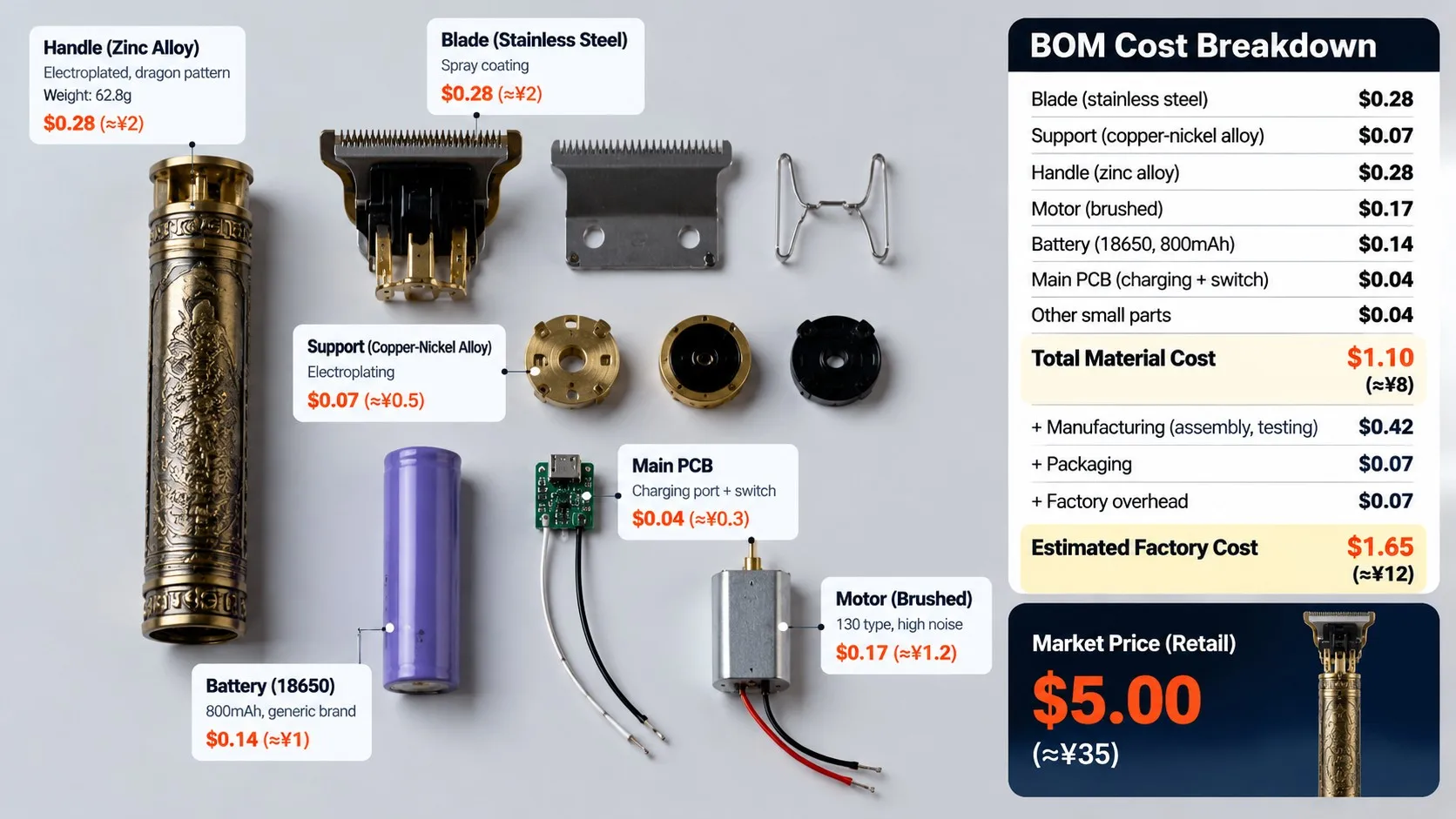
Fig 1. Full component teardown & manufacturing cost breakdown of a $5.00 retail vintage electric hair clipper.
3. Component-by-Component Cost & Quality Breakdown
A. Stainless Steel Cutting Blade Assembly (≈ $0.28 USD / ¥2.00)
The cutting unit consists of a stamped stainless steel moving blade, stationary T-blade, and spray-coated tension spring.
- Performance Impact: Blade precision and heat treatment dictate shearing efficiency and hair-pulling resistance.
- Sourcing Warning: At $0.28, standard 3Cr13 stamped steel is used. Professional-grade clippers ($15+ retail) require powdered metallurgy carbon steel or ceramic-coated blades with Rockwell hardness ≥58 HRC.
B. Structural Support Bracket (≈ $0.07 USD / ¥0.50)
A small copper-nickel electroplated alloy bracket secures the motor shaft eccentric bearing to the blade drive guide:
- Ensures mechanical alignment under continuous high-frequency oscillation.
- Low-tier factories often substitute unplated zinc brackets that wear down rapidly, causing blade rattle after 20 operating hours.
C. Engraved Handle & Housing (≈ $0.28 USD / ¥2.00)
The decorative cylinder (62.8g) utilizes die-cast zinc alloy with an electroplated antique bronze finish:
- Appearance vs Reality: Despite the "solid brass" visual cue, zinc alloy is standard across China manufacturing to balance weight feel with low raw material cost.
D. 130 Carbon-Brush DC Motor (≈ $0.17 USD / ¥1.20)
A standard 130-size carbon-brush DC motor drives the cutting mechanism:
- Trade-offs: Low unit cost ($0.17) but higher acoustic noise (>68 dB), noticeable operating heat, and a rated lifespan of approx. 150–200 hours.
- Upgrade Pathway: For salon or mid-tier DTC positioning, upgrading to a 180-size motor or brushless DC motor ($1.20–$2.50) dramatically enhances torque and product longevity.
E. Main Control PCB & Switch (≈ $0.04 USD / ¥0.30)
An ultra-minimalist single-sided PCB housing a Type-C / USB charging port, power switch, and basic charge-limiting resistor:
- No active microprocessor, over-charge IC, or constant-current regulation.
F. 18650 Rechargeable Battery (≈ $0.14 USD / ¥1.00)
A generic unbranded 18650 cylindrical lithium cell rated at approx. 800mAh:
- Procurement Audit Essential: Generic 800mAh cells offer short runtime (35–45 minutes). Brands selling into North America or Europe should specify branded A-grade cells (e.g. 1200mAh–2000mAh) with full UN38.3, CE, and MSDS compliance documentation.
4. Verified Bill of Materials (BOM) Cost Table
Based on mass-production tooling metrics in Ningbo and Wenzhou hardware clusters (MOQ 3,000 units), here is the verified component breakdown:
5. Manufacturing, Labor & Factory Overhead
Adding manual assembly line labor, blade alignment testing, retail blister packaging, and factory margin:
6. What Does This Mean for Brand Procurement Managers?
The goal of BOM cost analysis is not simply racing to the bottom price. It is about aligning internal product specifications with your brand's market positioning and return-rate tolerances.
1. Does the Specification Match the Price?
A supplier quoting $3.50 for what appears to be the same clipper is not necessarily overpriced—they may be quoting an authentic 1400mAh battery, a balanced 180 motor, and CNC-sharpened blades. Always audit component specs side-by-side.
2. Where Did the Factory Cut Costs?
Factories reduce quotations by swapping cell grades, thinning electroplated microns, or eliminating secondary QA run-in tests. Without physical teardowns, these hidden compromises only emerge after thousands of customer 1-star reviews.
3. Is the Product Positioned Correctly?
A $5 promotional clipper and a $30 barbershop tool may share identical exterior tooling. Internal component selection determines your brand equity, return rate, and long-term customer lifetime value.
7. Explore Verified Personal Care & Grooming Hardware
Explore our pre-vetted catalog of personal care grooming electronics from certified OEM/ODM manufacturers:

5-in-1 Electric Head Shaver & Grooming Kit (Model: GTJ026)
7D Floating Heads · Clipper Comb · IPX7
View Product Opportunity →
3D Floating Head Rechargeable Electric Shaver (Model: TXD029)
LED Display · 2000mAh Battery · Fast Charge
View Product Opportunity →Need a BOM Analysis for Your Product Before Sourcing from China?
Before transferring tooling deposits or signing volume purchase orders, contact BaiSourcing for a teardown-based cost evaluation and factory quotation verification.