
China remains the world's most agile consumer hardware manufacturing hub. But the primary sourcing challenge is not finding a supplier on Alibaba—it is verifying factory credibility, auditing true BOM costs, and guaranteeing mass production quality before transferring capital.
1. Finding a Supplier Is Easy. Finding the Right Partner Is Not.
From consumer electronics and small kitchen appliances to grooming hardware and outdoor gear, Chinese manufacturing clusters offer unmatched advantages:
- Hyper-mature sub-tier component supply chains (Shenzhen, Dongguan, Ningbo, Wenzhou)
- Flexible OEM private label and ODM custom tooling ecosystems
- Rapid rapid-prototyping and engineering sample turnarounds
- Extremely competitive volume manufacturing unit costs
Yet, countless overseas importers suffer painful losses by making purchasing commitments based purely on polished showroom photos, generic Alibaba Gold Supplier badges, and lowball initial quotations. A professional China sourcing framework requires looking past top-line quotes and understanding internal product engineering.
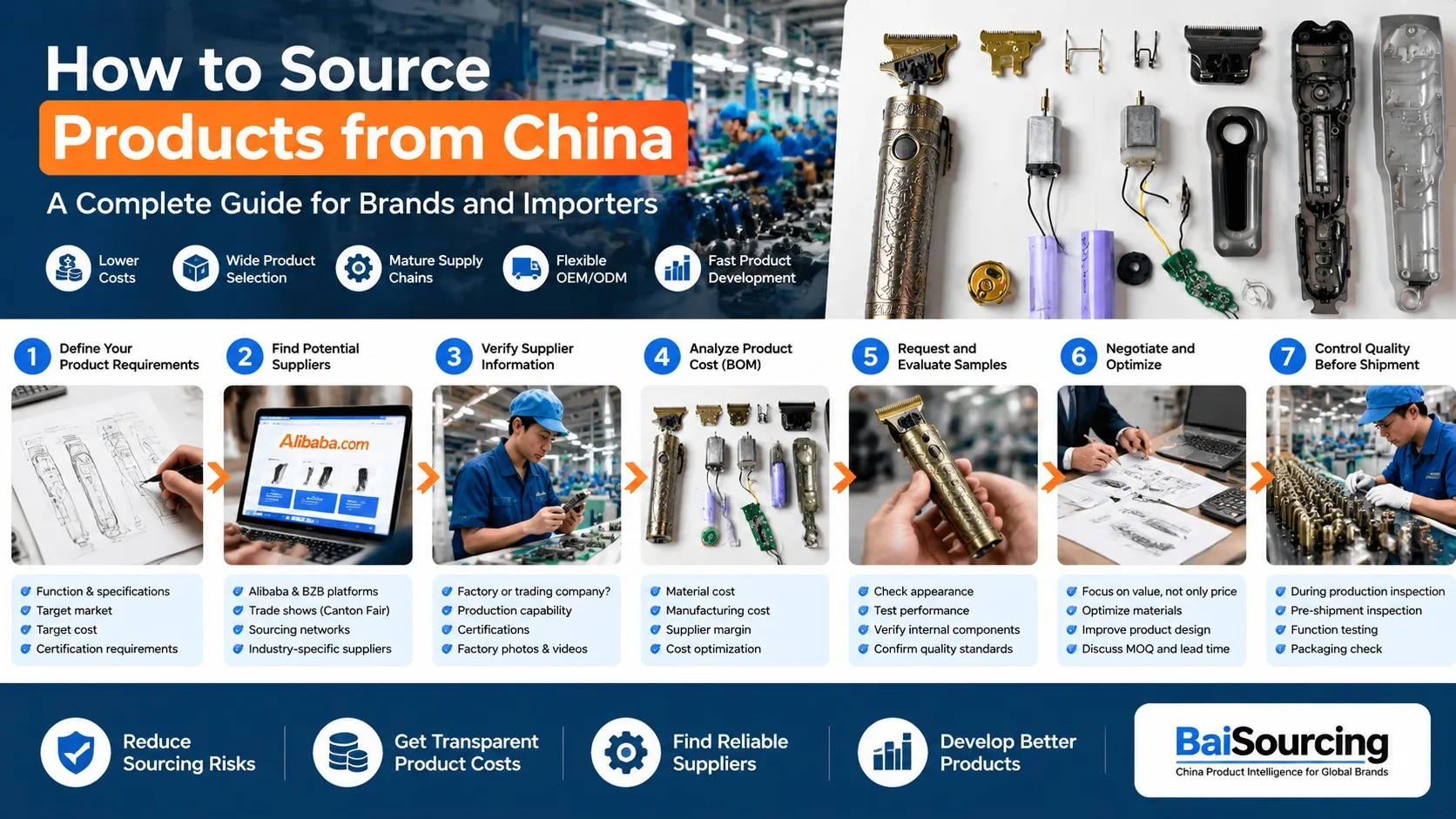
Fig 1. The complete 7-step China sourcing roadmap: from initial product definition to pre-shipment quality control.
2. The 7-Step China Sourcing Roadmap
Define Technical Product Specs & Target Unit Cost
Never ask a factory “How cheap can you make a portable fan?” Instead, specify exact operational parameters:
- Functional Specs: Battery chemistry (e.g. 2000mAh 18650 vs Li-polymer), motor type (BLDC vs brushed), airflow CFM, noise limit (<45dB), Type-C fast charging.
- Regulatory Compliance: US (FCC, UL), Europe (CE, RoHS, REACH, WEEE), Amazon FBA packaging standards.
- Target Factory Cost (EXW): Calculate reverse margins: a $39.00 retail SKU typically requires an EXW manufacturing target of $8.00–$11.00.
Filter & Screen Potential Chinese Suppliers
Source across multiple channels while mapping specialized industrial clusters:
- B2B Platforms: Alibaba, 1688.com, Made-in-China, Global Sources.
- Physical Trade Shows: Canton Fair (Guangzhou), Global Sources Consumer Electronics (Hong Kong).
- Regional Specialization: Shenzhen (Smart Electronics), Ningbo/Cixi (Small Home Appliances & Personal Care), Taizhou (Shavers & Oral Care), Yongkang (Hardware).
Verify Supplier Authenticity (Factory vs. Trading Entity)
Confirm whether the entity directly controls manufacturing lines or simply acts as a middleman markup:
- Audit their Chinese Business License (营业执照) for “Manufacturing / Processing” (生产/加工) in their Business Scope.
- Request unannounced live WeChat/WhatsApp video walkthroughs of SMT, tooling, and aging test workshops.
- Inspect catalog focus: genuine factories focus on cohesive product families, not 20 unrelated categories.
Perform Bottom-Up BOM Cost Audits
Deconstruct the supplier's quotation into verifiable component line items:
| Component Category | Shaver Teardown Example | Estimated Unit Cost |
|---|---|---|
| Housing & Structural Covers | Zinc alloy electroplated body + PC panel | $1.82 |
| Moving Blade Foil Head | Dual stainless steel cutter heads | $0.56 |
| Internal Motor & Battery | 130 Brushed Motor + 400mAh Li-ion pouch cell | $0.49 |
| PCBA & Small Hardware | Charging board, switches, springs, screws | $0.33 |
| TOTAL DIRECT MATERIAL BOM COST | $3.20 | |
| ESTIMATED FACTORY EXW COST (Inc. Labor & Overhead) | ≈ $5.20 | |
Sample Teardown & Physical Bench Testing
Never approve mass production based on external photos. Procure physical production samples and test:
- Cosmetics & CMF: Parting line alignment, mold flash, coating adhesion, assembly seam gaps.
- Functional Benchmarking: True battery mAh discharge capacity, decibel noise levels, operating temperature.
- Internal Disassembly: Check soldering quality, wire gauge thickness, and strain relief clamps.
Negotiate with Fact-Based Value Engineering
Negotiate based on structural design optimization rather than squeezing supplier margins:
- Standardize high-cost custom components around mature tier-1 catalog items.
- Consolidate multi-piece molded parts into unified snap-fit housings to lower assembly labor.
- Negotiate tiered price breaks tied to rolling 6-month PO forecasts.
Enforce Rigorous On-Site Quality Control (QC & AQL)
Quality defects discovered after ocean freight are fatal to brand economics. Establish multi-tier inspection protocols:
- Golden Sample Sign-Off: Retain mutually signed sealed production reference units in China.
- During Production (DUPRO): Inspect assembly lines when 20%–30% of the batch is completed.
- Pre-Shipment Inspection (PSI): Conduct MIL-STD-105E AQL Level II statistical inspections before releasing final balance payments.
3. 3 Costly China Sourcing Mistakes to Avoid
Mistake 01
Picking the Lowest Quote
Unrealistic low quotes always signal silent component downgrades and omitted QA testing.
Mistake 02
Blindly Trusting Claims
Claims like “100,000 RPM BLDC” or “5,000mAh battery” must be physically verified via laboratory testing.
Mistake 03
Skipping On-Site Audits
Releasing 100% balance payments before third-party pre-shipment container inspection.
4. How BaiSourcing Protects Your China Sourcing
Operating directly from our product teardown lab and factory audit center in Ningbo, BaiSourcing provides end-to-end supply chain transparency:
- Physical Teardown & BOM Audits ($299): X-ray component dissection and bottom-up factory cost calculation.
- On-Site Factory Audits ($499): Complete manufacturing capability, machinery verification, and ISO process audits.
- Product Discovery & OEM/ODM Development: Sourcing verified consumer electronics and managing contract manufacturing from sample to shipment.
5. Explore Our Core Sourcing Guides
Quotation Audit
How to Review a Supplier Quote: A Complete BOM Audit Guide →
Learn how to evaluate supplier quotations with real BOM cost modeling.
Strategy Guide
China OEM vs ODM: How to Choose the Right Strategy →
Understand tooling expenses, development lead times, and private labeling.
Ready to Source Products from China with Total Transparency?
Send us your product specification, supplier quotation, or target sample. BaiSourcing will audit factory capability, analyze internal BOM costs, and protect your manufacturing investment.