
Before you accept a Chinese factory quotation or transfer production deposits, understand what you are actually paying for. A lower price is not always a better deal—it often conceals downgraded components, thinner battery cells, or omitted quality assurance steps.
1. The Quotation Dilemma: Why Comparing Final Prices Fails
When sourcing hardware and consumer goods from China, many international buyers make the same fundamental mistake: they compare candidate suppliers solely by their top-line quotation number.
Supplier A Quotation
$8.50 / unit (FOB)
Includes branded cells, balanced motor, 100% QA run-in testing.
Supplier B Quotation
$7.20 / unit (FOB)
Looks identical on the surface. Lower unit price attracts buyers.
On a spreadsheet, Supplier B’s quote looks like an immediate 15% margin boost. But the critical question is: What is inside the product?
A lower factory quote almost never stems from "magic efficiency." In Chinese manufacturing clusters, raw materials and component markets are hyper-transparent. A $1.30 price gap typically comes from:
- Down-specced internal motor types (e.g. 130 carbon brush vs balanced 180 motor)
- Unbranded or recycled B-grade lithium battery cells
- Simplified PCB charging circuits without over-voltage or thermal cut-off ICs
- Substituted casing alloys (zinc electroplate vs solid aluminum extrusion)
- Eliminated secondary quality control and run-in aging tests
A product that fails after launch costs far more than the initial $1.30 "savings" in warranty claims, 1-star Amazon reviews, customer support tickets, and unsellable retail inventory.
2. What Is a BOM Audit?
A Bill of Materials (BOM) Audit is the disciplined engineering process of disassembling a product sample, cataloging every internal component and sub-assembly, determining exact raw material specs, and calculating bottom-up manufacturing costs against current China supply chain benchmarks.
Instead of asking a factory: “Can you make this cheaper?”, a professional buyer armed with a BOM audit asks: “Why is this component quoted at $0.80 when standard market pricing is $0.45?”
A Complete BOM Audit Verifies:
- Component Selection: Exact IC models, motor types, battery chemistry, and structural plastics.
- Material Grade & Weight: Precise alloy compositions, wall thicknesses, and surface finish microns.
- Manufacturing Processes: Tooling complexity, SMT assembly cycle times, and labor overhead.
- Cost Transparency: Verified EXW factory cost vs trading company markups.
- Cost Optimization Avenues: Engineering adjustments that lower unit cost without sacrificing durability.
3. Case Study: Deconstructing a $22.40 Electric Shaver
To demonstrate how a BOM audit works in practice, BaiSourcing engineers procured and disassembled a consumer electric shaver retailing at $22.40 USD (≈ RMB 159):
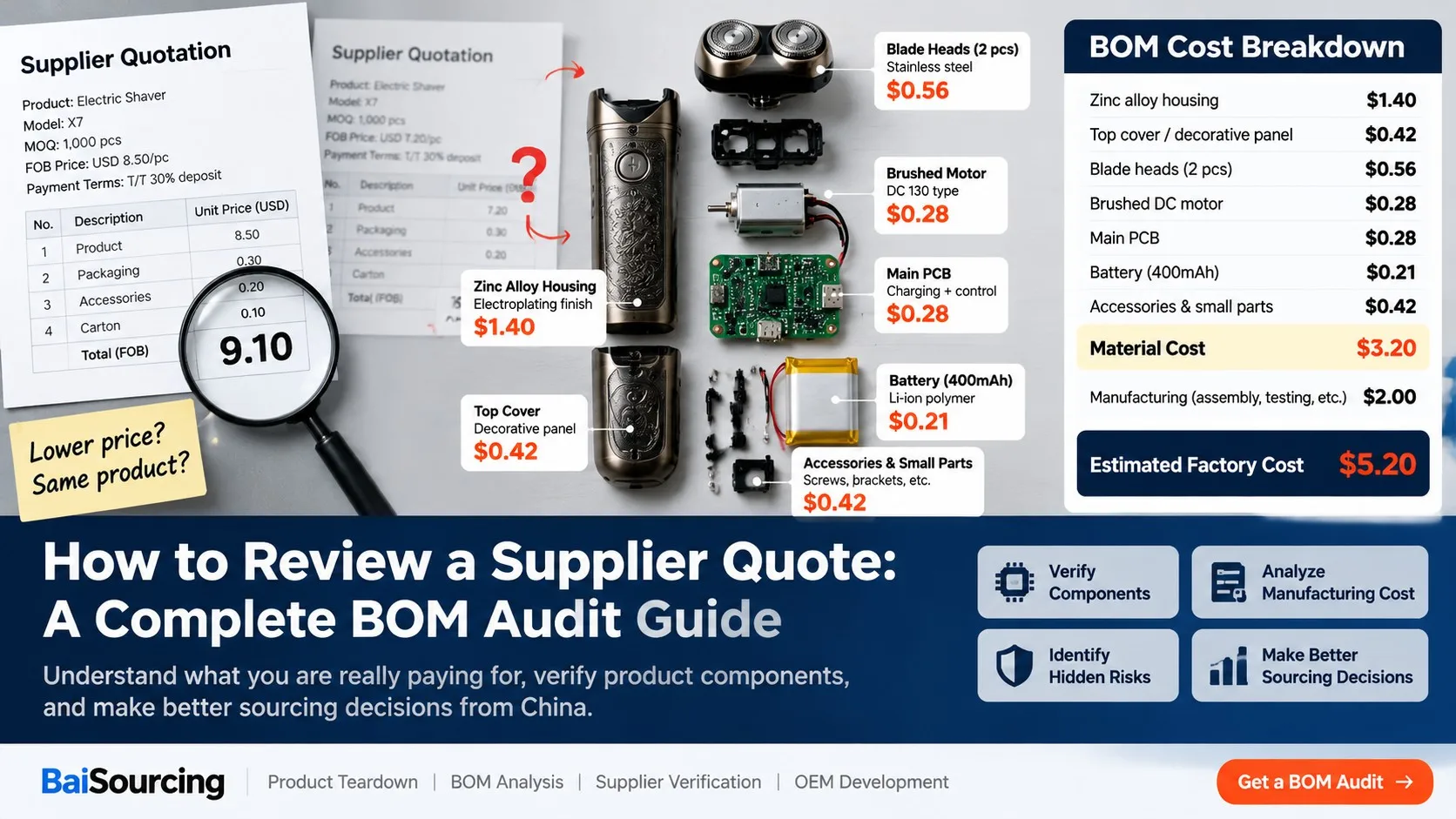
Fig 1. Real teardown analysis comparing supplier quotations against empirical component-level BOM costs.
BOM Breakdown & Factory Cost Analysis
What Does This Teardown Tell the Procurement Manager?
The product's external metallic housing creates an impression of high-end luxury. However, the internal motor ($0.28) and battery ($0.21) represent entry-level specifications.
If a buyer intends to retail this product at $35+ under an established brand name, they must upgrade the motor and battery to prevent early product fatigue. Conversely, if selling as an entry-level promotional item, the existing BOM structure is already dialed in. A BOM audit gives you the exact blueprint to make that strategic choice.
4. 5 Critical Areas to Audit in Any Supplier Quotation
1. Audit Active Components (Motors & Actuators)
Do not accept vague descriptions like "high-torque motor." Require the supplier to specify the motor frame size (e.g. 130 vs 180 vs 280), core material (copper winding vs copper-clad aluminum), RPM under load, operating decibels, and expected duty-cycle lifespan.
2. Verify Battery Chemistry & Protection ICs
Batteries represent the highest safety and regulatory risk in consumer electronics. Verify exact cell manufacturer, true measured capacity (mAh vs claimed), integrated BMS protection against over-charging/thermal runaway, and test report authenticity (UN38.3, IEC 62133, CE, MSDS).
3. Inspect Material Grades & Wall Thicknesses
A "metallic body" could be CNC aluminum, die-cast zinc alloy, or vacuum-metalized ABS plastic. Each material carries vastly different tooling expenses, thermal dissipation properties, and drop-test survivability.
4. Dissect Manufacturing Labor & Quality Control Overhead
Verify what quality assurance is baked into the price. Does the quotation include 100% functional testing, 4-hour aging room burn-in, salt-spray corrosion tests, and drop testing—or just basic cosmetic line inspection?
5. Compare Value-to-Market Fit, Not Raw Lowest Price
The winning product is rarely the cheapest one. Sustainable brand equity comes from balancing target retail price, return-rate targets (<2%), and long-term customer review scores.
5. The BaiSourcing BOM Audit Workflow
Operating directly from our engineering teardown lab in Ningbo, China, BaiSourcing provides transparent, independent product evaluation for global brands:
Step 01
Sample Intake & Teardown
We procure or receive competitor/supplier samples and perform physical disassembly down to the board level.
Step 02
Component Identification
We identify ICs, motor specs, battery chemistry, wall thickness, and sub-tier supplier origins.
Step 03
BOM Cost Modeling
We calculate true material and production costs against real-time China industrial cluster data.
Step 04
Actionable Audit Report
You receive a comprehensive report with negotiation leverage, risk flags, and cost-reduction recommendations.
6. Explore Related Engineering Teardown Reports
Explore our recent physical teardowns across key consumer electronics and personal care categories:
Ready to Review Your Supplier Quotation Before Production?
Send us your supplier's quotation, product spec sheet, or a sample unit. BaiSourcing will perform an independent teardown and BOM audit to verify component costs and identify hidden manufacturing risks.