
Inside a $6.90 Hair Dryer: Component Costs, Manufacturing Economics and Sourcing Risks
A teardown-based analysis examining how component selection, BLDC motor specs, heating safety design, and PCBA engineering drive China factory pricing and overseas procurement risks.
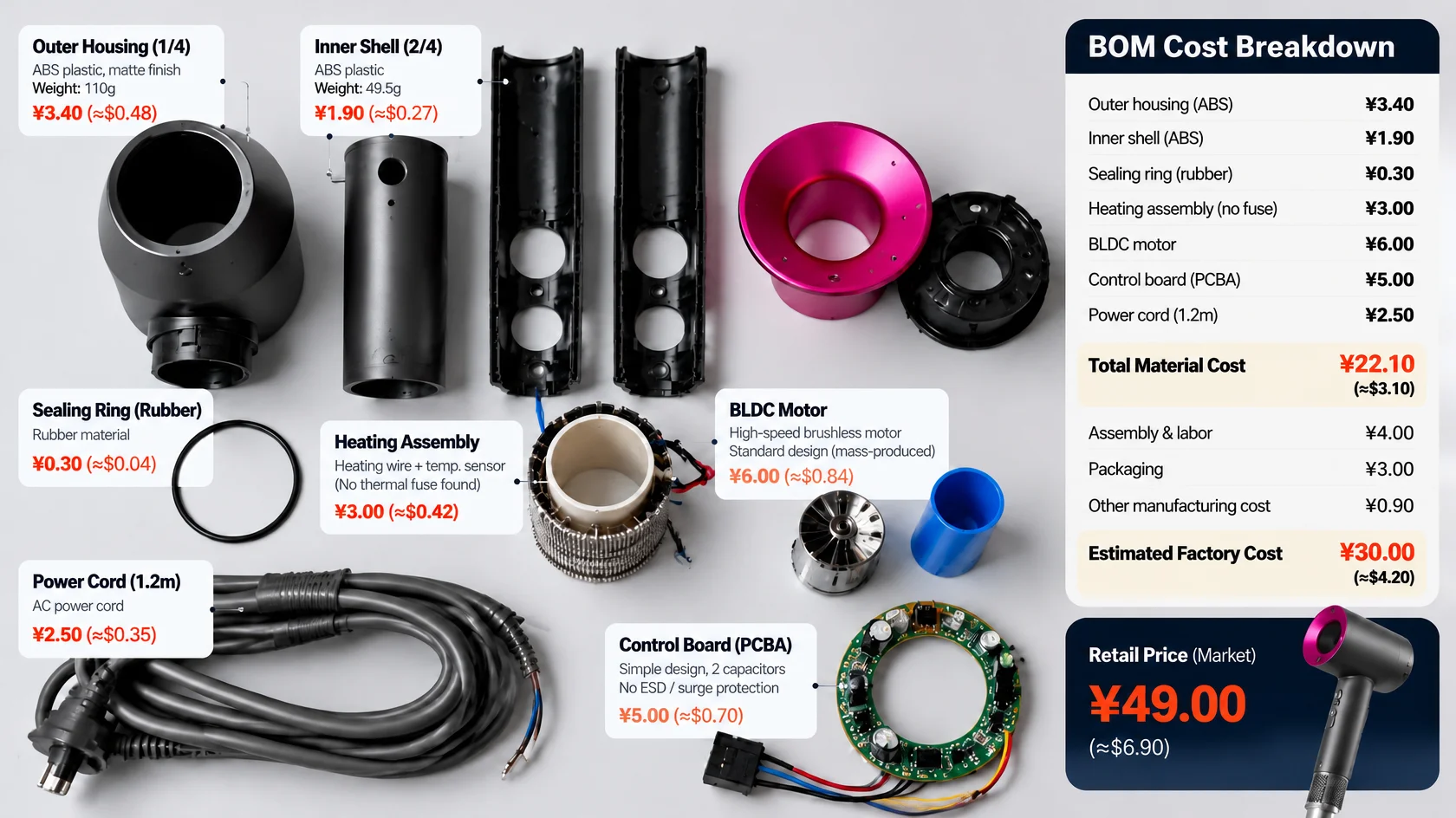
Fig 1.0: Component-level teardown of a ¥49 hair dryer, showing estimated material costs and key components requiring procurement verification.
A hair dryer selling for just $6.90 raises an important question for importers, retailers, and consumer electronics brands:
To find out, we disassembled a low-cost, Dyson-style hair dryer priced at approximately ¥49 in the market and examined its internal components.
The objective was not simply to calculate its bill of materials (BOM). We wanted to understand how component selection, electronics design, heating protection and manufacturing decisions affect the final product.
Our teardown produced an estimated material cost of ¥22.10 and an estimated factory cost of approximately ¥30.00.
But the numbers only tell part of the story. For procurement teams sourcing small appliances from China, the more important question is whether a low quotation reflects efficient manufacturing—or compromises that require further investigation.
1. Hair Dryer BOM Cost Breakdown: What Is Inside?
We separated the hair dryer into its major components and estimated their individual material costs.
The motor and control board together account for ¥11.00, representing approximately 49.8% of the estimated material cost.
This is an important finding for procurement teams. When two suppliers quote different prices for what appears to be the same hair dryer, the first step should not be to negotiate a lower price immediately.
Instead, buyers should investigate whether the two products use equivalent motors, electronic components, heating assemblies and protective designs. A similar external appearance does not guarantee an equivalent internal construction.
2. The BLDC Motor: Is the Motor Specification Worth Verifying?
The motor is one of the most critical components in a high-speed hair dryer. In our sample, the estimated motor cost was ¥6.00.
The motor used a standardized, mass-produced design rather than an obviously customized motor platform. This does not automatically indicate poor quality. Standardized motors can offer significant advantages in manufacturing efficiency, availability and cost control.
However, procurement teams should distinguish between a motor's marketing description and its actual engineering specifications. Before approving a supplier quotation, buyers should verify:
- Motor type: Is the motor genuinely brushless, or does it use a brushed design?
- Rated operating conditions: Are voltage, current and power consistent with the intended application?
- Performance claims: Have rotational speed (e.g. 110,000 RPM) and airflow claims been measured under defined test conditions?
- Thermal performance: Can the motor operate within acceptable temperature limits during extended use?
- Supplier consistency: Will the mass production version use the exact same motor model as the approved golden sample?
💡 Procurement Takeaway:
Compare motor specifications and measured performance under load, not just the marketing product title or quoted unit price.
3. Heating Assembly and Safety Protection: What Should Buyers Check?
The heating assembly in our sample had an estimated cost of ¥3.00.
During the teardown, we identified temperature sensing but did not find a separate thermal fuse. This observation deserves further investigation.
A temperature sensor and a thermal fuse are not interchangeable components. A temperature sensor provides real-time data to a control system, while a thermal fuse is designed to physically interrupt a circuit under runaway temperature conditions.
However, the absence of a separately identifiable thermal fuse does not, by itself, establish that a product is unsafe or non-compliant. Other protective mechanisms may exist, and determining compliance requires examining the complete design and relevant test evidence.
5 Questions to Ask the Supplier Before Purchase Approval:
- What over-temperature protection mechanisms are incorporated into the design?
- What happens if the primary temperature sensor fails or drifts?
- How does the product respond to blocked airflow or abnormal operating conditions?
- Are there accredited test reports covering relevant electrical and thermal safety requirements (e.g. CE, UL, CB)?
- Do the test certificates apply to the exact model and production configuration being purchased?
The key lesson: Safety-related requirements should be defined and verified before purchase-order approval, not left to assumptions based on the product's exterior finish.
4. PCBA Cost Analysis: A Low-Cost Board Is Not the Whole Story
The control board in the sample had an estimated cost of ¥5.00.
The board used a relatively simple single-layer/double-layer layout with two visible capacitors. During our visual inspection, we did not identify obvious ESD or surge protection components.
This is a preliminary observation, not a complete assessment of the board's electrical protection. Component-level inspection can identify questions that deserve further investigation, but visual inspection alone cannot establish whether a product passes applicable electrical safety or electromagnetic compatibility (EMC) requirements.
For procurement managers, a practical verification process should cover:
- Physical inspection of the PCBA layout against the approved golden sample.
- Verification of the critical electronic component list (active ICs, capacitors, switching MOSFETs).
- Review of relevant electrical safety, EMI, and EMC test evidence.
- Confirmation of firmware and control logic stability, where applicable.
- Random batch checks to prevent unapproved component substitutions during mass production.
For importers, an inexpensive PCBA is not necessarily a purchasing risk. An undocumented or unverified component substitution is.
5. From ¥22.10 in Materials to a ¥30 Factory Cost
A component-level BOM is useful, but it does not represent the complete manufacturing cost. For this sample, our estimates were:
The estimated factory cost is approximately 61.2% of the observed retail price.
The remaining ¥19.00 should not be interpreted as pure seller profit. Retail pricing must account for logistics, import duties, taxes, channel distribution margins, marketplace fees, marketing, warranty provisions, and customer service.
Nevertheless, this comparison illustrates why professional procurement teams separate three distinct figures:
Material Cost (BOM)
The estimated cost of physical components, plastics, metals, and electronics.
Factory Cost (EXW)
The manufacturing cost including labor, tooling amortization, packaging, and factory margin.
Landed Cost
The total delivered cost including ocean freight, tariffs, customs clearance, and local warehousing.
6. Why Can Two Similar Hair Dryers Have Different Prices?
When sourcing small appliances from China, buyers frequently encounter products that look virtually identical in catalog photos but have wildly different quotations. There are 5 key drivers:
- Manufacturing Scale & Automation: Factories producing high volumes benefit from bulk raw material pricing, higher injection molding utilization, and automated testing.
- Internal Component Specifications: Two products sharing the same outer housing may use completely different motor grades (110k RPM BLDC vs. 80k RPM vs. brushed), copper vs. CCA wiring, and flame-retardant vs. standard ABS.
- Engineering & Protection Rigor: Design features like redundant thermal cutoffs, PCB surge suppression, and acoustic dampening add bill-of-materials cost but prevent field failures.
- Quality Control & Testing Scope: One supplier may include 100% burn-in testing, high-pot isolation tests, and drop tests, while another quotes basic end-of-line functional checks.
- Commercial & Warranty Terms: MOQ commitments, spare parts allowances (e.g. 1% FOC units), custom retail packaging, and payment terms directly impact unit pricing.
7. A Practical China Sourcing Checklist for Small Appliances
For procurement managers sourcing hair dryers and consumer appliances from China, this structured checklist reduces uncertainty before committing capital:
8. What This Teardown Means for Procurement Teams
This ¥49 hair dryer demonstrates why a product's retail price and external appearance cannot tell buyers everything they need to know.
Our sample had an estimated material cost of ¥22.10 and an estimated factory cost of approximately ¥30.00. The component analysis also identified areas requiring additional verification, particularly the heating protection arrangements and electronic protection design.
The Core Procurement Principle:
The right purchasing decision depends on what is inside the product, what the supplier has actually quoted, and whether the product meets the specifications that protect your brand equity. Before approving a supplier, make sure you understand the bill of materials, the manufacturing cost structure, and the evidence supporting the factory's claims.
Need Help Sourcing or Comparing Products from China?
BaiSourcing helps brands, importers, retailers, and procurement teams identify product opportunities, vet Chinese factories, and verify samples before committing to a purchase order.
Frequently Asked Questions (FAQ)
Q1. How much does it cost to manufacture a hair dryer in China?
Manufacturing costs vary depending on motor specifications, heating components, electronic design, materials, order quantity and production requirements. In our teardown of one low-cost hair dryer, the estimated material cost was ¥22.10, with an estimated factory cost of approximately ¥30.00. These figures apply only to the sample examined and should not be treated as universal manufacturing benchmarks.
Q2. What is a BOM cost breakdown?
A bill of materials (BOM) cost breakdown identifies the components and materials used in a product and estimates their individual costs. It helps procurement teams understand the product's cost structure and compare supplier quotations on a consistent, apples-to-apples basis.
Q3. How can I verify a Chinese supplier's quotation?
Start by aligning product specifications, component requirements, order quantities and quotation terms. Request supporting documentation where appropriate, compare samples against the agreed specifications, and investigate significant differences in component selection or manufacturing scope before approving the order.
Q4. How do I compare two similar products from different Chinese suppliers?
Compare the actual specifications, internal components, materials, functionality, applicable testing requirements, packaging and commercial terms. Similar external appearances do not guarantee equivalent products. Sample evaluation and supplier documentation can help identify differences that are not visible in product photographs.
Q5. Can BaiSourcing help me find alternative suppliers in China?
Yes. BaiSourcing supports supplier sourcing and shortlisting, supplier capability comparison, quotation evaluation and sample comparison. The scope can be tailored to your product requirements, purchasing stage and target market.