
When evaluating Chinese supplier quotations, final unit price is never just Raw Materials + Factory Margin. A true manufacturing quote encompasses direct component BOM (50–70%), assembly labor (10–20%), quality testing (5–10%), packaging (3–8%), and factory overhead (5–10%). Understanding this breakdown is the key to fact-based procurement negotiations.
1. Why Does the Same Product Have Different Factory Prices?
When sourcing consumer electronics, hardware, or personal care products from China, procurement managers frequently ask: “Why is Supplier A quoting $8.00 while Supplier B quotes $12.50 for what appears to be the exact same product?”
The standard assumption is that Supplier B is overcharging. But in China's industrial clusters, price variance is almost always driven by what is built inside the product:
- Motor type (standard brushed motor vs. magnetic levitation sonic motor)
- Lithium battery capacity and cell grade (unbranded generic vs. tier-1 certified cell with protection IC)
- PCBA circuit complexity (single-layer basic charging vs. multi-layer smart MCU with thermal cut-offs)
- Quality control rigor (1-minute visual check vs. 4-hour aging room burn-in)
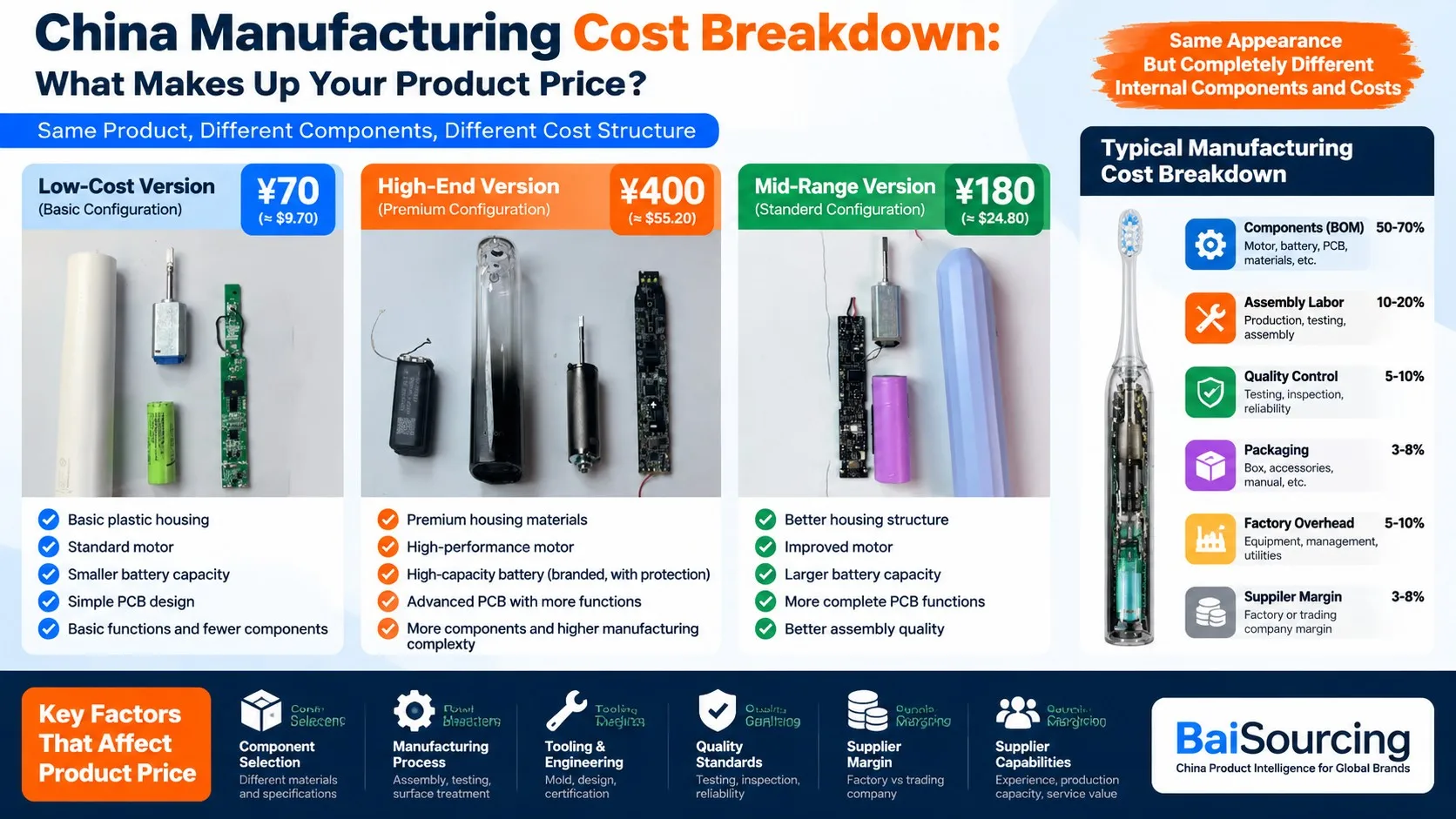
Fig 1. Real teardown analysis comparing 3 tiers of electric toothbrushes: Low-Cost (¥70 / $9.70) vs. Mid-Range (¥180 / $24.80) vs. High-End (¥400 / $55.20).
2. The 5 Core Pillars of a China Manufacturing Quotation
Pillar 1: Direct Bill of Materials (BOM) — 50% to 70%
Largest ShareBOM includes all raw materials and sub-tier components. In consumer hardware, small component upgrades multiply unit cost:
- Enclosure & CMF: Recycled ABS vs virgin polycarbonate vs die-cast zinc/aluminum.
- Active Actuators: 130 brushed DC motor ($0.25) vs brushless BLDC / maglev motor ($2.50–$3.50).
- Power Cell: 400mAh generic pouch cell ($0.20) vs 2000mAh 18650/21700 A-grade cell ($1.20–$1.80).
- PCBA: Single-sided charging board ($0.30) vs multi-layer MCU controller with NTC protection ($1.50).
Pillar 2: Assembly Labor & SMT Line Operations — 10% to 20%
Labor OverheadCovers SMT component placement, ultrasonic plastic welding, manual wire soldering, and final assembly line takt time. High part-count products with multiple manual screws require 2x–3x more labor stations than streamlined snap-fit architectures.
Pillar 3: Quality Control & Reliability Testing — 5% to 10%
Risk MitigationReliable tier-1 factories conduct 100% incoming material inspection (IQC), IPQC in-line checks, 4-hour burn-in aging room cycling, and drop testing. Low-end workshops skip aging rooms entirely, turning your end customers into their QA testers.
Pillar 4: Packaging & Accessories — 3% to 8%
Includes retail gift box, molded blister/pulp tray, EVA foam inserts, user manual, and accessory cables. Premium rigid gift boxes with magnetic closures cost $0.80–$1.50 compared to standard $0.15 folding paper boxes.
Pillar 5: Factory Overhead & Margin — 5% to 15%
Covers facility depreciation, electricity, tooling maintenance, and factory profit (typically 5%–10% net). Trading companies add an additional 10%–20% intermediary management fee.
3. Typical Manufacturing Cost Allocation Table
4. 4 Questions to Ask When Reviewing Supplier Pricing
1. What exact component specifications are itemized?
Request itemized model numbers for the motor, battery cell vendor, and PCB microprocessor.
2. What has been removed to reach a discounted quotation?
If a supplier offers a 15% discount, ask specifically what material grade or testing protocol was adjusted.
3. Does the cost structure match your channel return-rate tolerances?
Selling on Amazon or DTC requires higher reliability reserves (<2% returns) than discount offline clearance channels.
4. Can the supplier support future structural value engineering?
Verify whether their engineering team can redesign parts for snap-fit assembly to lower future volume costs.
5. Explore Related Sourcing Due Diligence Guides
Quote Variance
Why Chinese Supplier Quotes Differ: Understanding Hidden Costs →
Analyze why quotations for identical-looking products vary by 100%+.
BOM Audit
How to Review a Supplier Quote: A Complete BOM Audit Guide →
Deconstruct supplier pricing with real component-level cost modeling.
Need Help Auditing Your Factory Quotation or BOM Cost Structure?
Send BaiSourcing your current supplier quotation or physical product sample. Our Ningbo engineering lab will dissect every component and provide an itemized bottom-up cost breakdown.