5 Hidden Costs In Consumer Electronics Manufacturing: What Brands Often Miss Before Production
Discover the 5 hidden costs behind consumer electronics manufacturing in China: component quality risks, tooling, engineering changes, and quality control audits.

Executive Summary: The Invisible Costs Behind Factory Quotations
When overseas hardware startups, Amazon brand aggregators, and private-label buyers develop consumer electronics in China, their financial modeling is often anchored to a single number: the initial ex-factory unit quotation (e.g., "$8.50 EXW"). However, experienced procurement directors know that the initial quotation covers only the visible direct assembly cost. Between initial prototype sign-off and final distribution, brands frequently encounter five major hidden cost multipliers: substandard component failure rates, post-tooling engineering change orders (ECOs), amortized mold ownership traps, unbudgeted on-site QC testing, and flawed product definition trade-offs. This guide breaks down the true total cost of ownership (TCO) in Chinese manufacturing and how brands can mitigate these risks before issuing a purchase order.
Step 1. Why Cheap Quotations Frequently Become Expensive Products
In electronics manufacturing, a factory quotation is not a guarantee of total project cost—it is merely the starting point. When a supplier offers an aggressively low quote, that discount is often offset by transferring unstated engineering, testing, and warranty risks onto the buyer.
Understanding these five cost categories allows procurement teams to accurately compare supplier bids on a risk-adjusted basis:
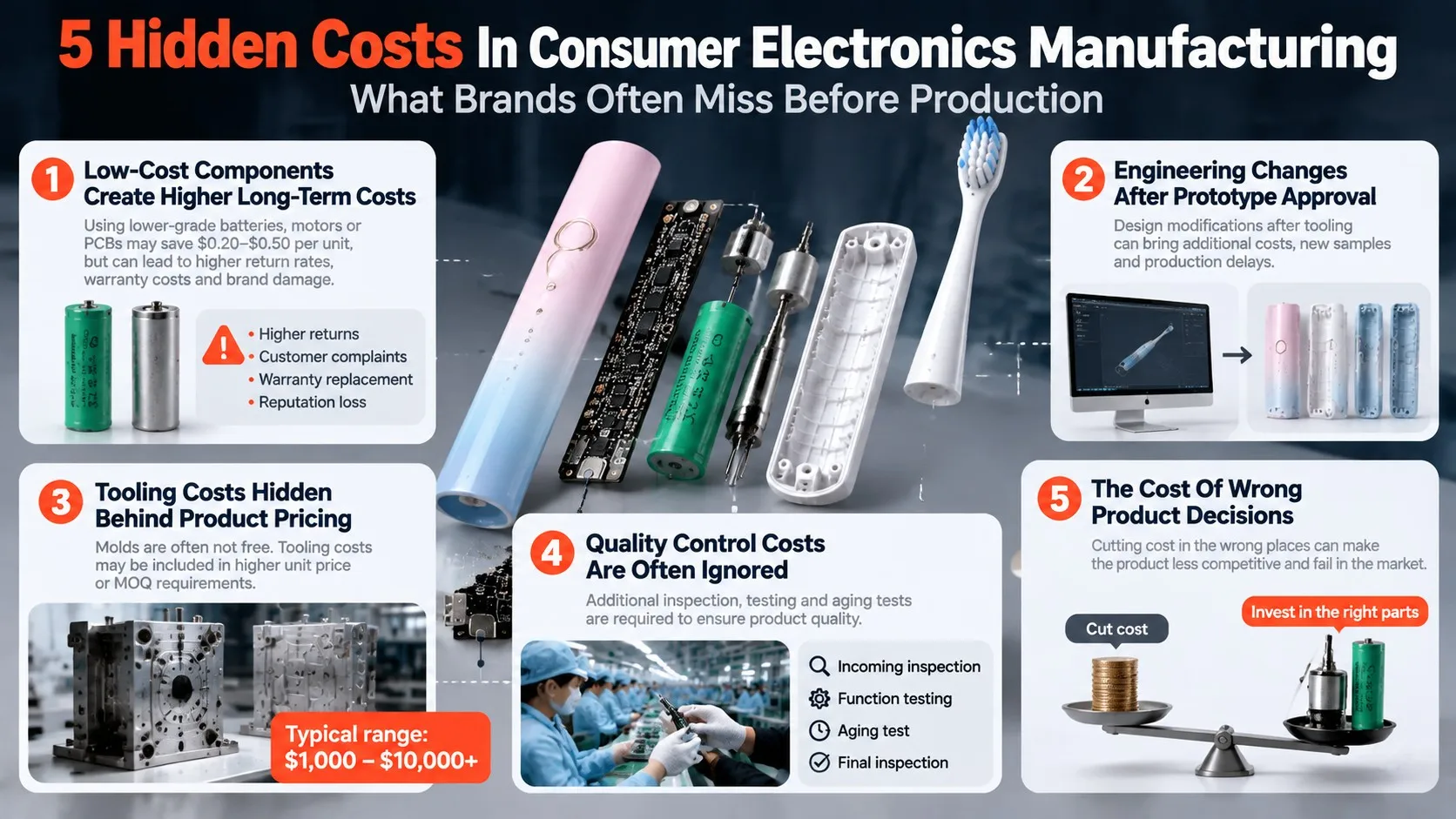
Step 2 & 3. Deep Breakdown of the 5 Hidden Cost Pillars
1. Low-Cost Components Create Higher Long-Term Costs
Saving $0.20 to $0.50 per unit by substituting lower-grade 18650 lithium cells, unbranded MOSFETs, or generic microcontrollers is one of the most common causes of catastrophic brand failure.
2. Engineering Change Orders (ECO) After Tooling Sign-Off
Modifying a product design on CAD software costs nothing; modifying hardened steel injection molds after CNC cutting is exceptionally costly. Common post-prototype change requests include:
- Relocating a USB-C port cutout or button travel clearance.
- Modifying internal plastic snap-fits to accommodate a larger battery cell.
- Adding internal structural screw bosses for drop-test reinforcement.
Each late mold modification incurs $1,500 to $8,000 in EDM electrode machining and welding repairs, while delaying mass production timelines by 3 to 6 weeks.
3. The Illusion of "Free" Tooling
When a supplier advertises "Zero Tooling Fee / Free Mold," the tooling investment is almost always amortized into a higher unit price or tied to strict contractual lock-in:
- Mold Ownership Retention: The factory retains legal title to the injection mold, preventing the buyer from transferring tooling to another supplier if quality degrades.
- Mandatory High MOQ Thresholds: The buyer must commit to 50,000+ units over 12 months to avoid retroactive mold penalty charges.
4. Underestimating Quality Control (QC) & In-Line Aging
Many first-time buyers assume the factory will thoroughly test 100% of finished units for free. In reality, standard factory testing is often limited to a 5-second power-on check. Full reliability assurance requires:
- IQC Incoming Material Testing: Verifying battery internal resistance (IR) and plastic granule moisture content.
- 4-Hour Continuous Aging Chamber: Identifying infant component mortality under thermal stress.
- Third-Party Pre-Shipment Inspection (PSI): AQL Level II sampling by independent QA engineers ($299–$499 per man-day).
5. The Cost of Flawed Product Definition & Over-Engineering
The single biggest waste of capital is engineering features that consumers do not value while skimping on core functionality. Successful consumer hardware ruthlessly optimizes cost:
❌ Where Bad Projects Overspend:
Unnecessary Bluetooth apps, excessive decorative trim, complex multi-part slider mechanisms, low-value gimmicky sensors.
✓ Where Winning Brands Invest:
High-torque motors, certified Grade-A battery cells, durable tactile switches, premium exterior surface texturing.
Step 4. Hidden Manufacturing Cost Risk Matrix
How visible supplier quotations compare against real-world backend cost impacts:
| Cost Category | Visible Factory Quote | Potential Hidden Cost Risk | Procurement Mitigation Strategy |
|---|---|---|---|
| 1. Component Quality | Save $0.30–$0.80 on unbranded parts | 5%–12% warranty returns ($15+ per unit) | Specify exact tier-1 component brands in contract |
| 2. Tooling / Molds | "Free Tooling" or low $1,500 deposit | Supplier holds mold hostage; lock-in | Pay full mold cost upfront; sign Tooling Ownership Agreement |
| 3. Design Changes | Free minor CAD adjustments | $3,000–$8,000 mold rework + 6-week delay | Complete DFM (Design for Manufacturing) freeze before T1 mold cut |
| 4. Quality Control | "Standard internal factory QC included" | High dead-on-arrival (DOA) rates at port | Mandate 100% Hi-Pot & 4-hour aging logs in SOP |
| 5. Compliance & Certs | "Factory has CE/FCC certification" | Certificate is under another brand; customs seizure | Budget $1,500–$3,500 for direct brand certification |
Step 5 & 6. Buyer Sourcing Checklist: 5 Non-Negotiable Contract Safeguards
-
✓
1. Demand Itemized Component-Level BOM Breakdown: Never accept lump-sum quotations. Require suppliers to list cell brand, motor model, MCU part number, and plastic material grades.
-
✓
2. Execute a Signed Tooling Ownership & Transfer Agreement: Ensure your contract explicitly states that upon full payment, the mold is the sole intellectual property of the buyer and can be relocated upon 48 hours notice.
-
✓
3. Establish Clear Defect Rate Penalty Thresholds: Set a contractual maximum defect rate (e.g., <1.5%). Defects exceeding this threshold should trigger supplier reimbursement of FOB shipping and retail replacement costs.
-
✓
4. Enforce Golden Sample Sign-Off Before Mass Production: Counter-sign and seal three sets of approved T1 golden samples: one for the factory QC station, one for the buyer, and one for third-party inspection teams.
-
✓
5. Require Independent Pre-Shipment Inspection (PSI): Never wire the final 70% balance payment until an independent QC audit confirms MIL-STD-105E AQL Level II compliance on finished packaged goods.
Pre-Audited Hardware Platforms with Zero Hidden Sourcing Costs
Explore our verified consumer hardware platforms with 100% transparent BOM breakdowns, audited tooling, and strict quality control:
8-in-1 Premium Air Styler & Hair Dryer (Model: RFS013)
110,000 RPM BLDC platform with CNC aluminum turbine, dual NTC thermal safety, and audited assembly tooling.
Bluetooth Audio Sports Glasses
Open-ear directional audio built into lightweight sports eyewear with dual-mic ENC.
BaiSourcing Sourcing Risk Audit Benchmark
BOM Transparency: 9.6/10 · Tooling Contract Rigor: 9.5/10 · QC Protocol Coverage: 9.4/10
Need an Independent BOM Audit or Sourcing Risk Assessment?
Don't discover hidden manufacturing costs after wire transfers are complete. Send your supplier quotation, product specification, or prototype to BaiSourcing for an independent physical teardown, BOM cost breakdown, and factory risk evaluation.