
3,000mAh Advertised vs. 1,800mAh Battery: What Buyers Should Check
Specifications printed on a product shell do not always tell the whole story. Learn how to verify physical 18650 cell markings, calculate true stored energy in Watt-hours (Wh), and prevent runtime discrepancies before mass production.
1. Introduction: What Is Inside the Product?
When sourcing portable fans from China, buyers often compare products by price, appearance, airflow, and advertised battery capacity.
However, specifications printed on a product label do not always tell the whole story.
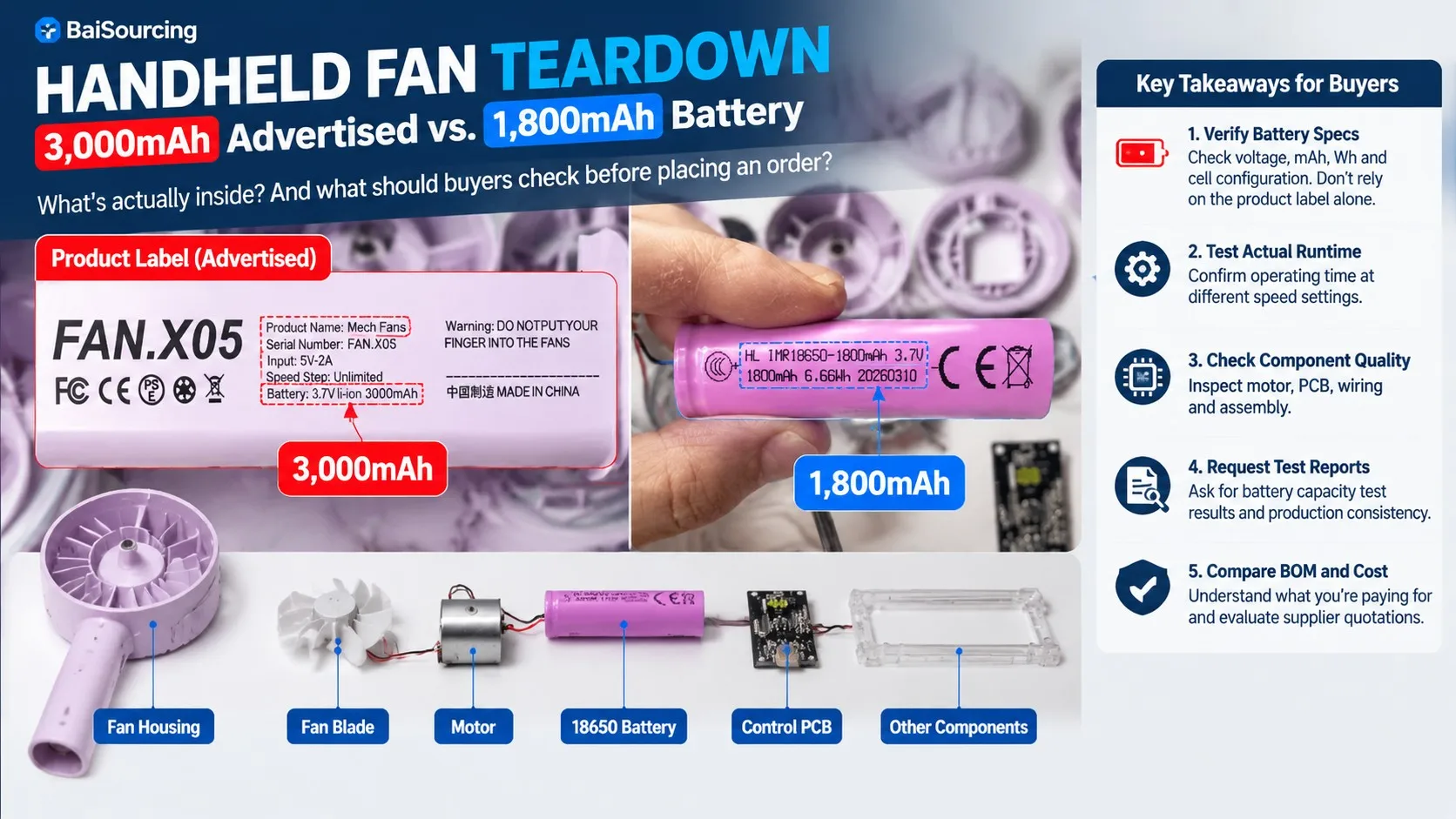
In this teardown, we examined a handheld fan labeled FAN.X05. The product's external label specifies a 3.7V lithium-ion battery with a capacity of 3,000mAh.
After opening the housing and inspecting the installed battery, we found a different specification printed directly on the cell.
The difference raises an important question for procurement teams: Does the installed battery match the capacity promised by the supplier?
2. The Key Finding: 3,000mAh vs. 1,800mAh
| Inspection Item | Product Label (Advertised) | Installed Battery Cell |
|---|---|---|
| Battery chemistry | Lithium-ion | Marked IMR18650 |
| Nominal voltage | 3.7V | 3.7V |
| Capacity specification | 3,000mAh | 1,800mAh |
| Nominal stored energy | 11.1Wh implied by label | 6.66Wh marked on cell |
| Verification status | External product specification | Physical cell marking observed |
The product label specifies a 3,000mAh battery, but the installed 18650 cell is marked 1,800mAh, 3.7V, and 6.66Wh.
If this is the complete battery configuration, the marked capacity is 1,200mAh below the advertised specification—representing a 40% discrepancy between the advertised specification and the physical cell marking.
3. Why Battery Capacity Matters to Buyers
3.1 Operating Time
A lower-capacity battery stores less energy. If the installed battery has less capacity than specified, the fan delivers a noticeably shorter runtime than expected, generating negative Amazon reviews and customer returns.
3.2 Supplier Quotation Comparisons
Suppose Supplier A quotes a fan with a "3,000mAh" battery, while Supplier B specifies 1,800mAh at a slightly lower price. If Supplier A actually installs an 1,800mAh cell, the apparent value advantage disappears completely.
3.3 Cost and Product Positioning
An authentic 3,000mAh 18650 cell costs significantly more than an entry-level 1,800mAh cell. Buyers must establish whether they are paying for high-capacity hardware or unverified marketing text.
4. How to Verify Battery Specifications During Sourcing
✓ Check 1: Inspect the Installed Battery Cell: Request teardown photos showing the cell model, voltage, and mAh/Wh markings.
✓ Check 2: Compare mAh and Watt-Hours (Wh): 3.7V × 1.8Ah = 6.66Wh vs. 3.7V × 3.0Ah = 11.1Wh.
✓ Check 3: Request a Battery Capacity Test Report: Demand 0.2C discharge test logs and UN38.3 compliance reports.
✓ Check 4: Verify Finished-Product Runtime: Test full-speed runtime under continuous operation.
✓ Check 5: Confirm Production Consistency: Lock in approved battery cell part numbers contractually.
5. A Practical Battery Verification Checklist
| Verification Item | What to Confirm |
|---|---|
| External specification | Does the product label match the approved purchasing specification? |
| Installed battery cell | Does physical cell marking match declared model and capacity? |
| Energy rating | Are voltage, mAh, and Wh mathematically consistent? |
| Capacity testing | Is there credible lab discharge data supporting the rating? |
| Production consistency | Are battery substitutions formally controlled with ECO sign-offs? |
6. How BaiSourcing Helps Buyers Make Better Product Decisions
At BaiSourcing, we look beyond product appearance and supplier quotations to examine internal components and specifications before you commit capital to inventory:
🔍 Product Discovery
Explore verified portable cooling fan and rechargeable electronics platforms.
⚙️ Product Intelligence
Physical product teardowns, battery capacity verification, and bottom-up BOM cost analysis.
🏭 Supplier Matching
Direct factory vetting, quotation benchmarking, and cleanroom production validation.
🛠️ OEM/ODM Development
Custom housing tooling, PCB power driver optimization, and pilot QC testing.
Frequently Asked Questions
Q1. How can a buyer verify battery capacity without laboratory equipment?
Open the housing and check the physical printing on the 18650 cell. In many cases, discrepancies between the external shell label and the internal cell marking can be identified by visual inspection.
Q2. What is the difference between mAh and Wh?
mAh measures electric charge capacity at a specific voltage, while Watt-hours (Wh = Voltage × Ah) measures total stored electrical energy. Comparing Wh provides an accurate benchmark across different battery pack voltages.
Q3. Why do suppliers sometimes install lower-capacity cells?
To meet competitive retail price targets or compensate for component shortages. An 1,800mAh cell costs less than an authentic 3,000mAh cell, creating immediate margin savings if buyers do not verify internal components.
Q4. How can buyers prevent battery down-speccing in mass production?
Specify exact cell brands, model part numbers, and minimum capacity thresholds in purchase contracts, and mandate incoming pre-shipment battery batch discharge testing.