
A Practical Guide to Motor Construction, Electronic Components, Manufacturing Quality, and Supplier Verification
Two fans can look identical on the outside but contain completely different internal drive systems. Learn how to compare ring-shaped stator assemblies, copper winding consistency, circular control PCBs, and wiring to identify real manufacturing quality and avoid hidden cost traps.
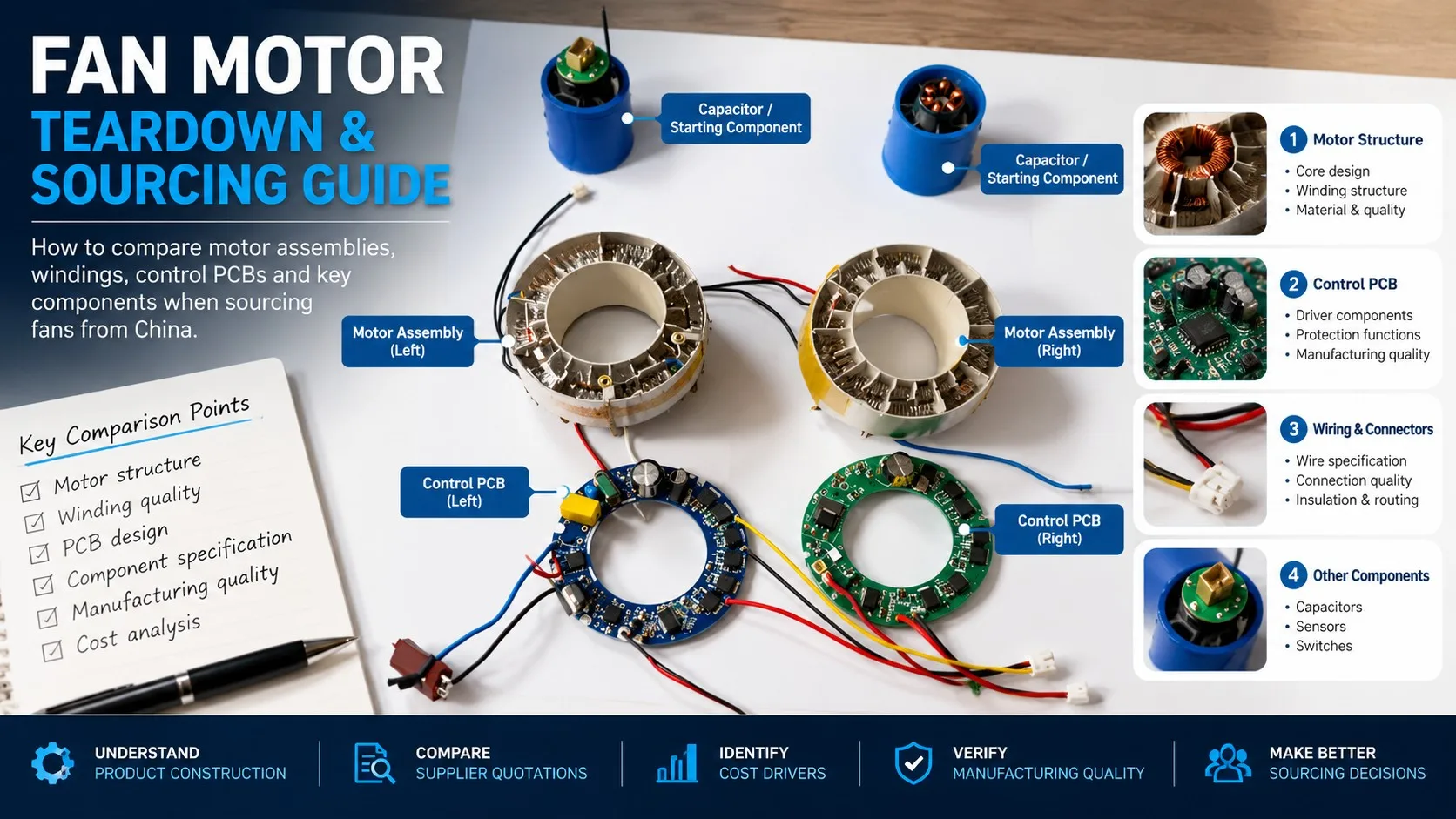
Two fans can look almost identical on the outside but contain very different internal components.
For brands, retailers, and distributors sourcing fans from China, these differences can affect motor performance, energy consumption, operating noise, reliability, and manufacturing costs.
A supplier quotation may specify the same product category, similar functions, and comparable appearance. However, without examining the internal construction, buyers may not know whether the proposed components meet their requirements.
A closer look at the motor assembly and control electronics can reveal important questions about product configuration and manufacturing quality.
In this teardown guide, BaiSourcing examines the key areas buyers should investigate when comparing fan motor assemblies, stator structures, windings, and control PCBs. The objective is not to assume that one design is automatically better than another. It is to understand what needs to be verified before making a purchasing decision.
1. Why Fan Motor Teardown Matters
The motor is one of the most important functional components in a fan. Its performance depends on more than the motor's external dimensions or advertised speed. The electromagnetic design, winding configuration, mechanical structure, control electronics, and operating conditions all influence the final result.
When evaluating two similar products, buyers should investigate five questions:
- Are the motor assemblies built to comparable specifications?
- Are the winding structures and electrical connections consistent with the intended design?
- Do the control boards provide the required functions and protection?
- Can the supplier demonstrate consistent manufacturing quality?
- Does the component configuration justify the quoted price?
For procurement teams, the objective is to verify what is actually inside the product—not simply what the supplier claims is inside.
2. Motor Assembly: Examine the Structure Before Comparing Performance
The motor assembly converts electrical energy into mechanical movement. Its design influences how the fan operates under different loads and operating conditions.
2.1 Core and Stator Structure
The ring-shaped assemblies contain repeated metallic laminations arranged around a central hub. The core geometry and winding arrangement form the foundation of the motor's electromagnetic torque generation:
- Silicon steel lamination grade and stamping precision.
- Number and spacing of stator teeth and slot fill factor.
- Winding placement, slot insulation, and phase isolation.
- Mechanical concentricity and rotor air-gap clearance.
2.2 Winding Quality
• Copper Wire Specification: Confirm pure copper magnet wire vs. copper-clad aluminum (CCA). Verify wire gauge (AWG) and enamel insulation thermal class (Class B 130°C vs. Class F 155°C).
• Winding Consistency: Inspect for crossover wire pinching, uneven slot tension, loose coil ends, or enamel micro-scratches.
• Resistance & Temperature Rise: Measure phase-to-phase DC resistance to ensure balanced magnetic fields and verify temperature rise under continuous full-speed operation.
3. Control PCB: The Electronic Design Behind the Motor
The circular printed circuit boards manage motor driving, power switching, speed regulation, and system protections:
- 3.1 Component Configuration: Microcontroller IC, MOSFET power switching bridges, electrolytic smoothing capacitors, and hall effect sensing lines.
- 3.2 PCB Manufacturing Quality: SMT solder joint wetting, solder bridge prevention, component alignment, and conformal coating protection against moisture.
- 3.3 Component Substitution Risk: Preventing unauthorized down-speccing of MOSFETs or lower-temperature capacitors during mass production runs.
4. Wiring and Connections: Small Components, Important Risks
Wire harnesses and terminal blocks link the control PCB to the motor and external power source:
• Wire Gauge & Insulation: High-flexibility silicone or heat-resistant PVC rated for motor operating temperatures.
• Terminal Crimping Quality: Precision automated crimps with pull-force verification (>30N) to prevent loose terminal pull-outs.
• Strain Relief & Routing: Ensuring harnesses avoid sharp sheet metal edges or moving rotor mechanical pinch points.
5. How to Verify Whether Two Fan Motors Are Actually Comparable
| Evaluation Area | What to Check | Why It Matters |
|---|---|---|
| Motor construction | Core geometry, winding slot fill, assembly fit | Establishes whether motor matches electromagnetic design |
| Electrical specs | Rated voltage, current, DC resistance, power draw | Verifies electrical efficiency and driver compatibility |
| Fan performance | CFM airflow, static pressure, acoustic decibels | Connects raw motor rotation to real customer cooling feel |
| Thermal behavior | Continuous temperature rise test under load | Prevents coil burnout and insulation degradation |
| Control PCB | MOSFET ratings, MCU firmware, surge protection | Identifies electronic durability and speed stability |
| Reliability data | Endurance burn-in and bearing life records | Proves long-term operation over 5,000+ hours |
6. BOM Cost Analysis: What Should Buyers Compare?
To conduct an effective bottom-up BOM audit, buyers should itemize cost drivers across three main tiers:
- 6.1 Motor Assembly Costs: Pure copper wire weight, stator core lamination grade, precision ball bearings vs. sleeve bushings.
- 6.2 PCB & Electronic Costs: Branded microcontrollers, power MOSFET thermal dissipation, and capacitor quality.
- 6.3 Assembly & Quality Control Costs: Automated winding vs. manual assembly, 100% electrical load testing, and AQL inspection sampling.
7. Common Mistakes When Sourcing Fan Motors
❌ Mistake 1: Judging motor quality by exterior appearance alone ➔ Fix: Audit internal lamination grade, wire gauge, and bearing brand.
❌ Mistake 2: Assuming more PCB components automatically equals better quality ➔ Fix: Review circuit efficiency and thermal safety protections.
❌ Mistake 3: Treating visual teardowns as complete proof of performance ➔ Fix: Combine physical disassembly with dynamometer load tests.
❌ Mistake 4: Accepting unapproved component substitutions ➔ Fix: Enforce strict Engineering Change Order (ECO) sign-offs.
❌ Mistake 5: Comparing supplier quotations without standardizing BOM scope ➔ Fix: Require itemized quotes covering identical motor, PCB, and harness scopes.
8. Practical Checklist for Fan Motor Supplier Verification
✓ Product Configuration: Confirm motor model, stator dimensions, copper wire gauge, and PCB part numbers.
✓ Electrical Performance: Verify rated voltage, operating current under load, and phase resistance balance.
✓ Fan Performance: Measure CFM airflow, static pressure, and acoustic sound levels (<50dB).
✓ Manufacturing Quality: Review factory automated winding consistency, IQC component records, and 100% burn-in testing.
9. How BaiSourcing Helps Buyers Make Better Sourcing Decisions
At BaiSourcing, effective sourcing starts with understanding the product. Our engineering and cooling hardware sourcing team helps brands, retailers, and distributors through four integrated services:
🔍 Product Discovery
Discover vetted cooling fan, motor, and consumer appliance platforms matched to your target market.
⚙️ Product Intelligence
Physical teardowns, bottom-up BOM cost analysis, and motor winding/PCB specification comparison.
🏭 Supplier Matching
Direct motor factory vetting, quotation benchmarking, and automated manufacturing validation.
🛠️ OEM/ODM Development
Custom motor tuning, PCB driver optimization, and pilot production quality control.
Frequently Asked Questions
Q1. Can you determine motor quality from a teardown photograph?
A photograph reveals core geometry, visible winding consistency, and PCB component density. However, confirming true electrical efficiency, acoustic noise, and service life requires laboratory dynamometer and thermal testing.
Q2. Does a more complex motor assembly perform better?
Not necessarily. Performance depends on matching stator slot geometry, wire gauge, and driver timing to the fan's required operating load and CFM airflow target.
Q3. Why should buyers inspect the control PCB?
The control PCB regulates motor commutation, speed levels, and safety cutoffs. Auditing PCB components identifies whether high-quality MOSFETs and transient protections are included or omitted.
Q4. How can buyers identify hidden cost differences between suppliers?
Standardize the BOM scope and compare raw copper weight, stator lamination grade, bearing types (ball vs. sleeve), and PCB components line by line.
Q5. Is a lower-cost motor necessarily lower quality?
A lower-cost motor may be entirely suitable for low-duty-cycle products. The critical issue is verifying that the supplier delivers the exact approved specification without unannounced component downgrades.