
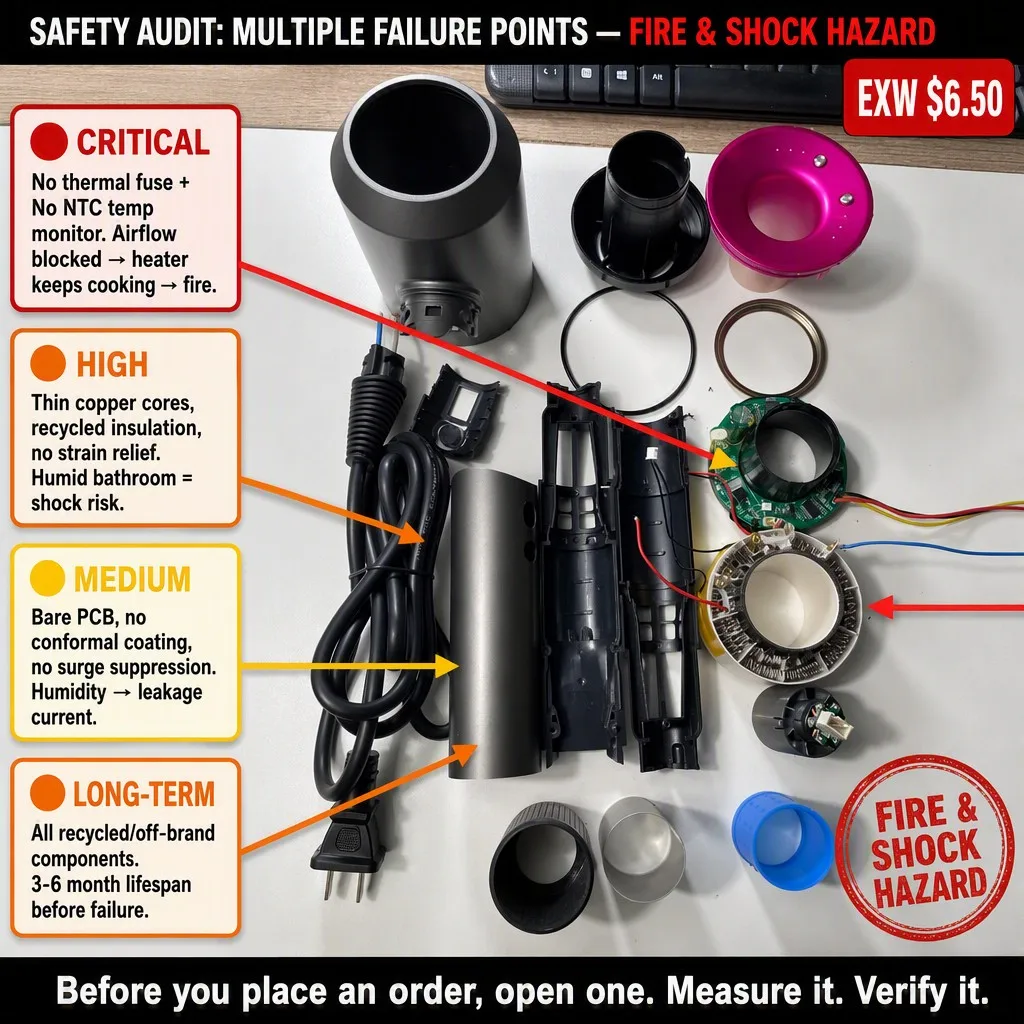
$6.50 EXW. Four Safety Failures. One Hair Dryer.
This is not just about inflated specs. This is about what happens when a Dyson-copy hair dryer is plugged into a bathroom wall outlet — and every safety system that should be there simply isn't. We tore down a generic Dyson-copy hair dryer sourced at $6.50 EXW. Below is the risk chain, from critical to long-term, at the component level.🔴 CRITICAL: No Thermal Fuse. No NTC Temperature Monitor.
The heating element assembly has no thermal fuse. No NTC thermistor feeding temperature data back to the MCU. No closed-loop thermal management of any kind. If the intake filter becomes clogged with hair and lint — inevitable over weeks of use — airflow drops. The heating coil continues drawing current at full power. There is no automatic shutoff. No power reduction. The element keeps cooking until the plastic housing softens, deforms, and eventually ignites. Regulatory agencies across multiple markets have issued warnings for Dyson-copy hair dryers failing blocked-airflow safety tests. In this teardown we found no thermal fuse or NTC thermistor to interrupt a blocked-airflow condition — the heating element would keep drawing current until thermal damage occurs. We did not run a full blocked-airflow burn test; formal results require laboratory testing. A single thermal fuse rated for 121°C costs approximately $0.08 at volume. An NTC thermistor costs approximately $0.12. Omitting both saves roughly $0.20 per unit at volume.🟠 HIGH: Undersized Copper. Recycled Insulation. No Internal Strain Relief.
The AC power cord uses thin-gauge copper conductor with recycled rubber insulation. The cord jacket is stamped "H05VV-F 2×0.75mm²" — a standard designation for light-duty PVC-insulated flexible cord — but the conductor cross-section and insulation quality do not match the marking. Internally, the wires have no anchor clips or strain relief at the handle entry point. The motor vibrates at 80,000–100,000 RPM. Over weeks of normal use, vibration rubs the insulation against sharp plastic injection-molding flash inside the handle. The insulation wears through. Live conductors are exposed inside the grip — the part the user is holding. In a bathroom environment — high humidity, bare feet on wet tile — this creates a direct path for electrocution. A genuine UK or European plug incorporates an internal safety fuse in the plug body. This two-prong North American plug has no fuse. No secondary protection.🟡 MEDIUM: Bare PCB. No Conformal Coating. No Surge Suppression.
The circular green PCB is bare FR4 laminate. No conformal coating. No X/Y safety capacitors. No common-mode choke for EMI suppression. No surge protection on the AC input. In a bathroom, ambient humidity condenses on cold surfaces — including bare PCB traces. A single condensation droplet bridging two adjacent traces creates a leakage current path from the AC mains into the handle housing. A compliant PCB for mains-powered bathroom appliances carries a protective conformal coating rated for moisture environments. This board has none. Additionally, without surge suppression components, a voltage spike from the wall outlet — common in buildings with aging electrical infrastructure — can punch through the rectifier diode or the MCU in a single event. The board has no protection against this.🟠 LONG-TERM: No Manufacturer Trace Codes — Component Provenance Unverifiable.
No manufacturer trace codes, lot numbers or datasheets were found on the PCB components. The absence of markings is consistent with recycled or unbranded parts, but provenance cannot be confirmed without laboratory analysis (e.g., decapsulation and die inspection). The aging curve for recycled semiconductors is unpredictable. A recycled rectifier diode rated for 600V may fail at 300V after thermal cycling. A recycled electrolytic capacitor may lose 50% of its capacitance within months. When the rectifier fails, the motor runs open-loop until the windings overheat. When the capacitor degrades, ripple voltage on the DC rail causes the MCU to brown out intermittently, leading to erratic operation. Estimated service life of components on this board: 3–6 months under normal use. Genuine components from authorized distributors carry 5–10 year lifespans in the same application.The Real Cost of $6.50 EXW
The unit economics appear attractive:EXW price: $6.50
Landed cost: ~$8.00
Retail price: $34.99
Gross margin: ~77% But the actual cost includes:
→ Returns from units that fail within 90 days
→ Chargebacks from customers reporting burning smells
→ Platform enforcement actions (Amazon listing suspension, FBA inventory hold)
→ Liability exposure from electrical fires or shock injuries
→ Brand damage that outlasts the product line A $0.08 thermal fuse. A $0.12 NTC thermistor. A $0.10 conformal coating spray. Total prevention cost: approximately $0.30 per unit. The factory chose not to spend it. The brand importing this product bears the consequences.
What We Do at BaiSourcing
Before you place an order on hair dryers, fans, heaters, or any mains-powered appliance from China, send us a sample. We disassemble it to the component level and audit every safety-critical subsystem: - Thermal protection: fuse presence, NTC monitoring, overheat shutdown logic - Electrical safety: conductor gauge, insulation type, strain relief, grounding, plug fuse - PCB integrity: conformal coating, surge suppression, safety capacitor compliance - Component provenance: manufacturer trace codes, lot numbers, datasheet verification - Certification cross-check: FCC, CE, UL, RoHS — verified against actual component-level compliance A full safety audit takes 3–5 business days. The report includes annotated teardown photos, component-level findings, risk tiering, and actionable recommendations. → Request a safety audit on your next productWholesale Hair Dryer Sourcing: Factory Price Benchmark
Looking for a high-speed hair dryer supplier or verifying a hair dryer factory price from China? This teardown is the exact screening we run before any purchase order. In 2026, genuine high-speed hair dryer BOM costs run between $8 and $28 EXW depending on motor class (brushless vs brushed), PCB protection, and grounding design. If your supplier quote looks cheaper, ask why - the difference usually hides in the motor, the battery, or the ground wire.