
A $6.90 Hair Dryer: Hidden Product Risks That Could Damage Your Brand
A product can look premium on the outside while hiding critical differences inside. For consumer electronics brands and importers, unverified factory shortcuts can turn a low purchase price into costly recalls, returns, and brand damage.
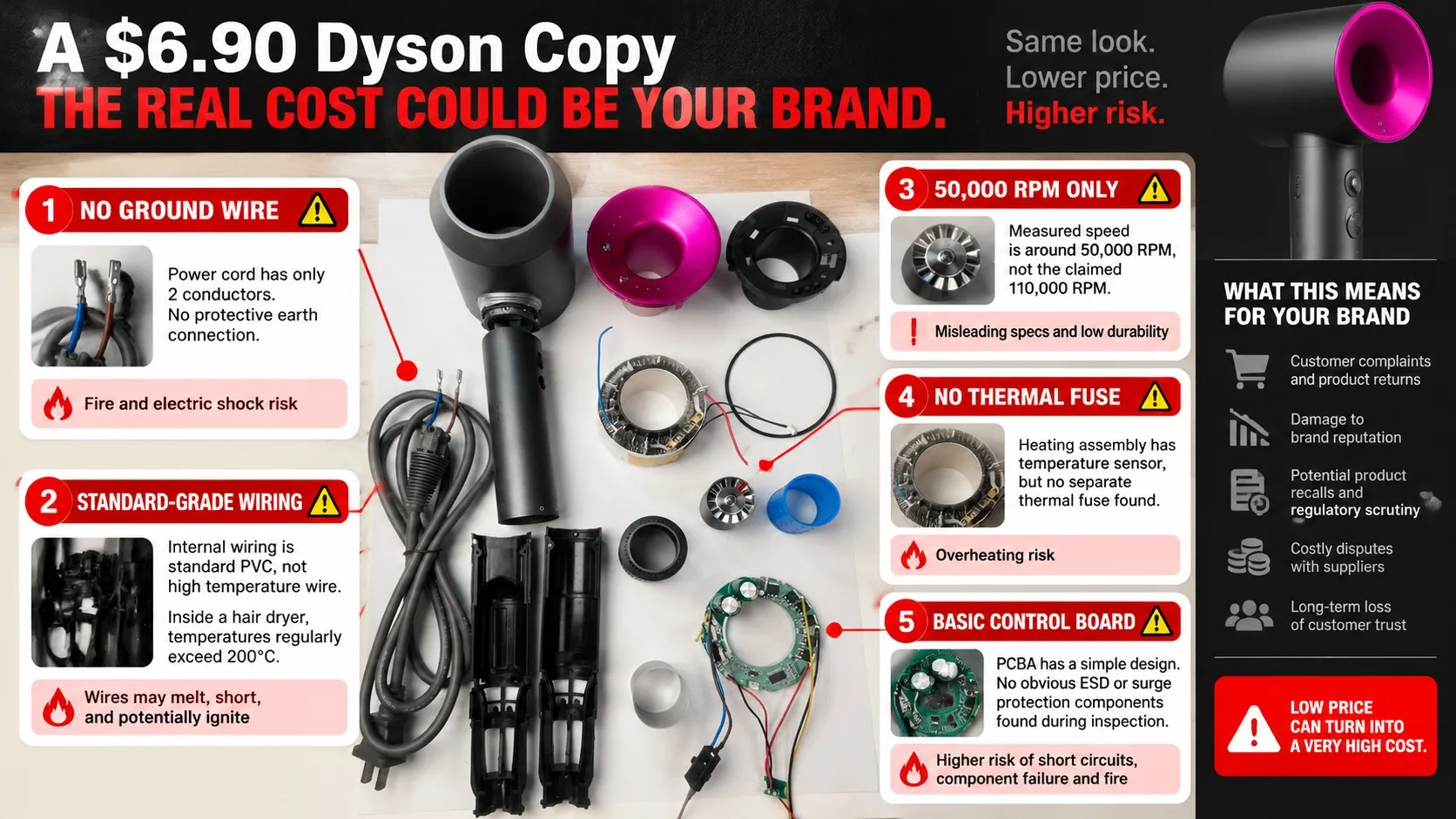
Fig 1.0: Component-level hair dryer teardown identifying potential sourcing and product verification risks before mass production.
A product can look premium on the outside while hiding critical differences inside. For brands sourcing from China, those differences can become expensive procurement problems.
We disassembled a low-cost, Dyson-style hair dryer priced at approximately $6.90 to examine its internal construction, component selection and engineering design.
What we found raised several questions about component specifications, electrical protection, thermal protection and the accuracy of the supplier's performance claims.
For importers and consumer electronics brands, the consequences extend far beyond product aesthetics. Unverified specifications and inadequate safety controls expose a business to customer complaints, high return rates, warranty expenses, regulatory scrutiny, and long-term reputational damage.
Here is what procurement teams should learn from this teardown—and how to address these risks before placing a purchase order.
1. Five Findings That Deserve Further Investigation
Power Cord: Verify Electrical Protection Design
The power cord in the sample had two conductors, with no separate protective-earth conductor identified. Whether this configuration is appropriate depends on the appliance's protection class (Class I vs. Class II double insulation) and applicable destination safety standards. The absence of an earth conductor alone does not establish non-compliance, but requires verification.
⚠️ Procurement Risk: Approving an appliance without verifying its electrical protection design leaves severe compliance and liability questions unresolved.
Internal Wiring: Confirm Temperature Rating
Hair dryers combine high-current electrical wiring with heating coils that generate localized temperatures exceeding 200°C. Standard PVC insulation will soften, degrade, and potentially short-circuit under continuous high thermal loads, requiring high-temperature silicone or Teflon-insulated wiring.
⚠️ Procurement Risk: Undocumented wiring material substitution can lead to wire melting, short circuits, and fire hazards during consumer use.
Motor Performance: 50,000 RPM vs. 110,000 RPM Claimed
The supplier's catalog claimed a high-speed brushless motor reaching 110,000 RPM, while our physical test of the sample measured approximately 50,000 RPM under load. That is a substantial performance deficit that directly impacts airflow velocity and drying time.
⚠️ Procurement Risk: Delivering a 50k RPM motor when marketing 110k RPM results in false advertising claims, immediate customer disappointment, and high return rates.
Heating Assembly: Verify Over-Temperature Protection
The heating assembly included an electronic NTC temperature sensor, but no separate one-shot thermal cutoff fuse was identified in the sample. While NTC sensors report temperature to the MCU, international electrical safety standards generally require a secondary, hardware-level thermal fuse to prevent catastrophic thermal runaway if the sensor or microprocessor hangs.
⚠️ Procurement Risk: Lack of redundant thermal protection creates extreme burn, melting, and fire hazards if airflow is obstructed during consumer use.
Control Board: Inspect Protection Components
The PCBA used a minimal circuit layout without obvious varistors (MOV) for AC surge suppression or TVS diodes for ESD protection. In consumer household environments, grid surges and electrostatic discharge can easily destroy unprotected microcontrollers.
⚠️ Procurement Risk: A low-cost PCBA that skips transient protection components will suffer high early-life failure rates in the field.
2. Why These Findings Matter to Your Brand
For a low-tier factory, the immediate objective is to manufacture a product at the lowest possible cost to win your order. But for a brand or importer, you own the customer relationship and all legal liability.
When an unverified product reaches retail channels, the consequences compound quickly:
Customer Complaints & Returns
Performance gaps (50k vs 110k RPM) and premature motor burnout spike return rates on Amazon and retail shelves.
Brand Reputation Erosion
Consumers associate failures with your logo, not the anonymous ODM supplier in Guangdong or Zhejiang.
Recalls & Regulatory Penalties
Non-compliant electrical wiring and missing thermal fuses trigger mandatory consumer safety recall notices (CPSC / RAPEX).
Costly Factory Disputes
Without clear technical specifications signed before PO approval, recovering losses from overseas suppliers is nearly impossible.
3. Why Comparing Factory Quotations on Price Alone Fails
Imagine receiving three competing quotations from Chinese factories for what appears to be the exact same high-speed hair dryer:
The cheapest supplier is not automatically fraudulent, and the most expensive supplier is not automatically safe. The real issue is that quotations cannot be compared until the engineering baseline is aligned.
A professional sourcing evaluation must dissect:
- Component BOM specifications (motor type, wire gauge, plastic flame retardancy).
- Over-temperature, surge, and insulation protection circuitry.
- Target market safety certifications (UL 859, IEC 60335-2-23, CE-LVD/EMC).
- Production consistency controls and pre-shipment inspection thresholds.
- Commercial terms (MOQ, spare parts allowance, tooling ownership, payment terms).
4. How BaiSourcing Helps Reduce China Sourcing Risks
Finding a supplier online is easy. Ensuring that the supplier actually delivers the exact specification, quality level, and compliance rigor you paid for is where procurement succeeds or fails.
BaiSourcing provides 4 engineering-led solutions tailored to your purchasing stage:
Supplier Sourcing & Shortlisting
For buyers who need qualified factories or alternative supplier options: We review your target specifications, screen Chinese direct manufacturers, evaluate factory capabilities, and filter out trading middlemen.
Quotation Comparison & Supplier Verification
For buyers comparing multiple supplier quotes: We conduct apples-to-apples quotation breakdowns, uncovering hidden differences in BOM assumptions, component tiers, and testing scopes.
Sample Comparison & Product Verification
For buyers evaluating samples before mass production: We disassemble samples, measure actual motor RPM/airflow/thermal curves, inspect internal electronics, and verify safety designs against supplier documentation.
OEM/ODM Product Development Support
For brands developing custom private-label appliances: We coordinate product definitions, component selection, cost engineering, tooling oversight, and factory NPI (New Product Introduction) workflows.
5. A Practical Procurement Workflow Before Your Next Purchase Order
For consumer electronics and small appliances, this 6-stage structured sequence helps prevent catastrophic supply-chain surprises:
6. The Real Objective: Better Purchasing Decisions, Not Just Lower Prices
This teardown highlights an essential principle for global supply chains: identifying low-cost components is interesting, but preventing commercial disasters is what creates business value.
A cheap quotation can be a legitimate advantage when backed by manufacturing automation and design optimization. But when lower prices come from skipping thermal fuses, exaggerating motor RPMs, or substituting inferior wiring, the buyer pays the price in brand equity.
The Golden Rule of China Procurement:
Don't just compare the quoted price. Verify the physical hardware, audit the factory's engineering documentation, and understand exactly what is inside the box before signing a purchase order.
Need Help Sourcing or Verifying Products from China?
BaiSourcing supports brands, importers, retailers, and procurement teams with supplier sourcing, quotation comparison, sample evaluation, and OEM/ODM coordination. Tell us what you need to source—we'll help you structure the right procurement approach.
Frequently Asked Questions (FAQ)
Q1. How can I verify a Chinese manufacturer's product quality?
Start by defining clear specifications and evaluating a physical reference sample. Compare the sample against the supplier's claims, inspect internal construction, review accredited test certificates, and define pre-shipment inspection (PSI) criteria before approving mass production.
Q2. How do I compare quotations from different Chinese suppliers?
Ensure all quotations cover equivalent component specifications, materials, order quantities, packaging standards, and incoterms (EXW vs FOB). Investigate significant price variations by requesting a component-level breakdown rather than negotiating blindly.
Q3. Can a product that looks identical have different manufacturing costs?
Yes. Products sharing identical plastic tooling can differ completely in internal motor speed, copper wiring, PCB surge protection, thermal safety fuses, and testing rigor. Exterior appearance is never a guarantee of internal quality.
Q4. Does a product teardown prove that a product is unsafe?
Not by itself. A physical teardown identifies visible engineering shortcuts and risk areas requiring investigation. Formal compliance requires testing against relevant harmonized standards (e.g. IEC/EN/UL) in an accredited laboratory.
Q5. Can BaiSourcing help me find alternative Chinese manufacturers?
Yes. BaiSourcing provides supplier discovery, factory vetting, quote comparison, sample teardown audits, and OEM/ODM engineering coordination tailored to your purchasing stage.