
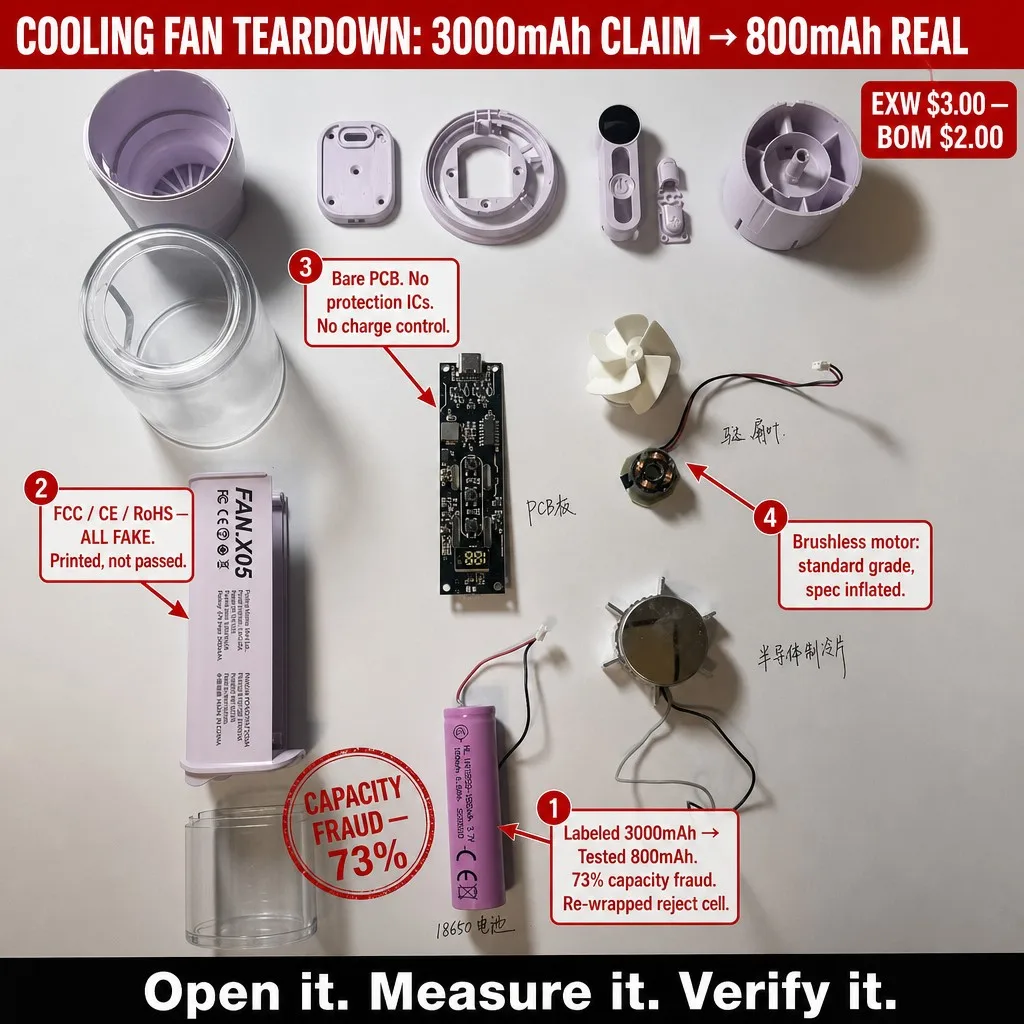
$3.00 EXW. $2.00 BOM. 3000mAh Claim. 800mAh Reality.
We sourced a handheld cooling fan at $3.00 EXW from a manufacturer in the Zhejiang cluster and performed a full component-level teardown. The unit's actual component cost is approximately $2.00 — leaving a $1.00 factory margin that explains the quality of every part inside.
This is the third in our series of battery-capacity fraud audits. The findings follow the same pattern we have documented across 40+ products: inflated specifications, re-wrapped battery cells, and certification marks that are printed rather than passed.
Battery: Labeled 3000mAh — Tested 800mAh
The product shell claims a 3000mAh battery. Inside, the unit uses a single pink-wrapped 18650 lithium-ion cell. We removed the cell and ran a full discharge test on a calibrated capacity tester.
Result: 800mAh actual capacity — 73% below the 3000mAh claim.
This is not a rounding error or a manufacturing tolerance. 73% of the advertised capacity simply does not exist. The cell is a re-wrapped reject or factory-second unit:
- No manufacturer branding on the can
- No date code
- No lot traceability
- Inconsistent cell chemistry (apparent by discharge curve shape)
A genuine 3000mAh 18650 cell from an authorized manufacturer costs approximately $1.10–1.40 at volume. This cell costs under $0.40. The factory saves roughly $0.70 per unit by installing a counterfeit cell — and passes the entire risk to the importer.
Why Battery Capacity Is the Most Common Fake Spec in This Category
Of every parameter on a handheld fan spec sheet, battery capacity is the easiest to falsify and the hardest to verify without disassembly:
| Parameter | Verification difficulty | Fraud frequency |
|---|---|---|
| Battery capacity (mAh) | Requires physical removal + discharge test | Very high — most common |
| Motor RPM | Requires tachometer test | High |
| Cooling output (Peltier ΔT) | Requires thermal measurement | Medium |
| IP rating | Requires environmental chamber | Medium |
| Charging specs | Visible on label, rarely tested | Low |
There is no way to catch battery capacity fraud from a catalog photo, a spec sheet, or a sample unit that passes a quick functional test. The capacity claim can only be verified by opening the product and running a controlled discharge test.
PCB: Bare Board. No Protection Circuitry.
The black PCB carries the minimum component count to drive the brushless motor and the Peltier cooling module. Missing from the board:
- Overcharge protection IC
- Over-discharge cutoff
- Short-circuit protection
- Cell temperature monitoring
- Charge current limiting (accepts whatever the USB source delivers)
A protected 18650 cell or a proper BMS (battery management system) IC adds $0.15–0.30 to the BOM. Without it, the cell operates unprotected. One charge cycle on a non-compliant charger, one internal short from a manufacturing defect, and the cell goes into thermal runaway.
Certifications: All Marks Are Printed, None Verified
The housing carries FCC, CE, and RoHS marks. Based on the component-level findings:
| Mark | Observed risk |
|---|---|
| FCC | No EMI filtering on the PCB. Motor driver switching noise is a likely Part 15 radiated-emission concern. |
| CE | No battery protection circuit; no compliant charging circuit — potential LVD (2014/35/EU) concerns. |
| RoHS | Re-wrapped 18650 cells from unverified channels present hazardous-substance compliance uncertainty; material/XRF testing required. Solder and PCB materials unverified. |
These marks are not evidence of compliance. They are decoration applied at the same factory that under-filled the battery.
The Financial Reality
| Item | Amount |
|---|---|
| Component cost (BOM) | ~$2.00 |
| EXW factory price | $3.00 |
| Landed cost (estimated) | ~$4.50 |
| Typical retail price | $19.99 |
| Advertised capacity | 3000mAh |
| Actual capacity | 800mAh |
The customer expectation gap: 4 hours of cooling claimed, approximately 1 hour delivered. The review that follows this experience is a one-star time bomb. The return and chargeback costs exceed the $1.00 saved on the cell by orders of magnitude.
What We Do at BaiSourcing
Every battery-powered product we audit includes:
- Cell removal and controlled discharge testing on calibrated capacity testers
- Cell provenance verification: manufacturer branding, date codes, chemistry verification
- BMS/protection circuit audit: overcharge, over-discharge, short-circuit, thermal protection
- Certification cross-check: FCC, CE, UL, RoHS claims verified at the component level
- Full BOM cost breakdown with component-level pricing
Wholesale Handheld Fan & Cooling Fan Price Guide
Sourcing portable fans or cooling fans from China? Compare any supplier quote against the real factory cost benchmark: entry fans start around $3 EXW, quality handheld fans with genuine 18650 cells run $6-$13.50, and premium engineered fans reach $38. The biggest cost drivers are battery grade (A/B/C cells), motor type, and blade balance. If a quote is far below the BOM floor, the battery is likely a lower-grade or re-wrapped cell — confirm with a discharge test.
Verify your fan supplier quote before you order
Wholesale Cooling Fans: Factory Price Benchmark
Buying Cooling Fans in bulk from China? This teardown sourced a unit at $3 EXW with a $2 BOM —and found the battery labeled 3000mAh tested at only 800mAh, a 73% capacity fraud. Before you sign a PO, verify the battery grade against the real BOM —that is exactly what this teardown did, component by component.
Cooling Fan sourcing & BOM audit → /pages/fans-air-sourcing
Start a Free Risk Screen → /pages/contact