
Same BLDC Motor Type, Different Speed, Different Design: What a Teardown Reveals
When sourcing consumer electronics from China, specifications alone rarely tell the full story. Here is what physical component verification uncovers.
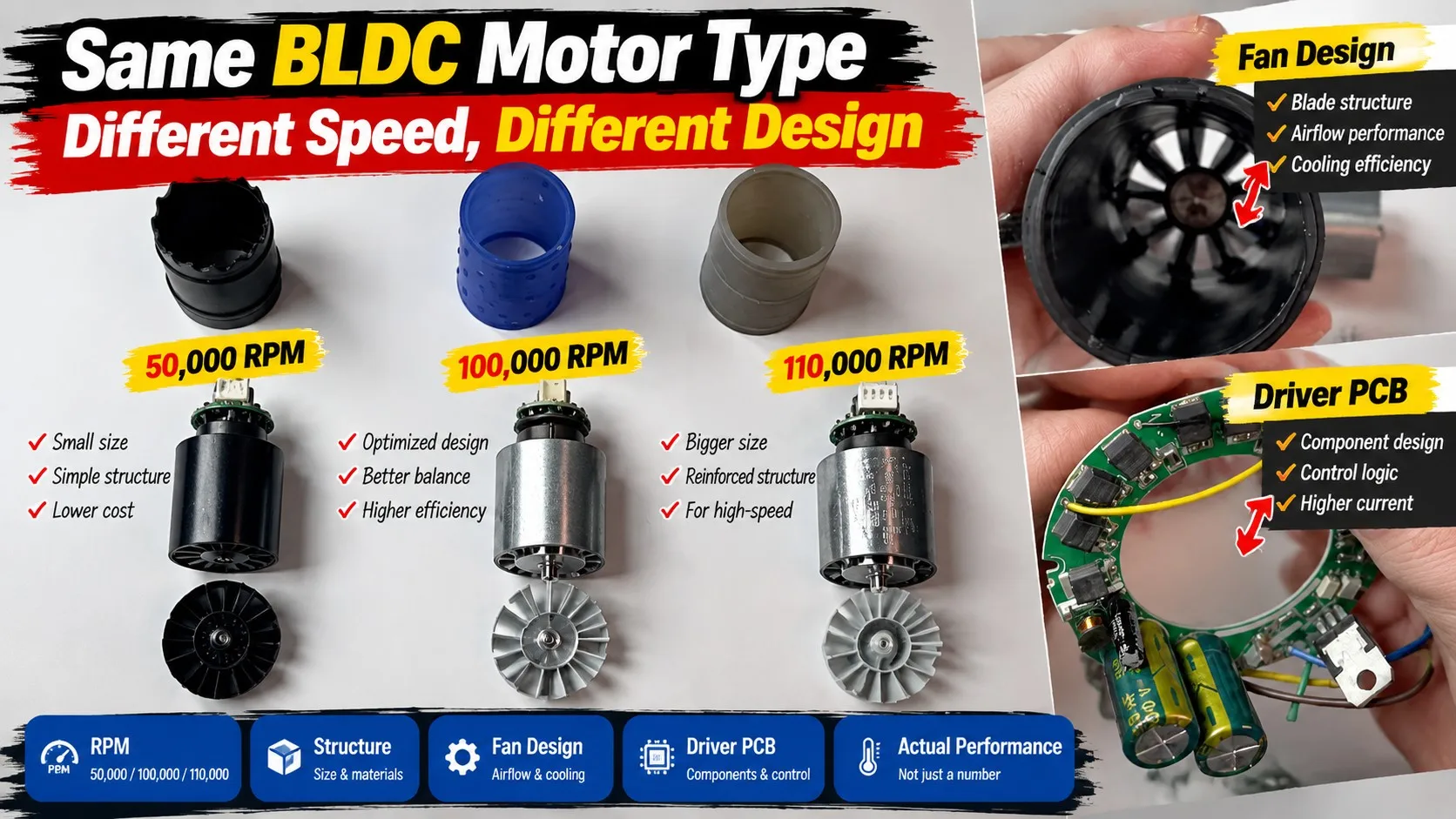
When sourcing consumer electronics from China, it is common to compare products based on specifications such as motor type, RPM, battery capacity, or power.
But specifications alone rarely tell the full story.
A recent teardown of three BLDC motor assemblies shows why. The three motors are used in similar consumer products, but their claimed or measured speeds are significantly different:
- 50,000 RPM (Small size, simple structure, lower cost)
- 100,000 RPM (Optimized design, better balance, higher efficiency)
- 110,000 RPM (Bigger size, reinforced structure, high-speed rating)
At first glance, they may look like the same type of motor. After taking them apart, the engineering differences become much more obvious.
1. BLDC Does Not Mean the Same Motor
All three assemblies use a BLDC (Brushless DC) motor architecture. But calling something a BLDC motor tells you very little about the actual engineering level of the product.
Motor performance depends on much more than the motor category. The overall system includes:
- Motor construction & material grades
- Rotor and stator dimensional design
- Motor diameter and magnetic flux volume
- Impeller or fan blade geometry
- Driver PCB architecture & electronic components
- Cooling structure & thermal dissipation paths
- Control strategy, firmware algorithm & power input
Two products can both claim to use a "high-speed BLDC motor" while having completely different internal designs. That is why component-level verification matters.
2. RPM Is Only One Number
The biggest difference in this teardown is the claimed speed: 50,000 RPM vs. 100,000 RPM vs. 110,000 RPM.
That creates an obvious question for procurement managers:
No. Increasing rotational speed creates exponentially higher engineering requirements. As rotational speed increases, the design must strictly account for:
- Rotor dynamic balancing: Preventing catastrophic high-frequency wobble
- Bearing durability & lubrication: Withstanding extreme thermal friction
- Mechanical tensile strength: Resisting centrifugal expansion
- Aerodynamic drag: Power consumption scales quadratically with speed
- Impeller geometry & clearance: Preventing housing rubbing
- Electrical current & heat dissipation: Preventing coil burning
- Vibration dampening: Requiring tailored silicone sleeves
A high RPM number on a product specification sheet is therefore not enough to determine whether the product will actually perform better in the field.
3. The Fan Design Changes With the Motor
The teardown clearly highlights radical differences in the fan and impeller structures.
The fan is not simply an accessory attached to the motor shaft. It is the critical component determining how rotational kinetic energy converts into usable static pressure and linear airflow.
Different fan designs drastically impact:
- Airflow volume (CFM / m³/h) and focused exit velocity (m/s)
- Static air pressure across dense thermal heat coils
- Aerodynamic efficiency and power drain
- Acoustic pitch, decibel levels, and perceived noise quality
- Motor thermal self-cooling circulation
This is especially vital for products such as high-speed hair dryers, portable jet blowers, mini vacuum cleaners, air dusters, and personal ventilation devices.
A supplier may advertise a higher motor RPM, but if the impeller and air duct are poorly matched, the final product will fail to deliver the expected performance.
4. The Driver PCB Is Part of the Motor System
Another easily overlooked component is the driver PCB. A high-speed BLDC motor requires sophisticated electronic commutation to operate reliably.
During a product teardown, we examine:
- PCB architecture & thermal layout: Heat dissipation for high-current MOSFETs
- Power components & capacitor grades: Filtering high-frequency ripple
- Driver IC selection: Sensorless FOC (Field-Oriented Control) vs. basic square-wave
- Component quantity & redundancy: Over-current, over-voltage & thermal protection
- Wiring & assembly craftsmanship: Solder quality and high-temperature insulation
A simple specification sheet may claim “110,000 RPM BLDC Motor”, but the internal PCB tells the true story of how that motor is being driven and protected.
5. Why Buyers Should Not Verify Only the Datasheet
When evaluating a supplier, there are three distinct layers of information:
Supplier Claim: What does the supplier verbally say? (e.g., "110,000 RPM BLDC motor.")
Product Specification: What is documented on the quotation, datasheet, or packaging? (Documented, but still unverified.)
Physical Verification (The Teardown): What is actually inside the physical product? Inspecting Motor → Fan → PCB → Battery → Materials → Construction.
6. What Should You Verify When Sourcing a Consumer Product?
Depending on the product, a structured verification process examines:
The Key Lesson: Don't Buy the Specification. Verify the Product.
A supplier's quotation tells you what they say the product is. A teardown helps you understand what the product actually contains.
You don't always need a more expensive product. You need to know what you are actually paying for.
8-in-1 Premium High-Speed BLDC Air Styler (Model: RFS013)
110,000 RPM high-speed BLDC motor, intelligent NTC temperature control, and complete factory BOM verification available.
Joe Bai
Founder & Sourcing Partner at BaiSourcing
Helping global brands, retailers, and product teams discover winning products, verify Chinese manufacturers, audit BOM quotes, and eliminate sourcing risks. Connect on LinkedIn →
Looking for Products or Sourcing Support in China?
Whether you're exploring new product opportunities or looking for reliable manufacturers, BaiSourcing helps you discover suitable products, compare suppliers, evaluate costs, and build a reliable sourcing pipeline in China.