Factory Verification in China: How to Evaluate Supplier Manufacturing Capability Beyond Quotations
Learn how to evaluate Chinese factories beyond quotations. BaiSourcing explains production control, quality inspection, assembly processes, and supplier verification.

Executive Summary: Beyond Factory Showrooms and Capacity Claims
When international brands and procurement directors evaluate Chinese manufacturing partners, the initial conversation almost always revolves around ex-works pricing and monthly production capacity (e.g., "We can produce 100,000 units per month"). However, output volume alone is an incomplete metric of manufacturing competence. A supplier's ability to produce 100,000 units does not guarantee that those units will function reliably across their warranty period. True product quality is not inspected into a finished product at the shipping dock—it is engineered into the production line across Incoming Quality Control (IQC), assembly consistency, in-line dielectric/functional testing, and aging cycles. This guide breaks down what procurement teams must evaluate on the factory floor before signing a purchase order.
Why Factory Capacity Does Not Equal Product Reliability
In China's high-speed hair dryer, electric shaver, and small appliance hubs (such as Cixi and Dongguan), dozens of suppliers share similar factory footprints and modern SMT machines. Yet, when products reach overseas consumers on Amazon or retail shelves, defect rates range from under 0.8% for premium tier manufacturers to over 8.5% for low-tier assemblers.
The difference lies in operational rigor across the four foundational stages of mass production:
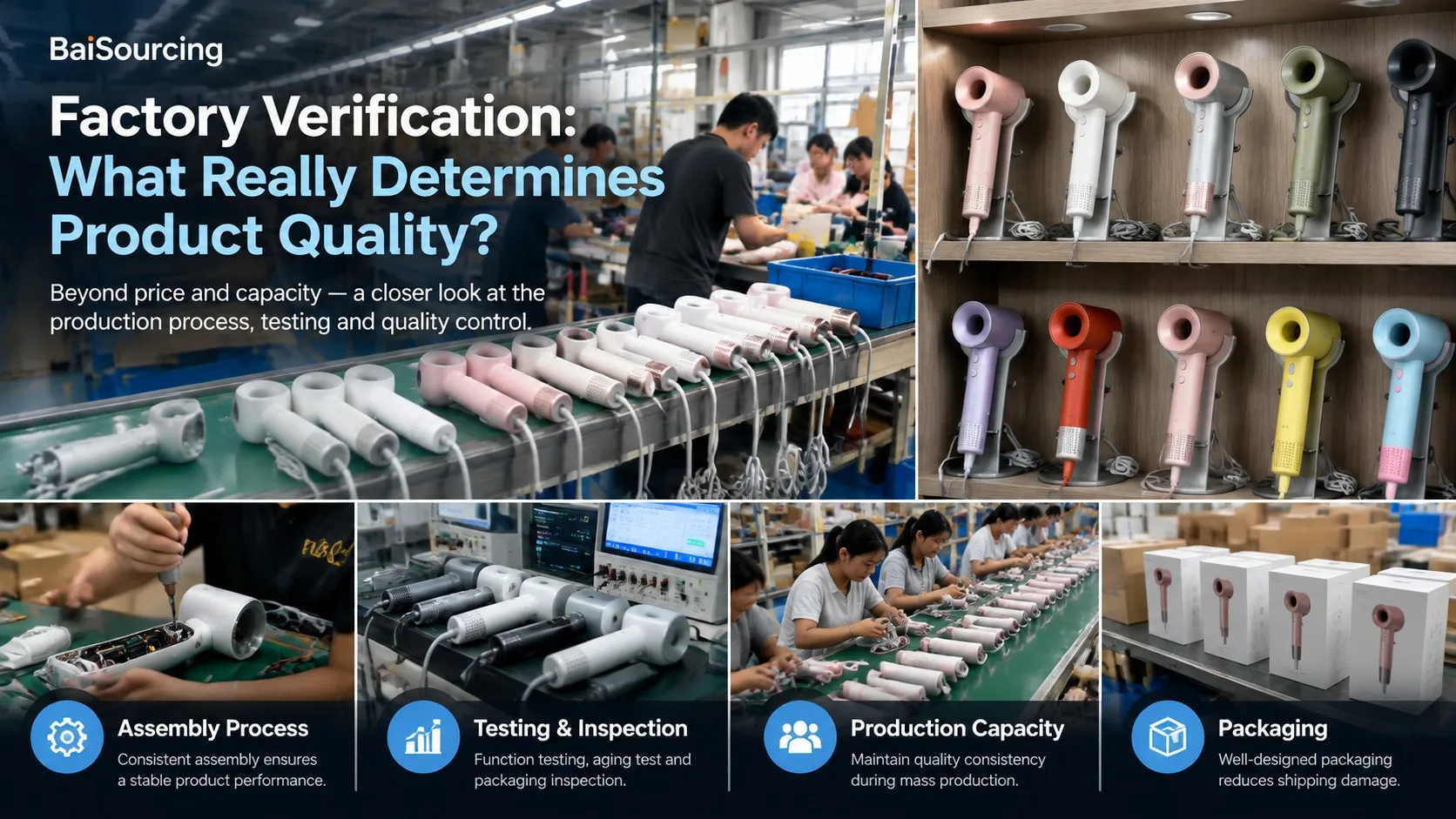
1. Component Preparation & Incoming Quality Control (IQC)
Before a single worker touches the final assembly line, the raw materials and sub-components dictate the quality ceiling of the production run:
- Plastic Housings: Virgin ABS/PC granules vs. regrind/recycled plastic that degrades structural impact resistance.
- Motor Assemblies: CNC machined aluminum turbine BLDC motors vs. stamped sheet metal or brushed motors.
- PCBA Driver Boards: Automated SMT placement with AOI (Automated Optical Inspection) vs. manual hand-soldered boards.
- Internal Wiring & Insulation: High-temperature silicone wiring with heat-shrink tubing vs. standard PVC wiring prone to melting.
2. Assembly Line Process Control & Torque Management
For high-speed rotary appliances like hair dryers (operating at 110,000 RPM) and oscillating grooming tools, manual assembly variance is the #1 cause of early customer returns:
Key Assembly Checkpoints Observed on Factory Audits:
- Electric Screwdriver Torque Calibration: Do assembly stations use electric screwdrivers with preset automatic torque cut-offs to prevent stripped plastic screw posts?
- Silicone Gasket Seating: Are waterproof O-rings and noise-damping silicone motor boots seated with dedicated fixtures or manually pushed into place?
- Wire Routing Grooves: Are internal wires guided through dedicated structural channels to prevent pinching when housing halves are snapped together?
3. Comprehensive In-Line Testing & Aging Cycles
A reliable factory does not rely on post-packaging sample inspection (OQC)—testing must be integrated directly into the line flow:
- 100% Hi-Pot Dielectric Voltage Test: Applying 1500V–3750V AC between live conductors and external touch surfaces to guarantee zero electrical shock hazard.
- Laser Tachometer RPM Verification: Real-time confirmation that every motor hits its specified RPM band under load.
- Continuous Run Aging Chamber: Sampling units from each batch and running them at maximum temperature for 4–8 hours to identify infant component mortality before shipping.
4. Packaging & Drop Test Integrity
A product can function perfectly off the line but arrive broken if packaging engineering is neglected. Professional OEM suppliers subject master cartons to ISTA 1A drop tests (10-point drop onto concrete) and simulate vibration profiles matching international maritime and courier transport.
Supplier Quality Tier Benchmark: Workshop vs. Tier-1 OEM
How factory engineering standards translate into real-world defect rates and sourcing costs:
| Quality Management Dimension | Budget Assembly Workshop | Standard Export Factory | Tier-1 Dedicated OEM / ODM |
|---|---|---|---|
| Incoming Material (IQC) | Visual check only; no test instruments | Batch sampling per MIL-STD-105E | Full vendor audits + lot traceability |
| In-Line Assembly Control | Manual screwdrivers; no SOP charts | Electric screwdrivers with visual SOP | Calibrated auto-torque + Poka-Yoke jigs |
| Electrical Safety Testing | Spot checks; no Hi-Pot logging | 100% Hi-Pot test without data logging | 100% Hi-Pot, leakage & ground bond logging |
| Aging Test Duration | None (powered on for 10 seconds) | 30 minutes to 1 hour batch sampling | 2 to 4 hours continuous cycling chamber |
| Expected Amazon / Retail Defect Rate | 6.5% – 12.0% | 2.0% – 3.5% | < 0.6% |
5 Things Buyers Must Inspect During a Factory Audit
-
✓
1. Check the Defect Quarantine Area: Look for the red-tagged "Non-Conforming Material" bin next to the line. An empty bin in a busy factory often means defects are simply pushed back into production.
-
✓
2. Verify Calibration Labels on Test Equipment: Ensure Hi-Pot testers, digital scales, and oscilloscopes have valid third-party calibration stickers dated within the past 12 months.
-
✓
3. Inspect the Golden Sample Cabinet: Confirm the factory maintains an approved "Golden Sample" and "Limit Sample" signed by the client, placed directly at the final QC station for visual comparison.
-
✓
4. Audit SMT & Component Warehouse Storage: Verify that sensitive electronic components and lithium batteries are stored in temperature- and humidity-controlled environments (RH < 60%).
-
✓
5. Review Sub-Tier Supplier Lists: Request the official vendor list for critical safety components (motors, batteries, thermal fuses) to prevent unannounced sub-supplier substitution.
Pre-Audited Personal Care & Appliance Platforms
Explore our verified manufacturing platforms with audited assembly lines, calibrated torque assembly, and compliant thermal loops:
8-in-1 Premium Air Styler & Hair Dryer (Model: RFS013)
110,000 RPM BLDC platform with CNC aluminum turbine, dual NTC thermal safety, and audited assembly tooling.
6-in-1 Multi-Function Air Styler (Model: RFS014)
Coanda attachment system with modular magnetic lock, high-temperature PCBA insulation, and CE/FCC compliance.
BaiSourcing Supplier Verification Standard: Small Home Appliances
IQC Rigor: 9.5/10 · Assembly Line Traceability: 9.2/10 · Electrical Safety Testing: 9.6/10
Planning a Factory Audit or Need On-Site Supplier Verification in China?
Don't rely on remote PDF audit reports or promotional factory videos. BaiSourcing conducts comprehensive on-site engineering audits, assembly line inspections, and BOM verification across Zhejiang and Guangdong.