How Chinese Factories Reduce Product Cost: The Real Strategies Behind Competitive Pricing
Learn how Chinese factories reduce product costs through product design optimization, supply chain integration, component sourcing, and manufacturing efficiency.

Executive Summary: The Real Drivers of Chinese Pricing Competitiveness
When global brands source consumer electronics and small appliances from China, they often ask: "Why can Chinese manufacturers deliver such aggressive pricing?" The common assumption is that lower labor wages or raw material compromises are the primary drivers. In reality, modern Chinese manufacturing competitiveness is built on structural engineering efficiency: Design for Manufacturing (DFM) structural consolidation, tightly coupled hyper-local supply chain clusters, tiered component allocation, and automated assembly line pacing. Understanding these legitimate cost-engineering mechanisms allows overseas brands to collaborate effectively with OEM suppliers—securing 20%–35% legitimate cost reductions without sacrificing product reliability.
Step 1. Cheap vs. Cost-Effective: The Fundamental Distinction
There is a critical distinction between a cheap product and a cost-engineered product:
- Cheap Products (Corner-Cutting): Reduce cost by substituting recycled battery cells, eliminating BMS protection ICs, using unhardened plastic gears, and skipping aging tests. Defect rates soar above 8%.
- Cost-Engineered Products (Smarter Manufacturing): Reduce cost by integrating structural parts, eliminating unnecessary fasteners, sourcing from cluster sub-suppliers, and optimizing injection cycle times. Defect rates remain under 0.8%.
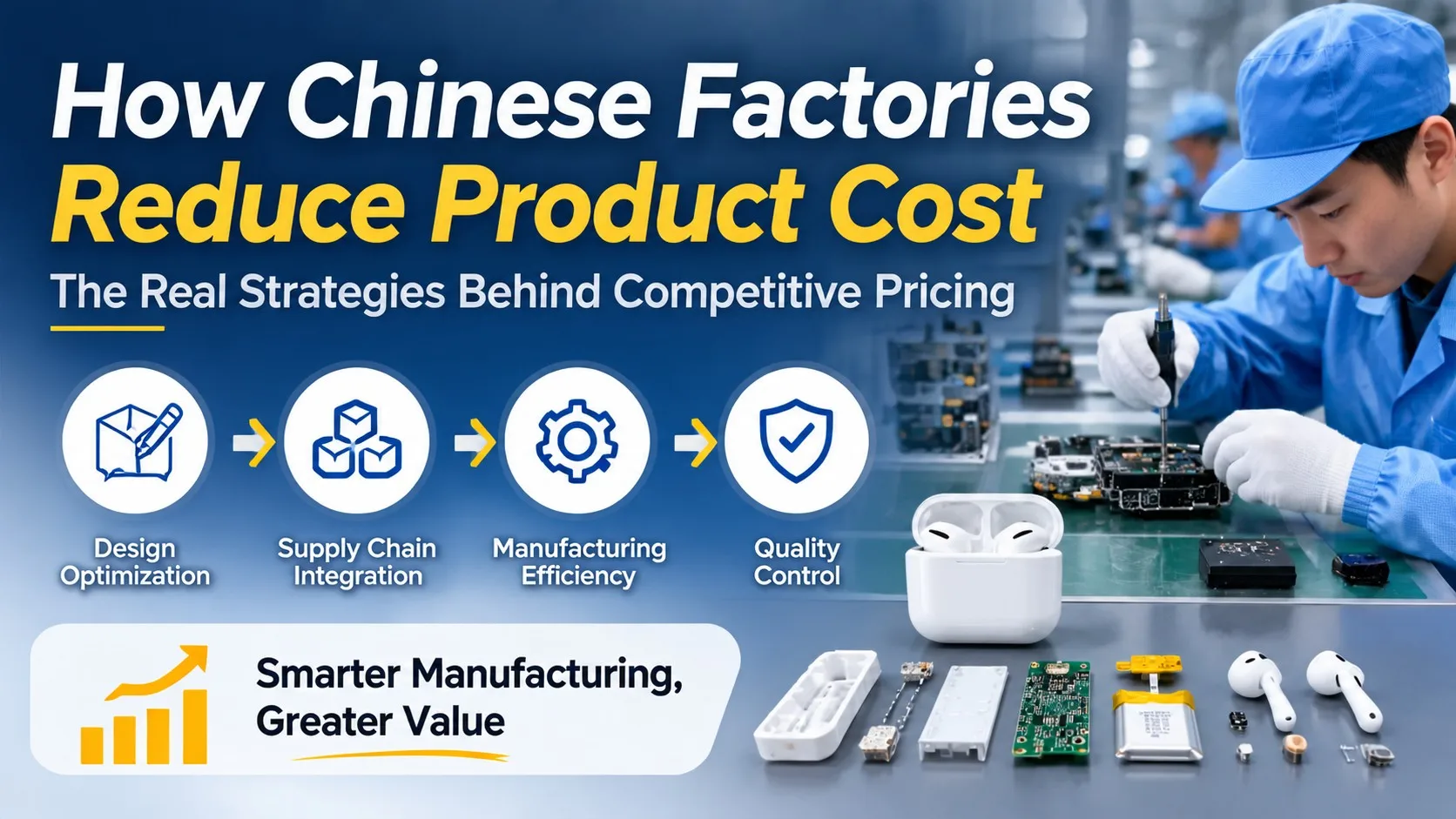
Step 2 & 3. The 6 Engineering Engines Behind Factory Cost Reductions
1. Structural Part Consolidation (DFM)
Experienced Chinese tooling engineers optimize CAD structures before cutting steel molds:
- Consolidating Parts: Merging internal chassis brackets into outer housing ribs reduces tool count from 6 molds to 3 molds, saving $8,000+ in tooling amortization.
- Snap-Fits vs. Screws: Replacing 8 threaded metal screws with molded snap-fits shaves 18 seconds off per-unit assembly cycle times.
2. Hyper-Localized Industrial Supply Chain Clusters
In China's core manufacturing hubs, every sub-tier supplier operates within a 30-minute logistics radius:
- Shenzhen (Bao'an / Longhua): SMT placement, Bluetooth SoCs, lithium battery packs, sensor modules.
- Dongguan (Chang'an / Tangxia): High-precision injection molds, CNC metal parts, silicone tooling.
- Ningbo / Cixi (Zhejiang): High-speed BLDC motors, thermal heating elements, personal care platforms.
- Yiwu / Wenzhou: Retail gift boxes, blister packaging, molded paper pulp trays, cables.
3. Volume-Integrated Component Sourcing
A Tier-1 OEM factory producing 150,000 units monthly across multiple client accounts purchases standard components (e.g., JL Bluetooth SoCs, 18650 cells, microswitches) in bulk directly from semiconductor and battery manufacturers at wholesale contract rates 25%–40% lower than small independent buyers can negotiate.
4. 3-Tier Component Allocation Matrix
Smart engineering teams divide the product into three distinct investment tiers:
- Tier 1: Customer-Visible Touchpoints (High Investment): Dual-spray gradient finish, tactile button feel, weighted chassis feel.
- Tier 2: Core Performance Drivers (Non-Negotiable Investment): Motor RPM stability, battery protection ICs, UL-certified wiring.
- Tier 3: Hidden Internal Brackets (Aggressive Cost Optimization): Standard virgin ABS, unpolished internal ribbing, standard zinc-plated fasteners.
5. Assembly Line Balancing & Semi-Automation
Factories optimize operator movement through workstation line balancing:
- Standardizing assembly operations down from 22 manual touchpoints to 12 optimized workstations.
- Deploying pneumatic screw feeders, automated PCB dispensing jigs, and laser optical tachometer inspection fixtures.
6. Material Scrap & Injection Wall-Thickness Optimization
Reducing plastic wall thickness from 2.2mm to 1.8mm with strategically placed reinforcement ribs saves 15% plastic weight and reduces injection cooling time by 4 seconds per cycle. On a 100,000-unit run, saving $0.12 per housing represents $12,000 in direct material savings.
Step 4. Cost Engineering Comparison: Cutting Corners vs. Smart DFM
How illegitimate cost cutting compares with professional factory cost engineering:
| Engineering Dimension | Illegitimate Corner-Cutting | Smart Chinese Factory Cost Engineering |
|---|---|---|
| Battery Selection | Recycled B-grade cells with high internal resistance | Standardized Grade-A 16500 / 18650 domestic tier-1 cells |
| Structural Design | Thin, brittle recycled plastic prone to cracking | Virgin ABS with structural ribs and integrated snap-fits |
| PCBA Architecture | Single-IC board without OVP/OCP protection | Optimized MCU layout with standard diode & MOS protection |
| Assembly Process | Manual screwdrivers; uncalibrated torque | Auto-feed pneumatic screwdrivers + line balancing |
| Mass Production Defect Rate | 6.5% – 12.0% (High Returns) | < 0.8% (Export Grade) |
Step 5 & 6. Buyer Sourcing Checklist: How to Validate Factory Cost Claims
-
✓
1. Request a DFM (Design for Manufacturing) Review Report: Ask the factory engineering team for structural feedback before mold cutting: part consolidation, parting line optimization, and draft angle verification.
-
✓
2. Audit Tier-2 Supplier Proximity: Confirm that critical sub-components (motors, batteries, PCBA, packaging) are sourced within the local industrial cluster to prevent logistics bottlenecks.
-
✓
3. Inspect Assembly Workstation Cycle Times: Review the factory's Standard Operating Procedure (SOP) charts at each workstation to verify balanced takt time and pneumatic tooling.
-
✓
4. Verify Sub-Component Batch Traceability: Ensure raw plastic bags indicate virgin material lot numbers and battery cells carry verifiable date-code markings.
-
✓
5. Conduct Independent Physical BOM Teardown: Disassemble pre-production golden samples to confirm that all internal components match the contractual BOM specifications.
Pre-Audited Hardware Platforms Engineered for Cost & Reliability
Explore our verified manufacturing platforms optimized through professional DFM, local supply chains, and transparent BOM structures:
8-in-1 Premium Air Styler & Hair Dryer (Model: RFS013)
110,000 RPM BLDC platform with CNC aluminum turbine, dual NTC thermal safety, and audited assembly tooling.
Bluetooth Audio Sports Glasses
Open-ear directional audio built into lightweight sports eyewear with dual-mic ENC.
BaiSourcing DFM & Cost Engineering Benchmark
DFM Structural Rigor: 9.6/10 · Supply Chain Integration: 9.7/10 · Assembly Efficiency: 9.4/10
Need Professional BOM Cost Auditing or DFM Optimization?
Don't leave product cost optimization to guesswork. Send your product sample, CAD files, or supplier quotations to BaiSourcing for an independent physical teardown, BOM cost breakdown, and DFM optimization audit.