
How Chinese Factories Build Their Ex-Factory Price: A Buyer's Guide to Supplier Quotations
A supplier's quotation is only the final number. To source effectively from China, buyers need to understand what is actually inside that number.
When sourcing products from China, buyers often start with one question:
“What is your best price?”
The supplier replies:
“$60 per unit.”
Then the buyer compares it with another supplier offering $55, and another offering $48.
But are these really cheaper suppliers? Not necessarily.
Different quotations can represent different materials, components, manufacturing processes, quality standards, packaging, production volumes, and even different levels of supplier margin.
For professional procurement teams, the important question is not simply “Who has the lowest price?” It is:
This guide explains how to break down a Chinese supplier quotation and what buyers should verify before placing an order.
1. What Is an Ex-Factory Price?
An ex-factory price generally refers to the price of the product at the supplier's factory or another agreed location before international transportation and destination-side costs.
However, buyers should always confirm the exact Incoterm used in the quotation.
Under EXW (Ex Works), the seller's obligation is relatively limited: the goods are made available to the buyer at the named place, and the buyer generally takes responsibility for subsequent transport and associated costs and risks.
A simplified purchasing cost structure looks like this:
→ China-side logistics
→ Export-related costs
→ International freight
→ Insurance, where applicable
→ Import duties and taxes
→ Destination charges
→ Inspection / rework / quality-related costs
Therefore, comparing suppliers only by their unit quotation can produce a misleading result.
2. What Is Inside a Chinese Factory Quotation?
For many consumer products, the factory price can be viewed as a combination of several major cost blocks:
The exact structure varies significantly by product, factory, production volume, and manufacturing process. For example, a product containing a large battery, high-speed motor, PCBA, and metal housing will have a very different cost structure from a simple molded plastic commodity.
An Illustrative Cost Structure
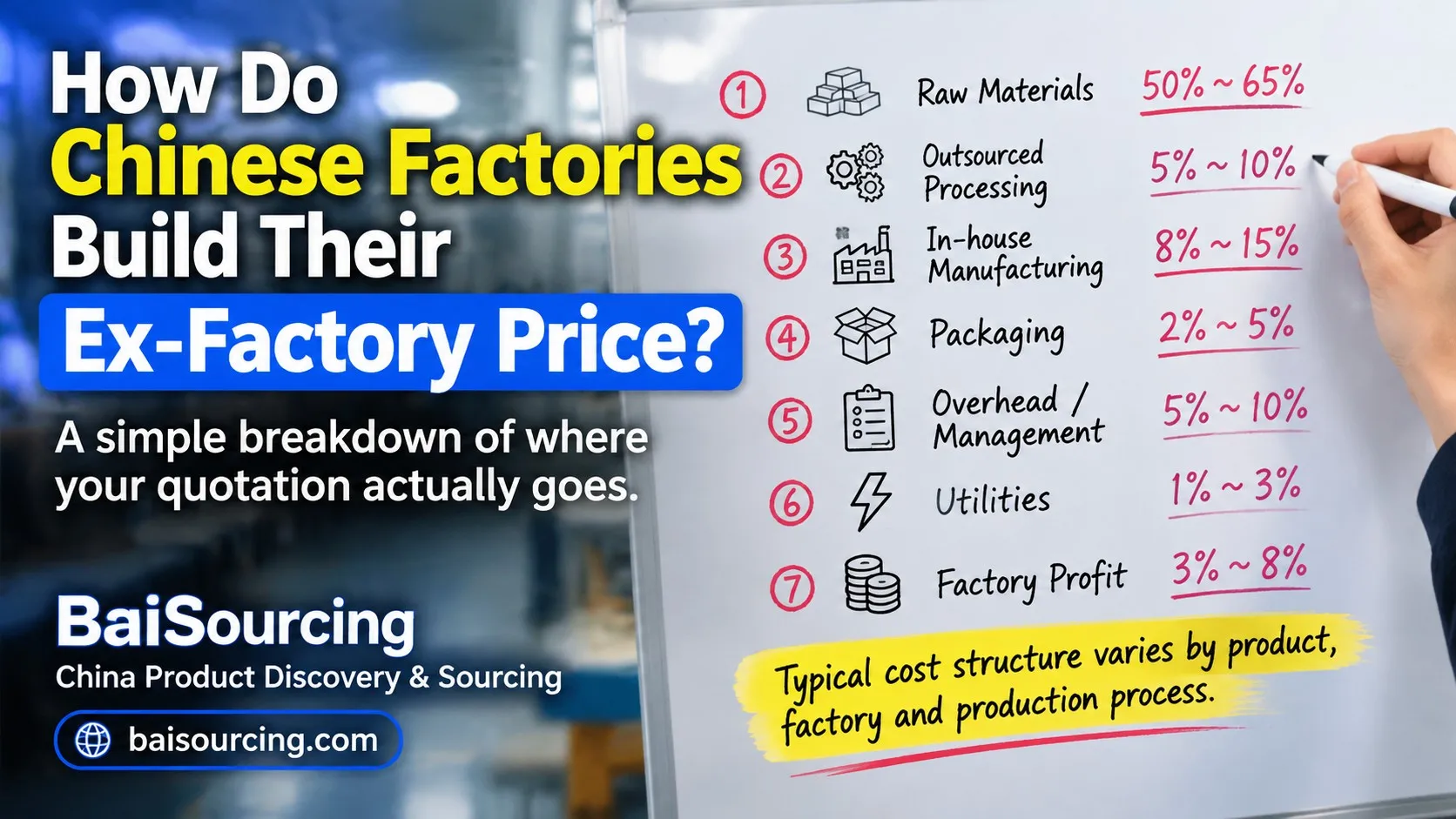
For one typical manufacturing scenario, the major cost categories break down roughly as follows:
- Raw materials & components: 50% – 65%
- Outsourced processing: 5% – 10%
- In-house manufacturing: 8% – 15%
- Packaging: 2% – 5%
- Overhead & management: 5% – 10%
- Utilities: 1% – 3%
- Factory profit: 3% – 8% (varies by supplier and product)
These percentages are illustrative rather than universal. The purpose is to show buyers how a quotation should be analyzed, not to suggest that every Chinese factory uses the identical cost structure.
3. Raw Materials Usually Deserve the Most Attention
For many consumer electronics and small appliances, materials and components are among the largest cost drivers.
Consider a small appliance whose BOM includes: plastic housing, motor, battery, PCBA, switches, connectors, wires, metal parts, magnets, bearings, display/LEDs, and packaging materials.
Supplier A quotes $10.00 / unit, while Supplier B quotes $7.80 / unit. The difference is rarely supplier profit margin. The second supplier may be using:
- A lower-grade battery cell (recycled or unbranded)
- A cheaper motor (brushed vs. BLDC, or low-RPM)
- Thinner, secondary-regrind plastic resins
- A simplified PCBA without protective ICs
- Lower-cost connectors without gold plating
- Fewer thermal protection components
This is why price comparison without specification comparison is dangerous.
4. Why Can Two Chinese Suppliers Quote Very Different Prices?
Suppose three factories quote for what appears to be the same product:
At first glance, Supplier A appears to be the obvious winner. But you must ask:
Are they using the same motor? Battery? PCBA? Plastic resin? Metal thickness? Surface finish? Testing standard? Packaging? Accessories?
If not, you are not comparing the same product. A $60 product and a $90 product can look identical from the outside while being completely different internally. This is particularly vital for hair dryers, electric toothbrushes, shavers, fans, massage devices, and portable electronics.
5. The Quotation Should Always Be Connected to a Specific Product Specification
One of the biggest procurement mistakes is asking “How much is this product?” without defining exactly what “this product” means.
A professional RFQ should clearly identify:
- Product model & revision version
- Key functional specifications
- Housing material requirements
- Battery capacity & chemistry
- Motor type, speed & torque specs
- PCBA layers & protection circuitry
- Packaging structure & target certifications
- Target order volume & delivery timeline
Instead of: “Please quote this electric shaver.”
Ask: “Please quote the attached shaver with the specified 8500 RPM motor, 400mAh battery with protection board, dual-ring blades, Type-C charging, electroplated housing, gift box packaging, and CE/FCC certification.”
6. Quantity Breaks, MOQ, and Tooling Costs
Ask for Multiple Quantity Breaks: A single unit price tells you very little. Request quotes for 100 pcs, 1,000 pcs, and 5,000 pcs, and ask what drives the variance (material purchasing scale, line setup, or tooling amortization).
MOQ Is a Cost Structure Question: If a supplier requires an MOQ of 2,000 pcs, ask why. Is it packaging printing MOQ, color-matching resin minimums, or component batch sizes? You can often lower the MOQ by adopting standard packaging or standard colors.
Separate Tooling from Unit Price: Always require one-time tooling/mold charges to be quoted separately from recurring unit prices. Clarify mold ownership, expected cavity life, and maintenance obligations.
7. Packaging & Total Cost of Quality
Packaging Affects Landed Freight: Packaging is not just a retail box—it directly impacts carton volume, gross weight, pallet utilization, and container shipping costs. Oversized packaging can easily erase unit price savings.
Calculate Quality Cost: The cheapest quotation becomes the most expensive order if quality fails. Total cost = Unit Price + Defect Rate + Inspection Fees + Rework + Customer Returns + Warranty Claims. Sourcing decisions must combine Cost + Quality + Capability + Reliability.
What Should Buyers Ask Chinese Suppliers Before Ordering?
- Product: Exact model, revision, and standard vs. customized spec breakdown.
- BOM & Components: Battery brand/capacity, motor type, PCBA layers, and material resins.
- Price & Terms: Exact Incoterm (EXW/FOB), currency, validity window, and volume price breaks.
- Production: Real MOQ, tooling lead time, sample lead time, and daily line capacity.
- Quality Control: Incoming material inspection, functional testing, and defect replacement policy.
- Commercials: Tooling ownership terms, payment milestones, and certification compliance costs.
8. Negotiating from Cost Engineering, Not Price Bargaining
The biggest mistake in supplier negotiation is simply demanding: “Your price is too high. Give me a discount.”
Instead, switch to cost engineering:
- Ask if adopting a standardized component or alternative resin grade can lower the BOM cost without hurting performance.
- Ask what specific sub-tier requirement drives the MOQ.
- Analyze the total procurement equation:
Total Cost = Product + Tooling + Packaging + Logistics + Tariffs + Quality Risk.
What We Look at When Evaluating Chinese Suppliers
At BaiSourcing, we evaluate suppliers across four core layers:
- Product: Is this genuinely the exact specification the buyer requires?
- Supplier: Does the factory possess authentic in-house manufacturing capability?
- Cost: Does the quote make engineering sense based on BOM, materials, and processes?
- Execution: Can the supplier maintain quality, capacity, and delivery timelines at scale?
Final Takeaway
When sourcing from China, the quotation is only the starting point. Professional buyers ask: “What is inside this price?” not simply “Can you make it cheaper?”
The best sourcing decisions come from understanding the complete chain: Product Specification → BOM → Manufacturing Process → Supplier Capability → Factory Cost → Final Quotation.
Joe Bai
Founder & Sourcing Partner at BaiSourcing
Helping global brands, retailers, and product teams discover winning products, verify Chinese manufacturers, audit BOM quotes, and eliminate sourcing risks. Connect on LinkedIn →
Need Help Evaluating Chinese Suppliers & Quotations?
Already have a supplier quote, product specification, or target sample? We evaluate quotes from an engineering and manufacturing perspective to protect your margins.