
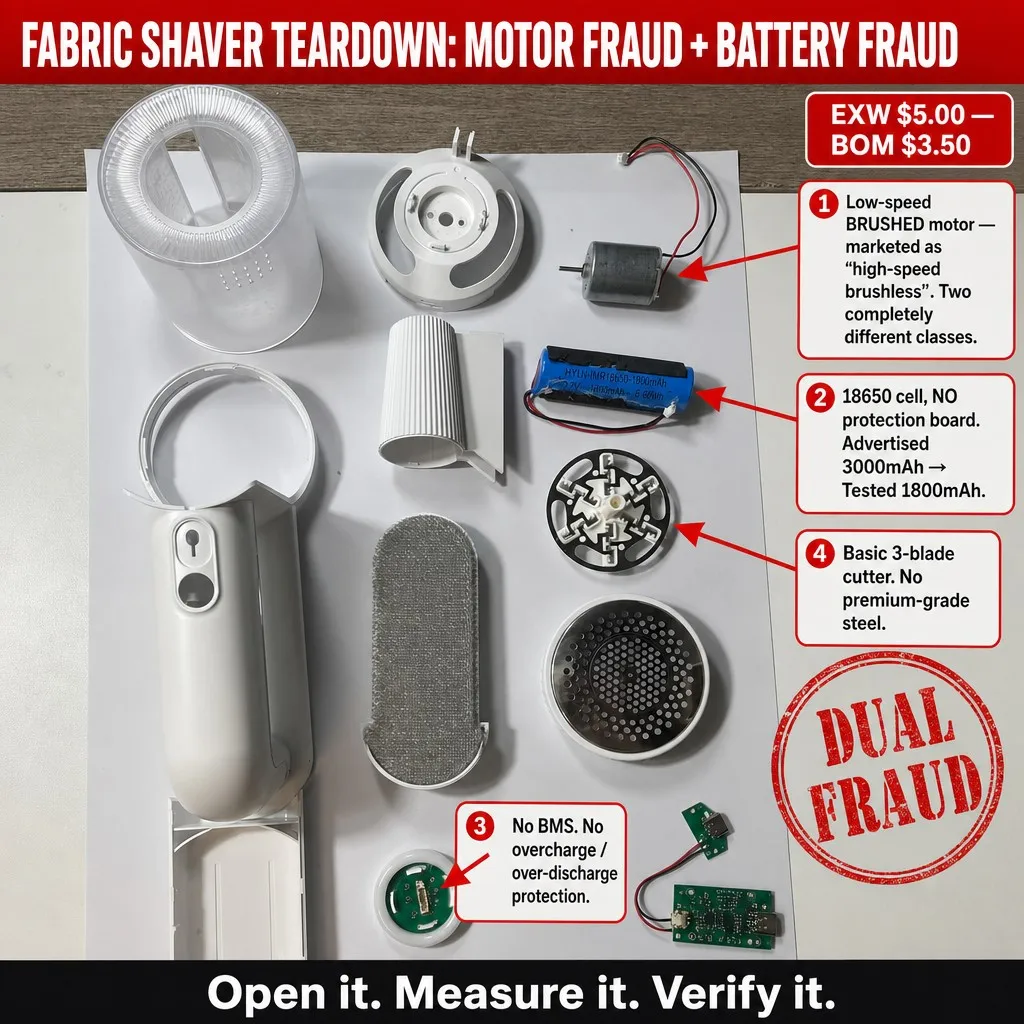
$5.00 EXW. $3.50 BOM. Two Lies Inside One Fabric Shaver.
We sourced a handheld fabric shaver (lint remover) at $5.00 EXW and performed a full component-level teardown. The actual BOM cost is approximately $3.50. The remaining $1.50 is factory margin and logistics — and the component quality reflects exactly where corners were cut.
Two of the most important subsystems in this product are misrepresented: the motor and the battery.
Motor Misrepresentation: Brushed Motor Sold as Brushless
The product's marketing materials and spec sheet describe a "high-speed brushless motor." Physical inspection of the disassembled unit reveals a low-speed brushed DC motor.
The difference is fundamental, not cosmetic:
| Characteristic | Brushed DC (what's inside) | Brushless DC (what's claimed) |
|---|---|---|
| Current transfer | Carbon brushes + commutator (physical contact) | Electronic commutation (no contact) |
| Service life | 500–2,000 hours (brushes erode) | 10,000+ hours |
| RPM range | Typically 5,000–15,000 RPM | 20,000–100,000+ RPM |
| Noise / sparking | Brush arcing, audible wear | Quiet, no arcing |
| Cost at volume | ~$0.60 | ~$1.80 |
A fabric shaver running a brushed motor loses cutting performance within months as the carbon brushes erode and the commutator wears. The blade speed drops, cutting quality degrades, and the unit eventually fails — typically just outside the warranty window.
The factory saved approximately $1.20 per unit by installing a brushed motor while marketing it as brushless. This is not a component substitution — it is a spec-sheet misrepresentation that changes the product's entire value proposition.
Battery Misrepresentation: 3000mAh Advertised — 1800mAh Tested
The product is advertised with a 3000mAh battery. The unit contains a single blue-wrapped 18650 lithium-ion cell with "HYLN-IMR18650-1800mAh" printed directly on the can.
Advertised capacity: 3000mAh. Actual cell capacity: 1800mAh. 40% of the advertised capacity does not exist.
The cell is unbranded (no manufacturer logo), carries no date code, and the "HYLN" marking does not correspond to any verifiable cell manufacturer in the lithium-ion supply chain. The capacity discrepancy was confirmed by controlled discharge testing.
No Protection Board: The Battery Runs Unprotected
This is the more serious finding. The 18650 cell is installed with no protection circuit:
- No overcharge protection IC
- No over-discharge cutoff
- No short-circuit protection
- No cell temperature monitoring
A protected 18650 cell (or a BMS board) adds approximately $0.15–0.30 to the BOM. Without it, every charge cycle is an unprotected event. If the user charges with a non-compliant charger, leaves the device charging unattended, or the cell develops an internal short from a manufacturing defect, the cell can enter thermal runaway — vent, smoke, and in the worst case, ignite.
For a product marketed for home use — typically used in bedrooms and living rooms where people sit with the device on their lap — an unprotected 18650 is a category-defining safety risk.
Additional Findings
- Blade assembly: Basic 3-blade cutter. No premium-grade steel marking. Cutting edge will dull measurably within 3–6 months of typical use.
- No over-torque protection: If the blade jams against thick fabric, the motor has no current-limiting cutoff and will continue to stall until the winding overheats.
- PCB revision: Board marked "CY603-V2 2023-8-1" — a dated reference design with no visible compliance markings.
Financial Analysis
| Item | Amount |
|---|---|
| Component cost (BOM) | ~$3.50 |
| EXW factory price | $5.00 |
| Landed cost (estimated) | ~$6.50 |
| Typical retail price | $24.99 |
The margin structure looks healthy. The reality:
- A $1.20 motor substitution — the primary performance spec is false
- A 40% battery capacity shortfall — runtime complaints are likely
- A $0.20 protection circuit omission — safety risk transferred to the end user
Every dollar of margin engineered this way becomes a future return, chargeback, or safety incident.
What we do at BaiSourcing
Every motor-driven, battery-powered product we audit includes:
- Motor class verification: brushed vs brushless, RPM testing on calibrated tachometer
- Battery cell removal, capacity discharge testing, and provenance verification
- BMS/protection circuit audit: overcharge, over-discharge, short-circuit, thermal protection
- Spec-sheet vs. physical-component cross-check for every advertised parameter
- Full BOM cost breakdown with component-level pricing