
Look Beyond Appearance and Specifications: The 3 Internal Drivers of Reliability & Cost
Two consumer electronic products with identical exterior housings and marketing claims can have a 50% manufacturing cost gap and a 10× difference in operating lifespan. Here is what engineering teardowns reveal behind supplier quotes.
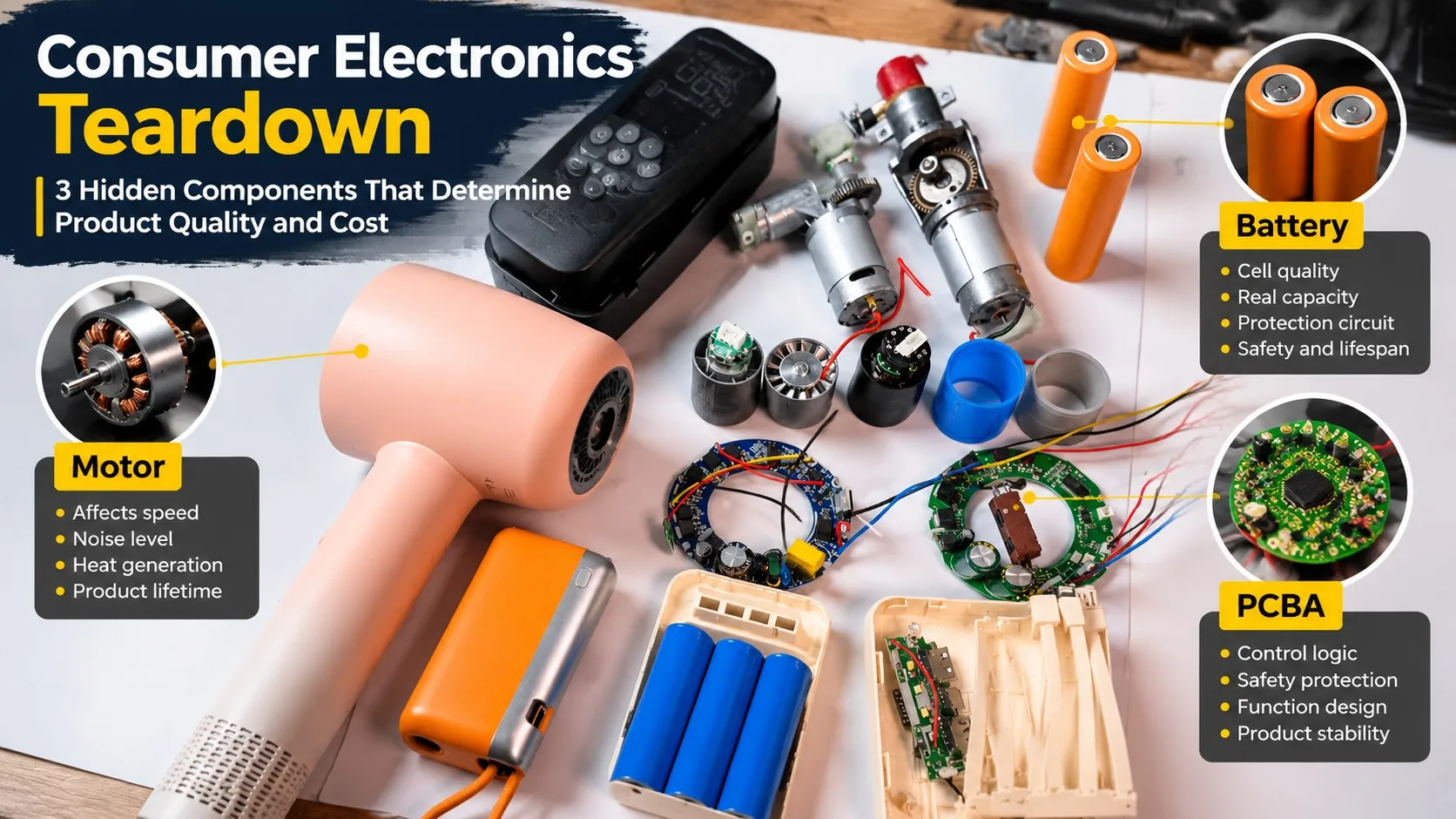
Fig 1.0: Physical engineering teardown of portable electronics — analyzing motor mechanics, battery cell configuration, and PCBA control logic.
Executive Takeaway for Hardware Buyers & Importers
When sourcing from China, relying solely on exterior design, spec sheets, and FOB quotes leaves brand owners vulnerable to hidden quality downgrades. The true commercial value of consumer electronics is dictated by three subsystems: (1) Motor Architecture (Brushed vs. BLDC), (2) Battery Chemistry & Protection Circuitry, and (3) PCBA Control Logic & Thermal Design.
When sourcing consumer electronics from China, most procurement managers start with the same baseline questions:
- What is the unit FOB price at 1,000 / 5,000 pcs?
- What are the available tooling colors and surface finishes?
- What headline specs and marketing features are listed on the catalog?
However, physical teardowns conducted in the BaiSourcing Product Lab consistently demonstrate that two products with almost identical outer shells can exhibit completely different reliability, safety profiles, and production costs. The divergence is never visible on the outside—it is engineered deep inside the bill of materials.
1. Motor System: The Core Mechanical Engine of Product Lifespan
For motorized consumer devices—including portable air inflators, high-speed hair dryers, desk fans, electric shavers, and massage guns—the motor represents between 25% to 45% of the total BOM cost.
When a supplier quotes $6.50 for a portable vacuum or dryer while another quotes $14.80, the difference is rarely factory profit margin—it is almost always the switch from an entry-level brushed motor to a precision three-phase BLDC motor with an electronic speed controller (ESC).
2. Hair Dryer & Thermal Engineering: Marketing Claims vs. Reality
Hair styling tools and high-velocity dryers represent one of the most competitive sourcing categories in Guangdong and Zhejiang. Many OEM catalogs advertise identical claims: "110,000 RPM High-Speed Motor, Negative Ion Technology, Intelligent Heat Control".
However, our teardown evaluations reveal major structural divergences:
🌀 Impeller & Air Duct Aerodynamics
CNC-machined aluminum alloy impellers maintain balance at 110k RPM, while cheap injection-molded plastic fans warp under heat, causing high-pitched resonance and motor stall.
🔥 Dual Thermal Safety Protection
Export-grade units feature an NTC glass-bead temperature sensor sampled 50 times/second plus a physical thermal fuse. Low-cost clones rely only on a crude bi-metallic switch.
3. Battery Subsystem: The Hidden Safety & Capacity Trap
Battery-powered hardware (power banks, cordless fans, grooming tools, smart lamps) presents the highest warranty claim risk if corners are cut during manufacturing.
Two products labeled "10,000 mAh Capacity" can diverge dramatically under the hood:
- Cell Grading (Grade A vs. Recycled/B-Grade): Premium Grade-A lithium polymer or 18650/21700 cylindrical cells (such as EVE, BAK, or LG) deliver 500–800 charge cycles at >80% capacity retention. Secondary-market or unbranded cells experience rapid degradation within 60–90 days.
- Protection Circuit Modules (BMS & PCM): A professional PCBA includes independent ICs for over-voltage, over-current, short-circuit, and high-temp cutoff. Cost-cut products frequently omit thermal NTC probes and reverse-polarity protection.
- Internal Wiring & Insulation: High-reliability manufacturing utilizes heat-shrink silicone wiring and dedicated fire-retardant (V0-rated) ABS cell brackets, whereas budget suppliers hot-glue cells directly against the outer housing.
📋 BaiSourcing Buyer Checklist: 5 Things to Verify Before Placing POs
- Request Unmasked Teardown Photos: Require the factory to provide high-res internal photos of the bare PCB, motor label, and battery cell stamping.
- Demand Battery UN38.3 & MSDS Test Reports: Verify that the cell brand and model number on the test report match the actual cells assembled in the product.
- Check Thermal Management Design: For high-power electronics, confirm heat sinks are fastened mechanically rather than with adhesive tape.
- Perform 72-Hour Continuous Aging Tests: Run pre-production samples at full load to detect motor brush arcing or battery swelling.
- Audit the Component BOM Structure: Compare line-item pricing against industry standard component benchmark costs.
Need a Hardware Teardown or BOM Cost Audit Before Production?
Do not gamble your brand reputation on unverified supplier claims. Send us your candidate samples or supplier quotations for an independent engineering audit, component verification, and BOM cost deconstruction.