
Brushed vs. Brushless Motors: The Hidden Core of Consumer Electronics Reliability
Two products with identical exterior housings and marketing claims can have completely different performance, noise levels, and operating lifespans depending on internal motor architecture.
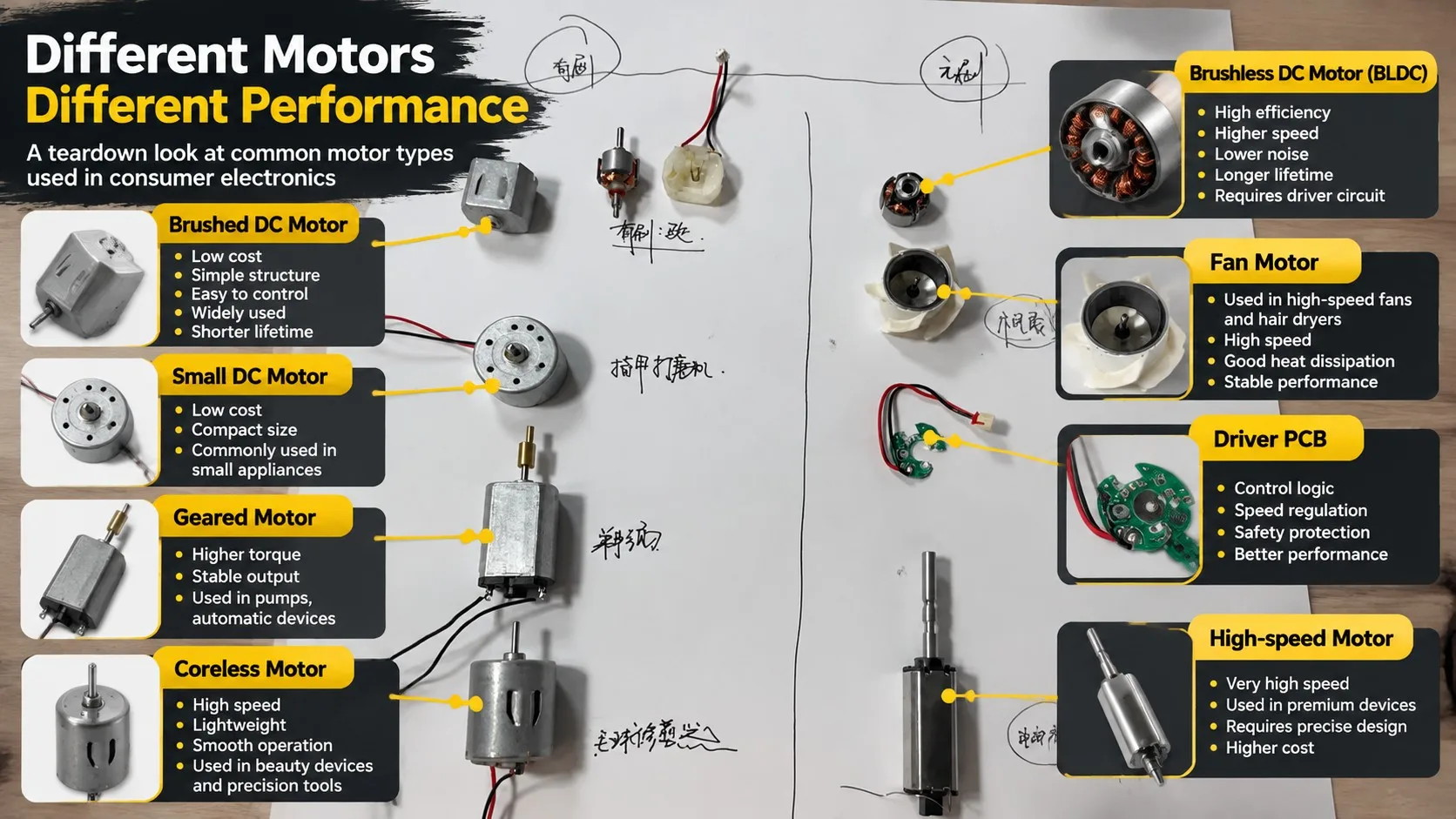
Fig 1.0: Physical engineering teardown comparing brushed DC, small DC, geared, coreless, and high-speed BLDC motors with driver circuits.
Executive Takeaway for Buyers & Hardware Importers
When evaluating supplier quotations for motorized consumer products, looking only at unit price and exterior design masks major technical trade-offs. The internal motor system is the primary driver of acoustic noise, heat dissipation, energy efficiency, and operational lifespan.
When sourcing consumer electronics from China, many procurement managers naturally focus on visible aspects:
- Industrial design and surface finishing
- Housing materials and tooling quality
- Headline marketing features and accessories
- Unit FOB price comparisons across factories
However, some of the most critical engineering decisions remain hidden inside the product assembly. The internal motor selection can create a decisive gap in product reliability, customer return rates, and real manufacturing cost.
1. Why Motor Selection Matters in Consumer Electronics
Motors serve as the mechanical heart across a wide range of consumer devices:
- High-speed and conventional hair dryers
- Sonic and rotary electric toothbrushes
- Personal grooming shavers and hair clippers
- Portable desk and handheld fans
- Tire inflators, portable air pumps, and massage devices
- Smart home appliances and beauty care electronics
A supplier may showcase the same external housing and promote similar performance claims, yet implement completely different motor solutions. A budget model may rely on a basic brushed motor with mechanical contact, while a premium unit incorporates a three-phase brushless motor with dedicated driver circuitry.
2. Common Motor Types Identified in Teardown Analysis
2.1 Brushed DC Motor
One of the most widely deployed low-cost motor solutions in consumer products.
- Low manufacturing cost
- Simple control logic (no driver required)
- Mature and accessible supply chain
- Carbon brush mechanical friction & wear
- Higher acoustic noise & electrical sparking
- Shorter continuous operational lifetime
Typical Applications: Entry-level mini fans, toys, basic grooming devices, and price-sensitive small appliances.
2.2 Brushless DC Motor (BLDC)
Replaces mechanical carbon brushes with electronic commutation and intelligent PCBA driver control.
- High energy efficiency & speed capability (100k+ RPM)
- Significantly lower operational noise
- Extended multi-year operating lifespan
- Superior thermal management & safety
- Requires dedicated driver ICs & MOSFETs
- More complex PCBA routing and shielding
- Higher baseline component BOM cost
Typical Applications: High-speed hair dryers, premium cordless fans, advanced beauty tools, and high-performance appliances.
2.3 Coreless Motor
Features a lightweight hollow-rotor design without a heavy iron core, enabling rapid acceleration, low inertia, and ultra-compact sizing.
Applications: Precision beauty devices, electric toothbrushes, micro-tools.
2.4 Geared Motor
Combines a high-speed motor with an integrated reduction gearbox to exchange rotation speed for high mechanical torque and stable output.
Applications: Pumps, automatic linear drives, smart valves, automotive accessories.
3. Engineering Comparison: Brushed vs. Brushless Motors
When comparing product options, the key question is not merely which product has the lowest FOB cost, but which engineering solution aligns with your target market positioning and warranty expectations:
4. Sourcing Risks & Technical Confirmation Checklist
A frequent pitfall in product sourcing is reliance on generic marketing descriptors such as "High-Speed Motor", "Powerful Motor", or "Long-Life Motor" without concrete engineering parameters.
📋 BaiSourcing Motor Audit Checklist for Procurement Teams
- Motor Specification Sheet: Confirm motor classification, rated operating voltage, rated RPM, power draw, and acoustic decibel rating.
- Reliability & Thermal Standards: Verify continuous operating lifespan testing records, thermal cutoff thresholds, and expected failure rates.
- Driver PCBA Protection: For BLDC systems, verify over-current, reverse polarity, and stall protection logic on the controller board.
- Component BOM Line-Item Review: Identify the motor sub-supplier and component grade to assess quote fairness against benchmark costs.
Verify Your Hardware Architecture Before Production
A supplier quotation indicates the purchase price; an engineering teardown reveals what you are actually buying. Partner with BaiSourcing for component verification, BOM cost deconstruction, and factory audits.