5 Things to Check Before Working With a Chinese Manufacturer
Before partnering with a Chinese manufacturer, learn the 5 critical checks every brand should complete, including supplier verification, BOM analysis, engineering capability, quality control, and production readiness.

Executive Summary: Mitigating Supply Chain Risk Before Issuing Purchase Orders
Partnering with Chinese manufacturers offers undeniable competitive advantages: mature component ecosystems, rapid prototyping cycles, and scalable assembly capacity. However, sourcing failures rarely occur because of a lack of manufacturing capability—they happen when overseas buyers skip foundational due diligence. Choosing the wrong supplier leads to substandard component substitution, delayed ship dates, unstated engineering compromises, and catastrophic customer return rates. This practical guide outlines the five mandatory verification checkpoints every brand owner, procurement manager, and product director must execute before signing manufacturing agreements in China.
Step 1. The Real Sourcing Dilemma: Beyond the Initial Price Sheet
When evaluating Chinese suppliers on platforms like Alibaba, Global Sources, or trade fairs, overseas buyers often treat quotations as direct comparisons of identical goods. In reality, two suppliers quoting the same finished product (such as a 3-blade rotary electric shaver) may have completely different cost structures, engineering capabilities, and quality control systems.
Before committing capital to production tooling or wire transfers, brands must evaluate these five critical dimensions:
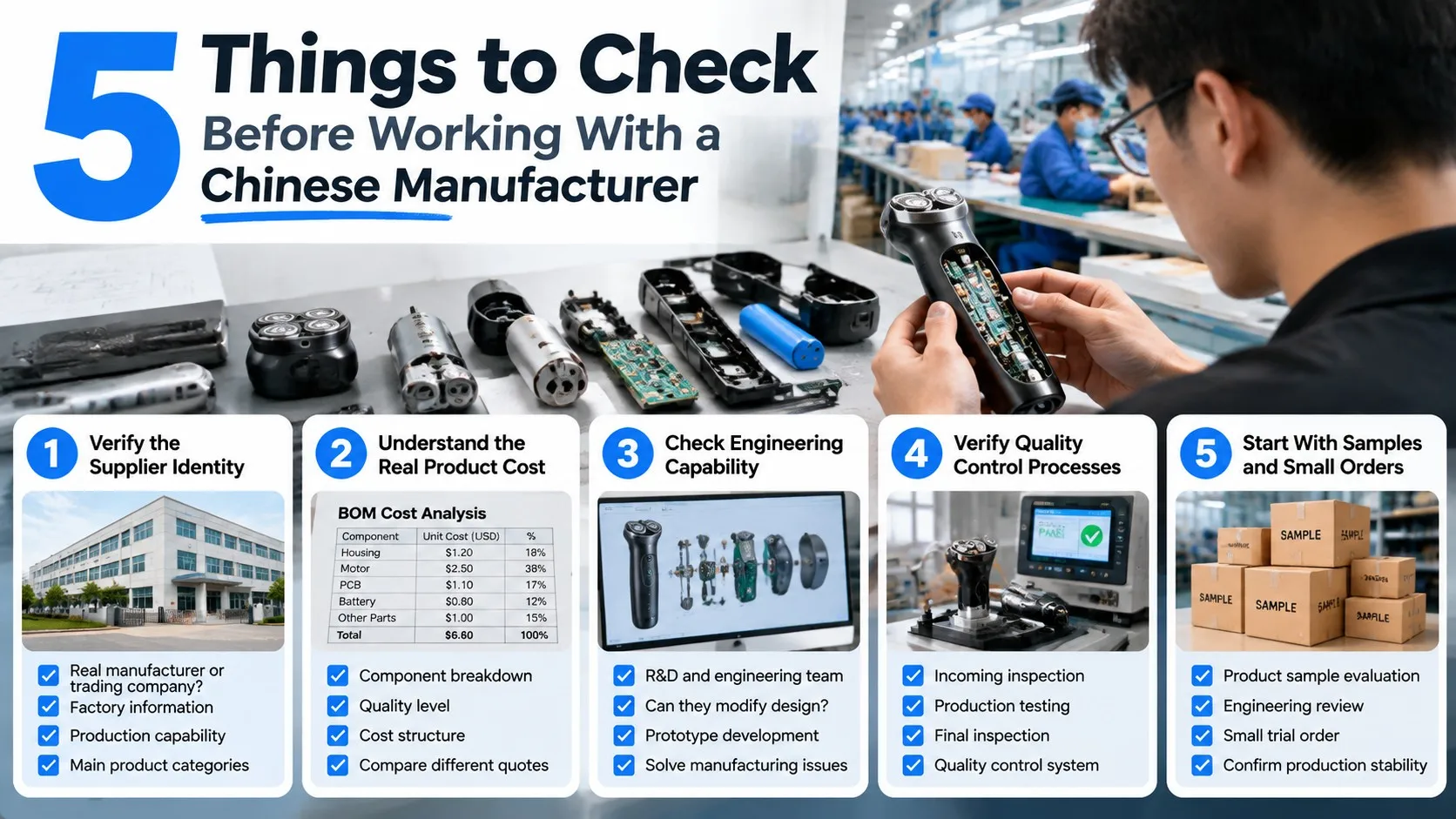
Step 2 & 3. Deep Breakdown of the 5 Mandatory Verification Checkpoints
1. Verify Supplier Identity: Direct Factory vs. Intermediary Trading Entity
One of the most frequent surprises for foreign buyers is discovering that their "factory partner" is actually an export trading company or third-party broker operating out of a residential office. While specialized trading companies provide valuable aggregation services, lack of transparency creates substantial communication lag and hidden price markups:
- Verify the Chinese Business License (营业执照): Check the registered business scope (经营范围). Legitimate manufacturers state "生产 / 制造 (Production / Manufacturing)", whereas trading firms list only "销售 / 贸易 (Sales / Trading)".
- Map Internal vs. Outsourced Workstations: Confirm which operations are conducted in-house (e.g., SMT placement, plastic injection) versus outsourced to sub-tier workshops.
2. Understand the Real Product Cost Structure (BOM Breakdown)
Never evaluate suppliers solely on a lump-sum FOB quotation. Require an itemized Bill of Materials (BOM) breakdown to understand where budget is allocated.
Case Example: Rotary Electric Shaver Benchmark BOM ($6.60 Total Material Cost)
If a competing supplier quotes $4.50 for the same shaver, they are almost certainly cutting corners on motor RPM balance, battery protection circuits, or using recycled plastic resins.
3. Evaluate In-House Engineering & DFM (Design for Manufacturing) Capability
A reliable manufacturer does not merely follow 2D drawings—they proactively identify structural flaws before cutting tooling steel:
- Does the factory employ dedicated mechanical and electronic engineers capable of modifying 3D CAD files?
- Can they optimize thermal dissipation, internal wire routing, and IPX7 waterproof silicone seals during the prototyping phase?
4. Verify In-Line Quality Control (QC) & Testing Equipment
Quality must be engineered directly into the assembly line, not inspected at the shipping container door:
- IQC (Incoming Quality Control): Verification of battery capacity, internal resistance (IR), and raw resin moisture content.
- In-Line 100% Electrical Testing: High-voltage dielectric testing, motor current draw under load, and thermal cutoff verification.
- Aging Test Rooms: Continuous 4-hour live burn-in testing under controlled ambient temperatures.
5. Implement a Phased Ramp-Up Protocol: Sample → Teardown → Trial Order → Scale
Never advance directly from quotation to a 10,000-unit mass production purchase order. Follow a disciplined 4-stage procurement funnel:
- Product Sample Evaluation: Benchmark physical fit, surface finishing, and tactile feel.
- Engineering Teardown Audit: Disassemble sample units to verify exact internal component part numbers.
- Small Pilot Batch (500–1,000 units): Stress-test factory assembly consistency, packaging integrity, and communication speed.
- Mass Production Scaling: Scale order volume only after pilot batch defect rates remain strictly below 1.0%.
Step 4. Supplier Capability Comparison Matrix
How different tiers of Chinese suppliers compare across core operational benchmarks:
| Evaluation Parameter | Trading Intermediary | Low-Cost Workshop | Tier-1 OEM/ODM Factory |
|---|---|---|---|
| BOM Transparency | Low (Lump-sum quote only) | Moderate (Generic specs) | 100% Itemized & Verifiable |
| In-House Engineering | None (Relies on third party) | Basic tooling technicians | Dedicated R&D, DFM & CAD Teams |
| Quality Control Rigor | Visual spot check at port | Basic power-on test | IQC + IPQC + 4h Aging + OQC |
| Average Defect Rate | 3.5% – 6.0% | 6.0% – 12.0% | < 0.6% (Export Quality) |
| Recommendation | Use only for small SKU batches | Avoid for brand hardware | Ideal for Scalable DTC Brands |
Step 5 & 6. Buyer Sourcing Checklist: 5 Pre-Order Safeguards
-
✓
1. Conduct a Formal Business License Audit: Request official unified social credit code (统一社会信用代码) and verify manufacturing scope on the National Enterprise Credit Information System.
-
✓
2. Require Itemized Sub-Supplier Declarations: Demand disclosure of core tier-2 suppliers for lithium batteries, motors, and PCBA microcontrollers.
-
✓
3. Perform Pre-PO Physical Teardown & BOM Audit: Disassemble benchmark production samples to inspect solder joints, wire gauge thickness, and protection circuits.
-
✓
4. Contractually Enforce MIL-STD-105E AQL Level II Inspections: Tie final balance payments (70%) to passing an independent pre-shipment inspection (PSI).
-
✓
5. Sign a Golden Sample & Limit Sample Agreement: Counter-sign and seal 3 physical sample sets representing maximum allowable aesthetic and functional tolerances.
Pre-Audited Hardware Platforms Ready for Private Label Sourcing
Explore our fully verified consumer electronics platforms manufactured in audited facilities with 100% transparent BOM records:
8-in-1 Premium Air Styler & Hair Dryer (Model: RFS013)
110,000 RPM BLDC platform with CNC aluminum turbine, dual NTC thermal safety, and audited assembly tooling.
Bluetooth Audio Sports Glasses
Open-ear directional audio built into lightweight sports eyewear with dual-mic ENC.
BaiSourcing Supplier Verification Audit Benchmark
Entity Verification: 9.7/10 · BOM Transparency: 9.6/10 · Quality Control Protocol: 9.5/10
Need On-Site Factory Verification or Physical Teardown Audits in China?
Don't risk production capital on unverified suppliers. BaiSourcing provides on-the-ground factory audits, engineering feasibility checks, and independent BOM teardown reports across China's major industrial manufacturing hubs.